


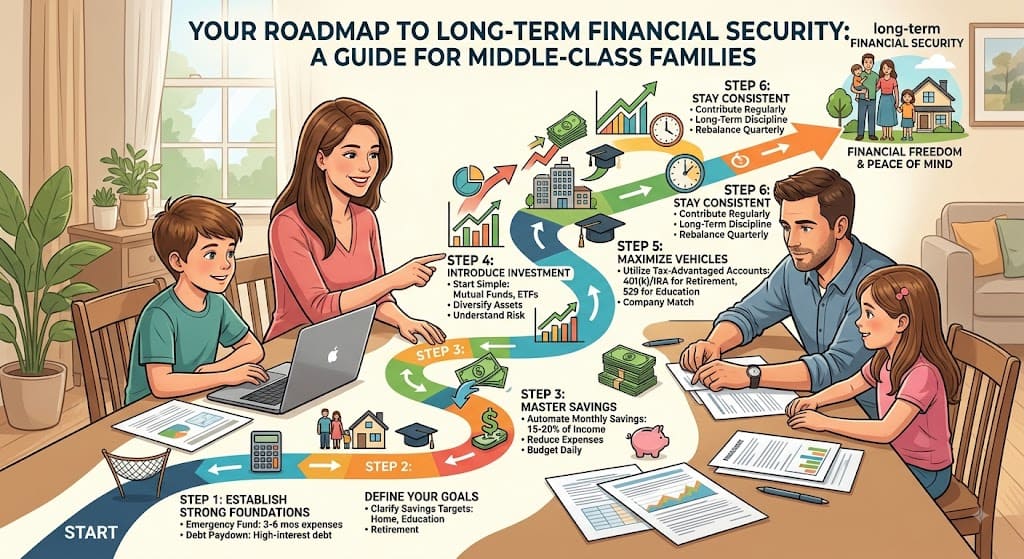
Managing a household budget on a fixed salary isn’t easy — rent or EMI, school fees, groceries, and the pressure to save for the future all compete for the same paycheck. The good news is you don’t need a huge income to build financial security — you need a clear plan for where your money goes. Here’s a practical breakdown of how much to save, where to put it, and which government-backed schemes are worth using right now.
Step 1: Decide How Much to Save
A simple starting point is the 50-30-20 rule: 50% of income for needs (rent/EMI, groceries, bills, school fees), 30% for wants, and 20% for savings and investments. If that feels tight at first, even starting at 10-15% and increasing it every year as your salary grows is a solid path — the habit matters more than the exact number in year one.
Before investing anywhere, set aside 3–6 months of expenses as an emergency fund in a savings account or liquid mutual fund. This protects your other investments from being broken early during a job loss or medical emergency.
Step 2: Where to Put Your Savings
Think of your savings in three buckets — safe government-backed schemes, market-linked growth investments, and insurance (kept separate from investment).
A. Government-Backed Savings Schemes (Low Risk)
These are ideal for the safe portion of your portfolio — capital is protected and returns are fixed by the government each quarter. Current rates (July–September 2026 quarter):
| Scheme | Current Rate | Best For |
|---|---|---|
| Public Provident Fund (PPF) | 7.1% (tax-free) | Long-term, retirement-linked savings (15-year lock-in) |
| Sukanya Samriddhi Yojana (SSY) | 8.2% (tax-free) | Parents saving for a daughter’s education/marriage (up to age 10) |
| Senior Citizen Savings Scheme (SCSS) | 8.2% | Retired parents needing regular quarterly income |
| National Savings Certificate (NSC) | 7.7% | 5-year fixed, tax-saving under Section 80C |
| Kisan Vikas Patra (KVP) | 7.5% (doubles in ~115 months) | Simple, no-lock-in-needed fixed growth |
| Post Office 5-Year Deposit | 7.5% | FD alternative with sovereign backing |
How to invest: All of these can be opened at any post office or, for PPF, most major banks. You can start a PPF or SSY account with as little as ₹500/year, and contribute via standing instruction — a simple way to build a tax-free corpus over 15 years without thinking about it monthly.
B. Market-Linked Investments (For Growth, Longer Horizon)
For goals more than 5-7 years away — retirement, a child’s higher education — pure fixed-income schemes alone won’t beat inflation as effectively as equity-linked investments can over the long run.
- Mutual Fund SIPs: Start a Systematic Investment Plan in an index fund or diversified equity fund. Even ₹2,000–5,000/month, increased gradually as your income rises, can build meaningfully over 10-15 years through the power of compounding. SIPs can be started through any mutual fund app or your bank, with auto-debit on salary day.
- ELSS (tax-saving) mutual funds: Similar to regular equity funds but qualify for Section 80C deduction with a shorter 3-year lock-in, versus PPF’s 15 years.
- NPS (National Pension System): A retirement-focused option with an additional ₹50,000 tax deduction under Section 80CCD(1B), over and above the ₹1.5 lakh 80C limit.
A reasonable split for someone with a moderate risk appetite: roughly 40-50% of your investment savings toward safe government schemes, 40-50% toward equity mutual fund SIPs, adjusted based on your age and how many years until you need the money — younger savers can lean more toward equity.
C. Insurance — Keep It Separate
Buy a pure term insurance policy (life cover of roughly 10-15 times annual income) rather than investment-linked insurance policies (ULIPs, endowment plans), which usually offer weak returns and inadequate cover for the premium paid. Add a separate family health insurance policy, even a modest one, so you’re not solely dependent on employer cover that disappears if you change jobs.
Step 3: Use Rate Stability to Your Advantage
The RBI held the repo rate steady at 5.25% in its August 2026 policy meeting — the fourth consecutive hold. This means home loan EMIs remain predictable for now, so it’s a reasonable time to review your loan tenure, consider prepaying if you have surplus cash, or lock in an FD/small savings scheme for a medium-term goal rather than waiting for rates to move.
A Simple Monthly Example
If you save ₹10,000/month toward long-term goals:
- ₹4,000 → PPF or NSC (safe, tax-saving)
- ₹4,000 → Equity mutual fund SIP (growth)
- ₹2,000 → Emergency fund, until it reaches 3-6 months’ expenses, then redirect to investments
Adjust the ratio as your income and goals change — the exact split matters less than starting now and staying consistent.
The bottom line: You don’t need to time the market or chase the highest returns. A disciplined mix of safe government schemes, equity SIPs for growth, and proper insurance — funded automatically every month — builds real financial security over time.
This article is for general informational purposes only and does not constitute personalized financial advice. Interest rates on government schemes are revised quarterly and may change — please verify current rates before investing, and consult a certified financial advisor for decisions specific to your situation.