


India Joins the Global Hydrogen Rail Club
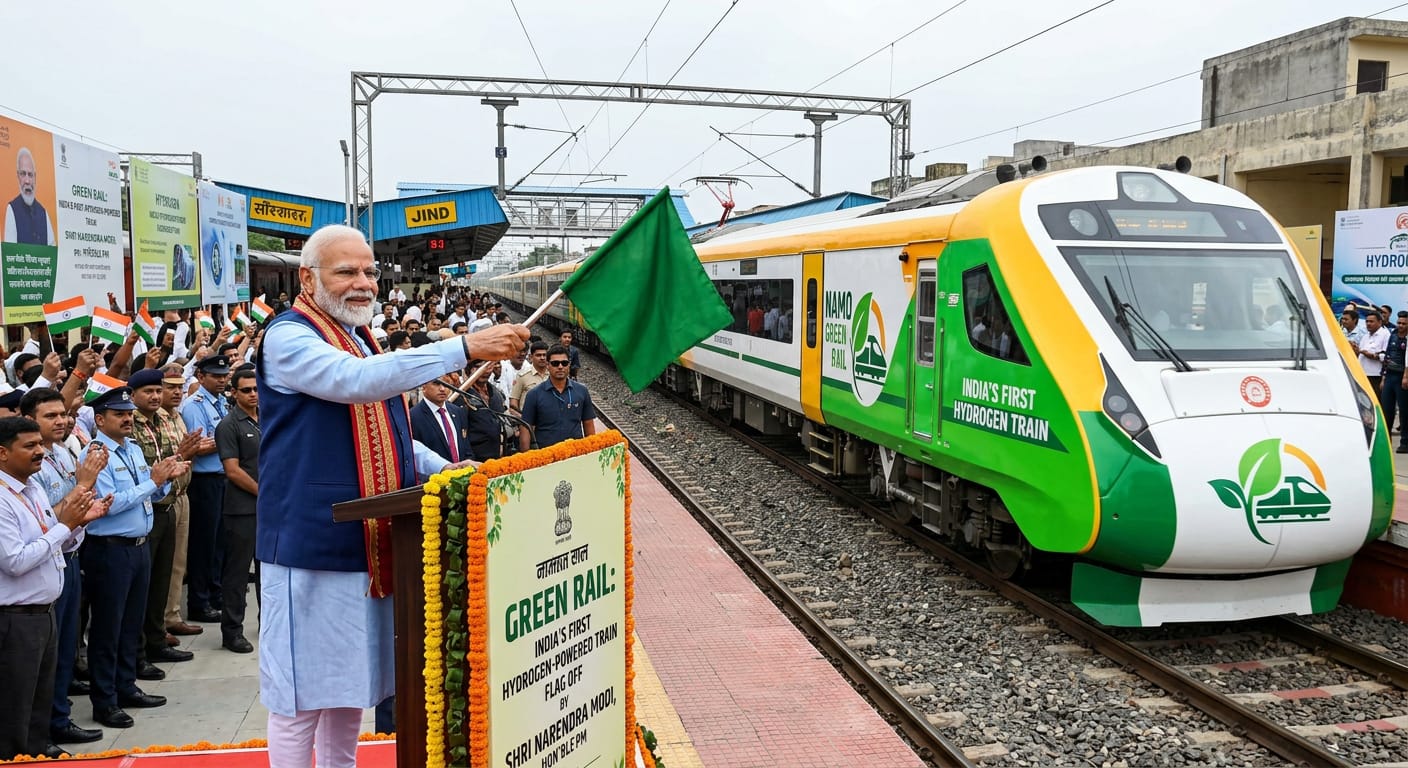
On July 17, 2026, Prime Minister Narendra Modi flagged off India’s first domestically built hydrogen-powered passenger train at Jind railway station in Haryana, putting the country’s first hydrogen fuel-cell trainset into commercial service on the Jind-Sonipat route under Northern Railway. Dubbed the “NaMo Green Rail” — a play on the Prime Minister’s name — the launch places India alongside a small group of nations, including Germany, Japan, China, and the United States, that have deployed hydrogen-powered passenger rail technology.
The train runs an 89-km one-way journey between Jind and Sonipat, making two round trips a day for a total daily coverage of about 356 km. The 10-coach train — retrofitted from a Diesel Electric Multiple Unit (DEMU) — has two driving power cars and eight passenger coaches, can carry roughly 2,600 passengers, and tops out at 75 km/h. It was designed by the Integral Coach Factory (ICF) and system-integrated by Medha Servo Drives, with technical specifications approved by the Research, Design & Standards Organisation (RDSO).
Before entering service, the train completed a final round of safety and performance trials covering emergency braking, running stability, and oscillation testing.
How It Works
Hydrogen fuel-cell trains generate their own electricity onboard by combining hydrogen and oxygen in a fuel cell — a chemical reaction whose only direct emission is water vapor. That makes them a genuine zero-tailpipe-emission alternative to diesel traction, particularly on routes where full electrification isn’t practical.
To fuel the NaMo Green Rail, Indian Railways built an indigenous hydrogen storage and refuelling facility at Jind, licensed by the Petroleum and Explosives Safety Organisation (PESO) for storing and dispensing compressed hydrogen gas. The site includes a hydrogen compression system with a standby compressor and leak/flame detectors, and reportedly consumes close to 300 kilograms of hydrogen a day to keep the train running. The project is powered by a 1,200-kilowatt hydrogen fuel-cell propulsion system.
Can Hydrogen Trains Actually Cut India’s Diesel Dependence?
This is the question that matters most for Indian Railways, one of the largest rail networks in the world at roughly 70,000 km. India has already electrified almost all of that network, but pockets — hilly terrain, low-traffic branch lines, and freight corridors — remain diesel-dependent, either because electrification is too costly or operationally impractical.
Hydrogen trains are pitched as the answer for exactly these gaps: they offer the range and power of diesel locomotives without the emissions, and they don’t require the overhead electrification infrastructure that full electrification demands. Indian Railways has stated an ambition to make its operations net-zero by 2030, and the Jind-Sonipat pilot is explicitly framed as a real-world testbed to build operational experience before wider rollout.
But the honest answer, going by how similar projects have played out elsewhere, is: not yet, and not by itself. A single pilot train covering under 360 km a day is a demonstration project, not a diesel replacement strategy. Its real value lies in what it teaches Indian Railways about fuel-cell durability, hydrogen storage safety, refuelling logistics, and cost — lessons that will shape whether the technology scales to dozens or hundreds of trainsets on genuinely diesel-heavy corridors.
How India Compares: Germany, Japan, and China
Germany — First mover, now pulling back
Germany was the first country to put hydrogen passenger trains into commercial service, launching a fleet of Alstom-built Coradia iLint trains in Lower Saxony in 2018, with a full 14-train fleet entering regular service on the Cuxhaven–Bremerhaven–Bremervoerde–Buxtehude line in 2022 — the world’s first hydrogen-powered train fleet, replacing diesel locomotives on that route.
However, Germany’s experience has taken a notable turn: regional operators in Lower Saxony pulled most of those 14 iLint units out of service in late 2024, and German operators have signaled that future orders will lean toward battery-electric trains instead. Adding to the uncertainty, the supplier base has wobbled — Cummins recently sold its fuel-cell business after significant losses, including the unit that supplied stacks for the Coradia iLint.
Takeaway for India: Germany proved hydrogen trains work technically, but also that they must compete on operating economics against battery-electric alternatives — and haven’t always won that fight.
Japan — Advanced tech, limited scale
Japan has developed the HYBARI (Hydrogen-Hybrid Advanced Rail Vehicle for Innovation), a hybrid train that combines fuel cells with batteries, undergoing testing on lines connecting Tachikawa and Kawasaki since 2022. Japan’s FV-E991 hydrogen train began fare-paying passenger tests on the Tsurumi Line the same year.
Despite this early technical progress, Japan’s hydrogen rail programme hasn’t scaled into wide commercial deployment. The country continues to treat hydrogen rail as a research and pilot-stage technology rather than a mainstream diesel replacement.
Takeaway for India: Even a technologically advanced rail nation like Japan has moved cautiously, prioritizing testing over rapid scale-up.
China — Industrial muscle, still testing
China, through state rail manufacturer CRRC, has built powerful hydrogen train engines — some rated above 1,200 horsepower — designed to operate across varied terrain. China’s hydrogen passenger trains have been running test operations, but like Japan’s programme, they haven’t yet moved into volume production.
China is separately investing heavily in the broader green-hydrogen ecosystem that would support rail expansion — including large renewable-hydrogen projects such as a solar-plus-storage-plus-electrolyser facility in Jiangsu — suggesting its rail ambitions are backed by wider hydrogen infrastructure investment.
Takeaway for India: China’s approach signals that industrial-scale hydrogen production capacity may be as important as the trains themselves — a point relevant to India’s own green hydrogen mission.
Where India stands
| Country | First hydrogen passenger service | Current status |
|---|---|---|
| Germany | 2018 (commercial fleet, 2022) | Scaling back; shifting toward battery-electric |
| Japan | 2022 (testing) | Advanced R&D, limited scale-up |
| China | Testing phase (CRRC-built) | Testing, not yet volume production |
| India | July 2026 | Single pilot trainset, indigenous build |
India’s entry is the newest, and notably, the most indigenous — the NaMo Green Rail was designed and built domestically under the Atmanirbhar Bharat (self-reliant India) push, unlike some other countries that lean on established suppliers like Alstom.
The Road Ahead
The global pattern is consistent: hydrogen trains work as a technology, but the economics — fuel cell durability, hydrogen production costs, refuelling infrastructure — remain tough to justify against diesel on some routes and against battery-electric trains on others. Germany’s partial retreat is a cautionary data point that India’s planners will be watching closely.
For India, the Jind-Sonipat pilot is best understood as the first real-world data point in a much longer decision: whether hydrogen fuel cells, battery-electric traction, or continued diesel use makes the most economic and environmental sense across the thousands of route-kilometres that remain unelectrified or diesel-reliant. If the pilot proves reliable and the underlying hydrogen production costs fall — as India’s broader National Green Hydrogen Mission intends — it could pave the way for wider deployment on branch lines and hilly routes where full electrification remains impractical.
For now, India has a working hydrogen train and a seat at a very small global table. Whether it meaningfully dents the country’s diesel bill will depend on what Indian Railways learns from Jind-Sonipat over the next few years — and on hydrogen economics that are still shaking out worldwide.
Sources: Press Information Bureau (Government of India), Al Jazeera (Reuters/AP), ABC News, Business Today.