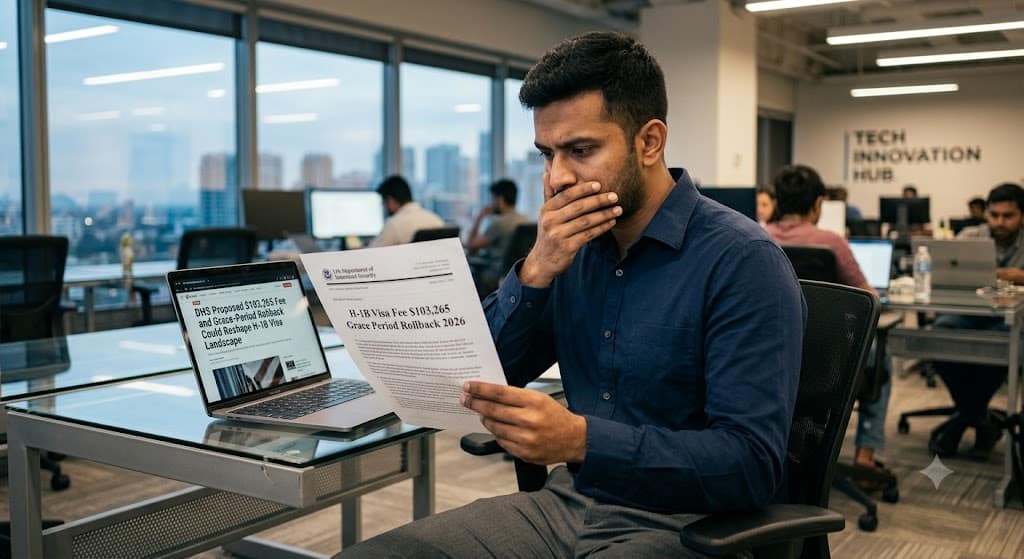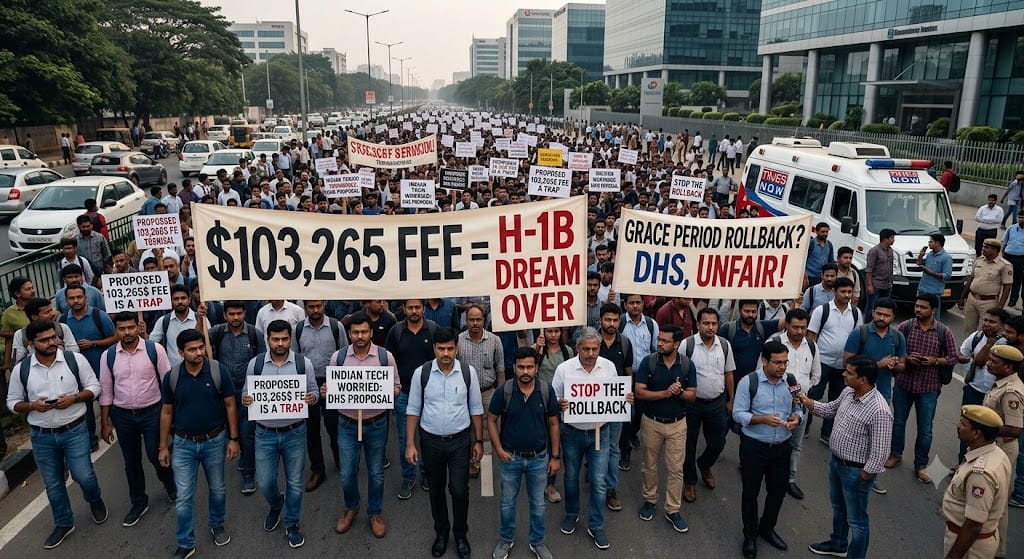
The H-1B visa — the main route for skilled foreign professionals, especially Indian engineers and tech workers, to work in the United States — is going through its biggest shake-up in years. Two separate proposals from the U.S. Department of Homeland Security (DHS) could soon make it far more expensive to hire H-1B workers, and far riskier to hold one.
Here’s a clear breakdown of what’s happening, why it matters, and who it affects most.
What Is DHS, and Why Does It Control This?
The Department of Homeland Security (DHS) is the U.S. federal agency responsible for immigration enforcement, border security, and visa policy. It oversees USCIS, the agency that actually processes H-1B petitions. Because DHS created the current grace-period rule through its own regulatory authority back in 2016, it can also revise or eliminate that rule without needing a new law passed by Congress — it simply has to go through a formal rulemaking process, which is what’s happening now.
The $103,265 H-1B Fee Proposal
The story starts in September 2025, when the Trump administration imposed a one-time $100,000 fee on new H-1B petitions — a massive jump from the previous $2,000–$5,000 range. In June 2026, a federal judge struck this down, ruling it functioned as an illegal tax the administration wasn’t authorized to impose that way.
DHS didn’t drop the idea — it came back in August 2026 with a revised proposal: a $103,265 fee on new H-1B petitions subject to the annual cap, this time justified as recovering government costs for adjudicating and supporting immigration programs, rather than as a restriction on hiring foreign workers. The fee would apply after a worker is selected in the H-1B lottery, once the employer files the actual petition — not as an entry fee to the lottery itself. It would not apply to cap-exempt petitions, such as many university and nonprofit research positions.
As of now, the fee is not in effect. It’s a proposed rule, with the public comment period open until September 24, 2026. After that, DHS can finalize it, revise it, or withdraw it altogether.
The 60-Day Grace Period: What’s at Stake
This is the part that’s drawing the sharpest criticism — and for good reason.
How it works today: Since 2017, H-1B workers (along with several related visa categories — H-1B1, E-1, E-2, E-3, L-1, O-1, and TN) get up to 60 days after their job ends, or until their authorized stay expires, whichever comes first, to find a new sponsoring employer, switch immigration status, or leave the country in an orderly way. It applies whether the job ends by layoff, firing, or resignation.
What DHS is proposing: On August 6, 2026, DHS submitted a proposal titled “Eliminating the Discretionary 60-day Grace Period” for White House review. If it goes through, losing an H-1B job would mean losing legal status almost immediately — no cushion to job-hunt, transfer employers, or wind down personal affairs. Workers and their dependents could be required to leave the U.S. without delay, with no ability to change employers or status from inside the country unless USCIS chooses to grant an exception.
Community leader Ajay Bhutoria called the move “inhumane and unworkable,” warning that families would be “uprooted overnight, thrown into chaos through no fault of their own.” Immigration attorneys note this could be one of the most consequential changes to employment-based immigration policy in years.
Important: As of now, this grace period has not been removed — it remains legally in effect while the rule goes through the federal review process. But it signals a clear intent, and it’s worth tracking closely.
Is This Only About Indian Workers?
No — technically, the rule applies to everyone in H-1B and related visa categories, regardless of nationality. But in practice, it would land hardest on Indian professionals. Indian nationals accounted for roughly 71% of all approved H-1B petitions in 2024, meaning any tightening of H-1B rules disproportionately affects the Indian diaspora and Indian workers hoping to go to the U.S.
Why the Lack of a Safety Net Makes This Riskier
H-1B status is tied directly to employment — there’s no unemployment benefit or social security cushion available to workers the way there might be for citizens. Your right to remain in the country depends on having an active, sponsoring employer. That’s precisely why the grace period matters so much: without it, “losing a job” and “losing legal status” become the same moment, with zero buffer in between.
A Third Change in the Works: H-4 Spouse Work Rights
Alongside the fee and grace-period proposals, DHS is also reviewing changes to work authorization for H-4 visa holders — spouses of H-1B workers who are currently allowed to work under certain conditions. Any rollback here would add further financial pressure on H-1B households already facing higher costs and less job security.
Timeline: How We Got Here
| Date | Development |
|---|---|
| 2017 | 60-day grace period rule takes effect |
| Sept 19, 2025 | Trump signs proclamation for $100,000 H-1B fee |
| Sept 21, 2025 | $100,000 fee takes effect |
| June 2026 | Federal judge strikes down the $100,000 fee as an illegal tax |
| Aug 6, 2026 | DHS submits proposal to eliminate the 60-day grace period |
| Aug 25, 2026 | DHS publishes new $103,265 fee proposal in the Federal Register |
| Sept 24, 2026 | Public comment period on the $103,265 fee closes |
What Should H-1B Workers and Employers Do Now?
- Track the rulemaking process — neither proposal is final yet, and both could change after public comments.
- Employers sponsoring H-1B workers should factor the possible $103,265 cost into 2026–27 hiring budgets.
- Workers currently on H-1B status, especially those between jobs or anticipating layoffs, should consult an immigration attorney about contingency plans while the grace period is still in effect.
- Green card applicants should pay close attention — losing the grace period could complicate pending permanent residency strategies.
Frequently Asked Questions
Is the $103,265 H-1B fee currently in effect? No. It is a proposed rule with a public comment period open until September 24, 2026. It is not yet law.
Has the 60-day grace period already been eliminated? No. It remains legally in effect. DHS has only submitted a proposal to eliminate it, which is still under review.
Does this only affect Indian H-1B holders? The rules apply to all nationalities on H-1B and related visas, but Indian nationals make up the large majority of H-1B holders, so the impact would be felt most heavily within the Indian professional community.
What happens if I lose my H-1B job right now? As of today, the existing 60-day grace period still applies, giving affected workers time to find a new employer or arrange their departure.
This is a developing policy story. Given the open comment period and pending regulatory review, expect further updates before any final rules take effect.