


Published: August 26, 2026
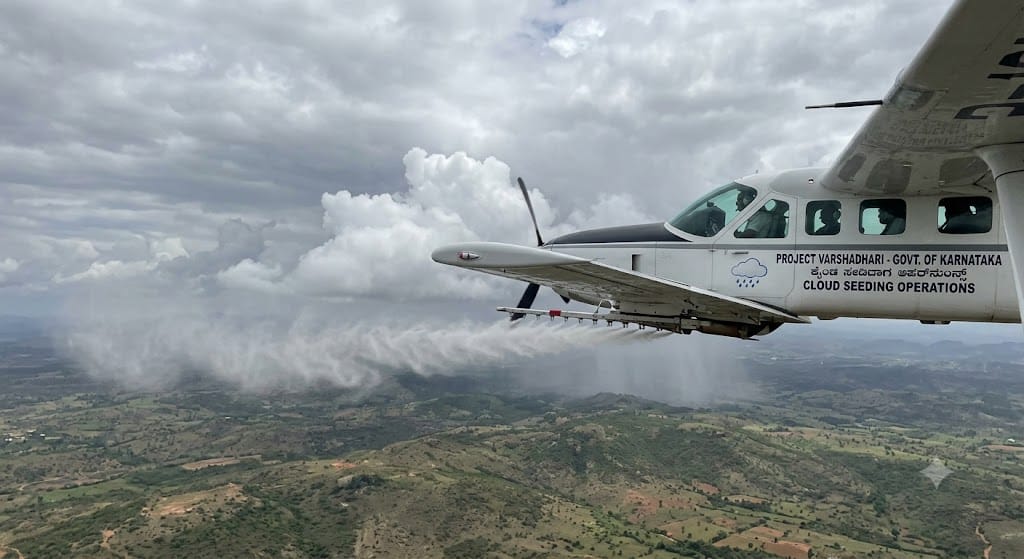
Karnataka is about to try something most residents have only heard of in passing: making it rain, artificially. With reservoirs running low and large parts of the state facing a serious rainfall shortfall, the state government has fast-tracked a 60-day cloud seeding operation, backed by an estimated ₹27 crore budget.
Here’s what’s actually happening, how cloud seeding works, and what it can realistically be expected to achieve.
Why Karnataka is doing this
According to the Karnataka State Natural Disaster Monitoring Centre (KSNDMC), the state recorded a 42% rainfall deficit by the end of June and a 29% deficit by the end of July. As of mid-August, rainfall deficiency had been reported in 178 taluks across 27 of Karnataka’s 31 districts.
Water Resources Minister N. Chaluvarayaswamy said the decision followed requests from elected representatives during meetings chaired by Chief Minister D.K. Shivakumar across the Kalaburagi, Belagavi, and Bengaluru divisions, where officials flagged the rainfall shortage as a growing concern for the current water year. While some parts of the state have seen patchy rainfall, weather forecasts point to a lack of sustained, continuous monsoon activity — the gap the government is now trying to fill artificially.
The government has said it is prepared to bear the cost regardless of the financial burden, prioritising uninterrupted drinking water supply for people and livestock.
What exactly is planned
The state Cabinet approved the cloud seeding programme on August 13, 2026, with an administrative order estimating the total cost at approximately ₹27–28.5 crore. Key details of the operation:
- Duration: 60 days, timed to run through the current period into September
- Flying hours: Approximately 200 hours of aerial operation using a single aircraft
- Daily schedule: Sorties will operate daily from 8:00 AM to 6:00 PM
- Coverage: All four revenue divisions of the state
- Range: Each seeding flight is designed to induce precipitation within roughly a 15 km radius of the targeted cloud
Three oversight committees have been set up: a monitoring committee led by the department’s Additional Chief Secretary, a technical committee drawing on experts from IIT, IISc, and the meteorological department, and a field operations and evaluation committee. The Karnataka State Natural Disaster Monitoring Centre will handle technical scrutiny of costs and post-operation assessment, while the Karnataka Irrigation Corporation will manage administrative and financial matters.
Officials chose the current window deliberately: September typically brings denser cloud cover, which is what seeding requires, while cloud volume tends to drop off sharply by October.
How cloud seeding actually works
Cloud seeding doesn’t create rain out of nothing — it works with clouds that already have some moisture potential but aren’t efficiently converting it into rainfall on their own.
The basic science: water in a cloud can remain in liquid droplet form even at sub-zero temperatures unless it has something solid to freeze onto — a “nucleus.” In nature, that role is usually played by dust or pollution particles. Cloud seeding introduces a substitute nucleus, most commonly silver iodide, whose crystal structure closely resembles that of natural ice. This gives water droplets an efficient surface to freeze onto and grow into ice crystals — which, as they grow heavy enough, fall as precipitation.
In a typical operation:
- An aircraft flies into or near a cloud carrying sufficient supercooled moisture
- Silver iodide particles are released, either burned as flares or dispersed as smoke
- The particles act as ice-forming nuclei inside the cloud
- Ice crystals form and grow around these particles
- Once heavy enough, they fall as rain (or snow, in colder conditions)
It’s worth being clear about what this technology can and can’t do: seeding only works on clouds that already carry usable moisture — it cannot manufacture rainfall from a clear sky or from clouds without sufficient moisture content. Karnataka’s own minister acknowledged this, saying operations will only proceed depending on real-time cloud density and availability, and flights will be dynamically routed accordingly.
What success looks like
Chaluvarayaswamy set expectations candidly, stating that achieving a projected 30% success rate in the current campaign would be enough to establish the overall viability of the project. That relatively modest bar reflects a broader reality about cloud seeding globally: research bodies, including assessments by the US Government Accountability Office, note that while the underlying science is well understood, cloud seeding’s real-world effectiveness at meaningfully boosting precipitation remains debated and hard to measure precisely, since it’s difficult to know how much rain would have fallen anyway.
Is it safe?
Silver iodide is the primary chemical used in most cloud seeding programmes worldwide, including this one. It occurs naturally in the environment at low concentrations, and available research — including assessments from cloud seeding programmes in the United States — has generally found it does not pose a significant environmental or health risk at the concentrations typically used. It is not classified as an emerging concern in the way some industrial chemicals are, though monitoring bodies note that comprehensive, large-scale, long-term data on widespread use is still limited.
What this means for the ground reality
The government has framed the immediate goal clearly: recharging local lakes, ponds, and minor water bodies, easing pressure on drinking water reserves, and supporting dryland agriculture ahead of the coming summer season — not solving the drought outright. Officials have been explicit that cloud seeding is a supplementary measure, not a substitute for adequate monsoon rainfall.
For residents in the affected districts, the practical takeaway is this: cloud seeding flights over the next two months are a deliberate, government-funded intervention aimed at squeezing more rainfall out of whatever cloud cover does form — not a guarantee of relief, but an attempt to reduce the odds of a deeper water crisis heading into the dry months.
Digital Waves News will follow up as the operation begins and as evaluation data on its effectiveness becomes available.