


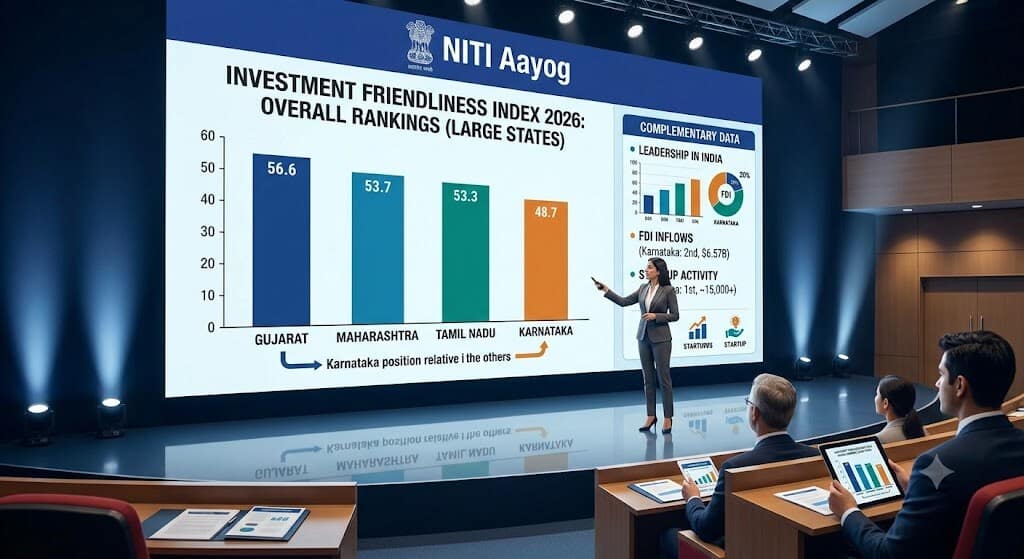
Karnataka is home to India’s biggest tech hub, some of its highest FDI inflows, and a start-up ecosystem few states can match. So when NITI Aayog’s first-ever Investment Friendliness Index (IFI) 2026 placed Karnataka 9th overall — behind Gujarat, Maharashtra, Tamil Nadu, Goa, Odisha, Delhi, Madhya Pradesh and Andhra Pradesh — it raised a fair question: why does a state with such strong investment outcomes rank outside the top tier?
The answer lies in what the index actually measures, and what it doesn’t fully capture yet.
Karnataka’s score, in context
Karnataka scored 48.7 out of 100, placing it in the “frontrunners” band (45–50), just short of the “top performers” tier (above 50) occupied by Gujarat (56.6), Maharashtra (53.7), Tamil Nadu (53.3), Goa (53.1) and Odisha (52.4). Karnataka is tied on score with Andhra Pradesh, and sits close to Rajasthan (48.1), Chhattisgarh (47.5) and Telangana (47.3) — a reminder that the middle of this table is extremely tightly packed.
The index scores states across eight weighted pillars — infrastructure (25%), business climate (20%), resources (15%), regulatory ease (12%), government policy (10%), financial health (7%), institutional environment (6%) and environmental resilience (5%) — using a mix of 65% hard data and 35% investor perception surveys drawn from over 1,850 investors.
Infrastructure
Infrastructure carries the single largest weight in the index (25%), and this is where the legacy industrial states pull ahead. Gujarat leads the pillar nationally on the back of the lowest capacity-weighted port turnaround time in the country, industrial power priced around 29% below the national average, and nearly 23.8 hours of daily power supply. Tamil Nadu ranks first among large states on infrastructure, backed by the third-best port turnaround time nationally and a large, well-connected highway and export network. Kerala also ranks among the infrastructure pillar leaders.
Karnataka’s physical infrastructure — ports, dedicated freight corridors, power reliability at industrial scale — hasn’t been built out to the same degree or over the same multi-decade timeline as Gujarat’s or Tamil Nadu’s. That gap alone, given the pillar’s 25% weight, is enough to hold Karnataka’s overall score back significantly.
Industrial policy
Gujarat’s industrial policy edge rests on plug-and-play investment regions such as Dholera Special Investment Region, GIFT City, Sanand, Dahej, Jhagadia and Saykha, coordinated through a single-window clearance system run by the Industrial Extension Bureau (iNDEXTb). Maharashtra, meanwhile, leads the business climate pillar outright, pulling in roughly 35% of India’s private equity and venture capital investment.
Karnataka does have its own industrial policy architecture and sector-specific incentives, particularly for electronics and aerospace, but it hasn’t been packaged into the same kind of large-scale, plug-and-play investment regions that Gujarat has built over the past two decades. The state’s strength has historically been organic — clustering around Bengaluru’s talent base — rather than state-engineered industrial zones.
Ease of doing business
Analysts studying the index consistently flag one factor as decisive for top performers: predictable, time-bound governance. States that keep approval timelines short and consistent score far better on the regulatory ease and institutional environment pillars — together worth 18% of the index — than states where the same approvals take months and vary case by case.
This is an area where Karnataka has room to improve relative to Gujarat and Tamil Nadu, both of which the report credits with strong policy consistency and high project-to-approval conversion rates. Tamil Nadu, for instance, posts a near-100% MoU conversion rate, a strong signal of follow-through on investment commitments.
Manufacturing ecosystem
Tamil Nadu’s manufacturing base benefits from decades of policy continuity, a dense supplier network, and an export-to-GSDP ratio 36% above the large-state average. Gujarat’s manufacturing corridors, similarly, have been built over multiple state governments and remain uninterrupted by political change.
Karnataka’s manufacturing ecosystem is real but narrower — concentrated in electronics, aerospace and precision engineering around Bengaluru, with less of the broad-based, export-heavy manufacturing depth that Gujarat and Tamil Nadu have built across multiple industrial belts.
IT versus manufacturing
This is arguably the crux of Karnataka’s ranking gap. The Investment Friendliness Index, in its first edition, weighs physical infrastructure, industrial resources and manufacturing-oriented indicators heavily — areas where states with established industrial corridors naturally score better. Karnataka’s strongest card — a services and technology economy anchored by Bengaluru’s talent pool, its university depth, and one of the world’s largest startup ecosystems — isn’t captured as directly by an index built primarily around manufacturing-era metrics like port capacity, industrial power tariffs and export-to-GSDP ratios.
Yet by outcome, Karnataka’s model works: alongside Maharashtra, Gujarat, Delhi and Tamil Nadu, it is one of five states that together draw around 85% of all FDI into India. Industry analysts studying the index have noted this exact divergence — that Karnataka’s talent concentration, startup density and innovation-led growth don’t yet have a direct equivalent in the index’s current pillar structure.
Areas where Karnataka excels
Despite ranking outside the top tier, Karnataka’s underlying investment fundamentals remain among the strongest in the country:
- Among the highest FDI recipients in India, year after year, regardless of this index’s ranking.
- India’s leading technology and startup hub, with an ecosystem built over decades around Bengaluru’s talent and university base.
- Strong innovation credentials, reflected in Karnataka topping earlier NITI Aayog assessments such as the India Innovation Index.
- High-value, knowledge-intensive investment, rather than volume-driven industrial investment — a different but equally valuable growth model than the one the current index is built to measure most directly.
What Karnataka needs to improve
Based on where the index penalises Karnataka relative to the leaders, the priority areas are fairly clear:
- Port and logistics infrastructure — closing the gap with Gujarat and Tamil Nadu on turnaround times and connectivity, given infrastructure’s outsized 25% weight in the index.
- Industrial power reliability and cost — matching the tariff and supply-hours advantage that Gujarat has engineered for industrial users.
- Regulatory predictability — reducing variability in project approval timelines, an area the report’s own analysts single out as the single biggest driver of investor confidence.
- Large-scale, plug-and-play industrial zones — building out Gujarat-style investment regions beyond the Bengaluru corridor, to broaden the manufacturing base.
- Diversifying investment geography within the state — reducing overdependence on Bengaluru so that infrastructure and industrial policy gains show up more broadly across Karnataka’s districts, which is where index-style metrics are measured.
NITI Aayog has been explicit that the IFI is meant to function as a reform roadmap rather than a final verdict — each state receives a detailed pillar-wise profile benchmarked against the top performer. For Karnataka, that roadmap points toward physical infrastructure and regulatory predictability as the two levers most likely to close the gap with Gujarat, Maharashtra and Tamil Nadu in future editions of the index.