


Digitalwavesnews.com
What Is the PM Vidyalaxmi Scheme?
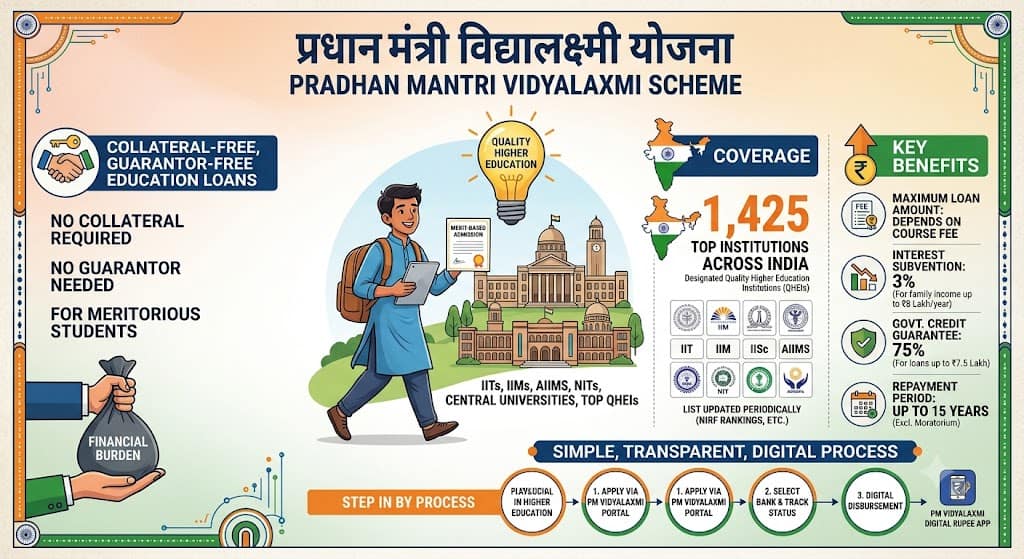
PM-Vidyalaxmi is a mission-mode government initiative that provides collateral-free and guarantor-free education loans to students who secure merit-based admission — not through management or NRI quotas — at designated Quality Higher Education Institutions (QHEIs) across the country. The scheme also layers on interest subvention for students from lower-income families, making higher education financing simpler and more affordable.
The entire process runs through a single, unified digital portal where students can apply for loans, track application status, claim interest subvention, and raise grievances — all in one place.
Why the Scheme Matters
India’s Gross Enrolment Ratio (GER) in higher education has climbed from 23.7% in 2014-15 to 30.0% in 2023-24, but financial constraints continue to keep many meritorious students out of top institutions. High interest rates on conventional education loans have long been a barrier — one that PM-Vidyalaxmi is specifically designed to remove. The scheme draws its mandate from the National Education Policy (NEP) 2020 and supports India’s progress toward UN Sustainable Development Goal 4 on inclusive, equitable education.
Key Features and Benefits
- Coverage: 1,425 QHEIs nationwide, spanning both public and private institutions.
- Credit guarantee: The government provides a 75% credit guarantee on loans up to ₹7.5 lakh, encouraging banks to lend more freely.
- No loan ceiling: There’s no upper cap — loan amounts depend on tuition, hostel fees, laptop costs, and living expenses.
- Interest rate cap: Rates are capped at the bank’s Externally Benchmarked Lending Rate (EBLR) + 0.5%, always lower than standard education loan rates.
- Repayment window: Up to 15 years, excluding a moratorium period covering the course duration plus one year.
- Lender network: Available through Scheduled Banks, Regional Rural Banks (RRBs), and Cooperative Banks.
- Tax benefit: Interest paid qualifies for deduction under Section 80E.
Interest Subvention: Who Benefits and By How Much
PM-Vidyalaxmi works alongside the existing PM-USP Central Sector Interest Subsidy Scheme (CSIS) to offer layered support based on family income:
| Criteria | PM-USP CSIS | PM-Vidyalaxmi |
|---|---|---|
| Eligible institutions | NAAC/NBA accredited, INIs, regulator-approved technical institutes | Top 100 NIRF-ranked private; top 200 state govt; all central govt QHEIs |
| Courses covered | Professional/technical only | All degree and diploma courses |
| Family income limit | ₹4.5 lakh/year | ₹8 lakh/year |
| Interest subvention | 100% during moratorium | 3% during moratorium |
| Annual slots | Unlimited | 1 lakh fresh slots per year |
| Repayment period | Up to 15 years post-moratorium | Up to 15 years post-moratorium |
Students with family income up to ₹8 lakh get a 3% interest subvention on loans up to ₹10 lakh during the moratorium period. If the loan amount exceeds ₹10 lakh, subvention applies only to the first ₹10 lakh of the principal. Banks may also offer up to 1% additional concession for those who service interest during their study period. Importantly, a student can avail interest subvention and credit guarantee benefits only once — for either an undergraduate, postgraduate, or integrated course — and cannot combine it with any other government scholarship or fee reimbursement scheme.
The government has earmarked ₹3,600 crore from 2024-25 to 2030-31 for the scheme, with an estimated 7 lakh fresh students expected to benefit over this period.
Which Institutions Qualify?
Eligibility is determined by NIRF (National Institutional Ranking Framework) rankings:
- Top 100 HEIs in overall, category-specific, or domain-specific NIRF rankings
- Top 200 state/UT government-run HEIs in the latest NIRF list
- All remaining central government-run HEIs
Foreign institutions — whether their Indian campuses, Indian institutions’ foreign campuses, or standalone foreign universities — are not covered. The list is refreshed periodically to align with the latest NIRF rankings and ensure equitable representation across states.
Digital Rupee Wallet: How Subsidies Reach Students
Once a loan is sanctioned and disbursed, eligible students can claim interest subvention through the PM Vidyalaxmi Digital Rupee App, a CBDC (Central Bank Digital Currency) wallet. The subsidy is credited directly to this wallet and then transferred to the student’s education loan account — a digital-first mechanism designed to cut delays and improve transparency.
As of July 22, 2026, the scheme had 35,777 active wallets, enabling disbursement of subsidies worth ₹57.66 crore. Separately, for FY 2025-26, Canara Bank alone processed 4.14 lakh CSIS claims worth ₹892.81 crore.
Scheme Performance: The Numbers So Far
In FY 2025-26, the PM-Vidyalaxmi portal recorded:
- 6,45,514 total education loan applications across all schemes
- 1,10,667 applications specifically for PM-Vidyalaxmi loans
- 70,852 loans sanctioned
- 67,728 loans already disbursed
Gender-Wise Breakdown
- 3,68,742 men and 2,76,764 women applied for loans in FY 2025-26
- 2,03,438 loans sanctioned for men and 1,58,629 for women
Inclusive Reach
Applicants came from across social categories — including the Economically Weaker Section (EWS), General category, Non-Creamy Layer OBC, OBC, SC, ST, and Persons with Disabilities (PwD) — reflecting the scheme’s broad social reach.
Eligibility to Apply
Basic eligibility for the education loan:
- The student must have secured admission purely on merit — through a competitive entrance exam or equivalent process — at a designated QHEI. Admissions under management quota or NRI quota do not qualify.
- The loan is available for all degree and diploma programmes, at any of the 1,425 listed QHEIs.
- The student must register on the portal using Aadhaar-based verification.
- Students from all income categories can apply for the base loan; there’s no income ceiling to get the collateral-free, guarantor-free loan itself.
Additional eligibility for the 3% interest subvention:
- Annual family income up to ₹8 lakh (for the PM-Vidyalaxmi 3% subvention on loans up to ₹10 lakh).
- Annual family income up to ₹4.5 lakh (for the full/100% interest subvention under the existing PM-USP CSIS scheme, for professional/technical courses at NAAC/NBA-accredited institutions).
- The student must not be receiving any other Central/State government scholarship, interest subvention, or fee reimbursement at the same time.
- Interest subvention and credit guarantee benefits can be availed only once — for one undergraduate, postgraduate, or integrated course.
Conditions to continue receiving benefits:
- The student must remain enrolled and not discontinue the course midway or be expelled for disciplinary/academic reasons.
- From the second year onward, the student must maintain satisfactory academic performance to keep receiving interest subvention.
How to Apply
Students can apply entirely online through the official PM-Vidyalaxmi portal (pmvidyalaxmi.co.in). Here’s the step-by-step process:
- Register on the portal using your Aadhaar details and basic personal information.
- Fill out the common loan application — a single form that can be submitted to multiple banks at once, so you don’t need to apply separately to each lender.
- Select your preferred bank(s) from the list of participating Scheduled Banks, Regional Rural Banks (RRBs), and Cooperative Banks.
- Upload required documents, including admission proof from the QHEI, income certificate (for subvention eligibility), and other KYC documents as requested by the bank.
- Track your application status in real time on the portal dashboard as the bank processes it.
- Once the loan is sanctioned and disbursed, apply for interest subvention through the portal based on your family income category.
- Receive subsidy credit via the PM Vidyalaxmi Digital Rupee App (CBDC Wallet), which is then transferred to your education loan account.
- Use the same portal to raise and track grievances if you face any issues at any stage.
Students already holding an education loan for an eligible QHEI can also check with their bank about migrating to PM-Vidyalaxmi benefits, subject to scheme guidelines.
The Bigger Picture
By removing collateral and guarantor requirements while layering in targeted interest subvention, PM-Vidyalaxmi directly tackles one of the biggest barriers to higher education access in India: affordability. The scheme supports NEP 2020’s vision and contributes to India’s SDG 4 commitments — and with over a lakh applications and nearly 68,000 disbursed loans in its first full reporting year, it’s already reshaping how meritorious but financially constrained students fund their education at India’s top institutions.
Source: Press Information Bureau (PIB), Government of India — Release ID 2290972, July 29, 2026.