


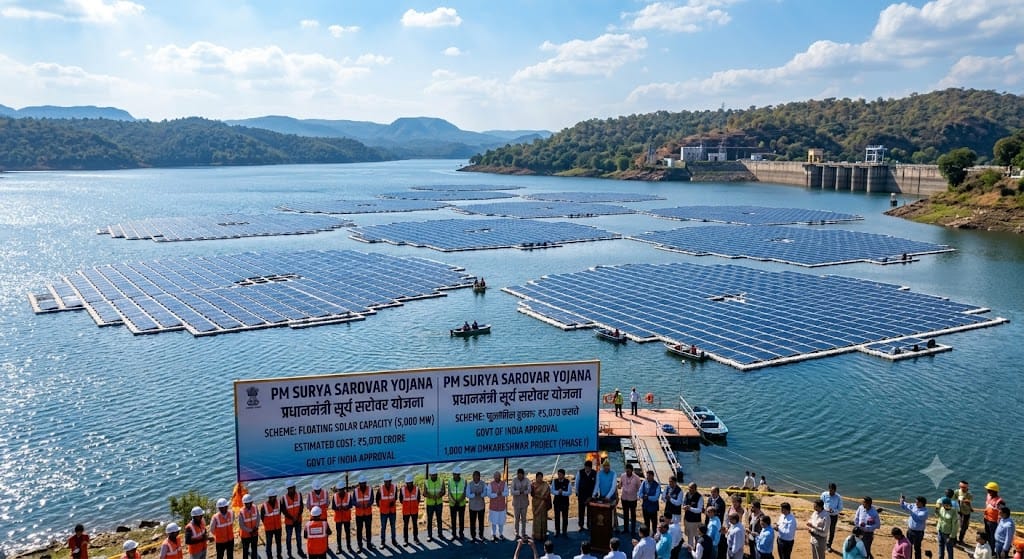
Cabinet approves ₹5,070 crore floating solar scheme to add 5,000 MW capacity across India’s reservoirs and water bodies
The Union Cabinet, chaired by Prime Minister Narendra Modi, has approved the Pradhan Mantri Surya Sarovar Yojana (PM-SSY), a new Central Sector Scheme worth ₹5,070 crore aimed at scaling up floating solar power generation across the country. The scheme marks one of India’s most ambitious pushes yet into floating solar photovoltaic (FSPV) technology and is expected to reshape how the country uses its reservoirs, dams, and industrial water bodies for clean energy generation.
Here’s a complete breakdown of what PM-SSY is, who can benefit from it, and how eligible entities can apply.
What Is PM Surya Sarovar Yojana?
PM-SSY is a Central Sector Scheme designed to promote the development of Floating Solar Photovoltaic (FSPV) Projects integrated with Energy Storage Systems (ESS). Instead of using land, FSPV technology mounts solar panels on buoyant platforms placed directly on the surface of water bodies such as reservoirs, dams, lakes, and industrial ponds.
By tapping into inland water surfaces, the scheme avoids competing with agricultural or forest land for solar installations — a major constraint that has slowed India’s land-based solar expansion in recent years.
Key Highlights of the Scheme
- Total outlay: ₹5,070 crore
- Target capacity: 5,000 MW of floating solar, paired with a minimum of 10,000 MWh of co-located battery storage (at least two hours of storage per project)
- Implementation window: Projects will be sanctioned between FY 2026–27 and FY 2030–31, with financial disbursements continuing up to FY 2032–33
- Financial support: Commissioned projects will receive Central Financial Assistance (CFA) of ₹1 crore per MW, plus up to ₹50 lakh per project for pre-construction studies such as bathymetry, hydrography, and environmental assessments
- Coverage: All States and Union Territories are eligible to benefit
- Resource potential: Based on assessments by the National Institute of Solar Energy (NISE), India’s floating solar potential is estimated at roughly 102.18 GWp — compared to just around 700 MW currently installed
Expected Impact
The government projects that PM-SSY will:
- Cut approximately 10 million tonnes of carbon dioxide emissions annually
- Generate 16,000–17,000 full-time equivalent jobs across the project value chain
- Boost domestic manufacturing of floating platforms, solar modules, cells, and battery storage systems
- Strengthen the Aatmanirbhar Bharat (self-reliant India) push in the renewable energy manufacturing sector
Who Is Eligible for PM-SSY?
This is an important distinction many people miss: PM-SSY is not a household or rooftop solar subsidy scheme. It is a utility-scale program aimed at large developers and government bodies, not individual citizens.
Broadly, the scheme is designed for:
- Solar power developers and independent power producers (IPPs) capable of setting up multi-megawatt floating solar installations
- State government agencies and public sector undertakings that own or manage reservoirs, dams, and other inland water bodies suitable for floating solar
- Public and private sector companies in the renewable energy space with the technical and financial capacity to execute FSPV projects with integrated storage
- Irrigation departments, power utilities, and water resource authorities that control access to eligible water bodies
If you’re a homeowner looking for a solar subsidy, PM-SSY isn’t the scheme for you — that would be the separate PM Surya Ghar Muft Bijli Yojana, which targets rooftop solar for residential consumers.
How to Apply for PM-SSY
Since the scheme was only approved by the Cabinet in the first week of August 2026, the detailed operational guidelines — including the exact bidding process, project selection criteria, and application portal — are expected to be notified shortly by the Ministry of New and Renewable Energy (MNRE).
Based on how similar Central Sector renewable energy schemes have typically been rolled out, eligible developers and agencies can expect the process to follow this broad pattern:
- Official notification of guidelines — MNRE will release detailed scheme guidelines specifying technical standards, project size caps, and eligibility documentation.
- Identification of water bodies — State agencies will likely be asked to identify and offer suitable reservoirs, dams, or water bodies for floating solar development.
- Competitive bidding — Developers will likely bid for project capacity through a tendering process, possibly routed through implementing agencies such as Solar Energy Corporation of India (SECI) or state renewable energy agencies.
- Project sanction and pre-construction studies — Selected developers can access support of up to ₹50 lakh per project for preliminary technical and environmental studies.
- Commissioning and disbursement of CFA — Once a project is successfully commissioned, developers become eligible for the ₹1 crore per MW Central Financial Assistance.
Interested developers and state agencies should track updates directly on the MNRE official website (mnre.gov.in) for the formal application window, tender notifications, and eligibility documentation once released.
PM-SSY vs PM Surya Ghar Yojana: What’s the Difference?
| PM-SSY | PM Surya Ghar Yojana | |
|---|---|---|
| Scale | Utility-scale (MW) | Household rooftop (kW) |
| Who applies | Developers, state agencies | Individual homeowners |
| Location | Water bodies (reservoirs, dams, ponds) | Residential rooftops |
| Support type | ₹1 crore/MW CFA + study support | Direct subsidy per household system |
Why This Scheme Matters
India’s renewable energy expansion has increasingly bumped up against land availability constraints, especially in densely populated states. Floating solar offers a workaround by using otherwise idle water surfaces — with the added benefit of reduced water evaporation and improved solar panel efficiency due to the cooling effect of water. With PM-SSY, India aims to close the gap between its estimated 102 GW floating solar potential and its current installed base of under 1 GW, positioning floating solar as a meaningful pillar of the country’s clean energy transition toward its broader renewable energy targets.
This article will be updated as MNRE releases detailed scheme guidelines and the formal application process.