


A quick primer on the Centre’s flagship scheme for India’s border villages — what it is, which states it covers, and why it just got bigger.
What Is the Vibrant Villages Programme?
The Vibrant Villages Programme (VVP) is a Central Sector Scheme launched by the Government of India to develop villages sitting along the country’s international land borders — places that have historically had sparse population, weak connectivity, and limited infrastructure.
The idea is simple: border villages are often the last to get roads, mobile networks, schools, and healthcare — yet they’re strategically the most important. VVP aims to fix that by funding tourism, agriculture, livelihood generation, and basic infrastructure in these areas, so that people don’t migrate away from the border and these communities stay strong and self-reliant.
The programme was first announced in the Union Budget 2022 and formally launched by the Union Home Minister at Kibithoo, a remote village near the India-Tibet border, on 10 April 2023.
VVP-I: Where It Started
The original phase, VVP-I, covers the Northern Border and spans:
- 46 blocks across 19 districts
- 4 states: Arunachal Pradesh, Himachal Pradesh, Sikkim, Uttarakhand
- 1 Union Territory: Ladakh
Under this phase, 662 villages were identified for priority development, with the largest share — 455 villages across 11 districts — in Arunachal Pradesh alone.
VVP-II: The Big Expansion (Approved March 2026)
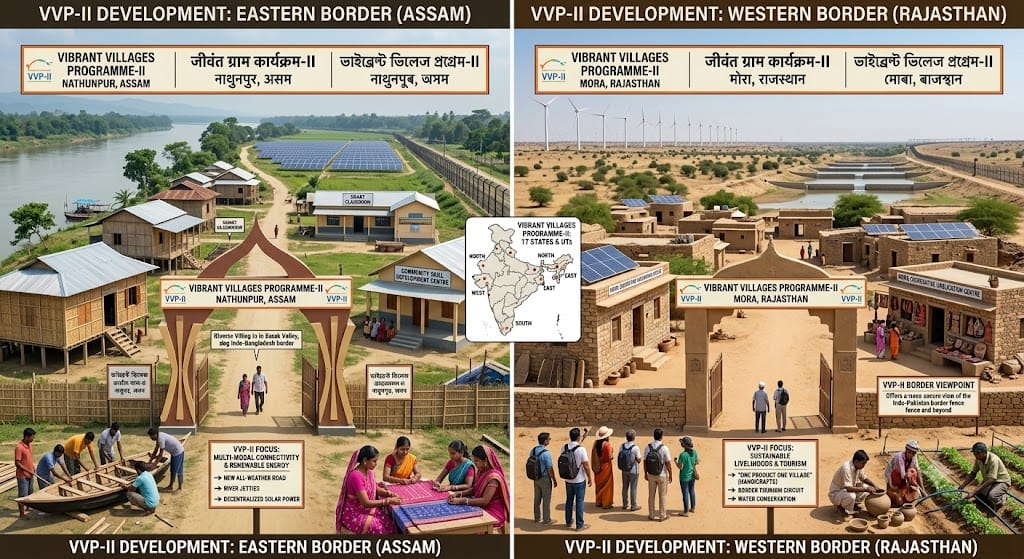
In March 2026, the Central Government approved a second phase — Vibrant Villages Programme-II (VVP-II) — significantly widening the scheme’s reach. This is the update most people haven’t heard about yet.
Key numbers:
- Total outlay: ₹6,839 crore, running until Financial Year 2028-29
- 1,954 villages identified for development
- Covers blocks abutting all of India’s international land borders — not just the Northern Border, but also the western, eastern, and northeastern frontiers
VVP-II extends coverage to a much longer list of states and UTs: Arunachal Pradesh, Assam, Bihar, Gujarat, Jammu & Kashmir (UT), Ladakh (UT), Manipur, Meghalaya, Mizoram, Nagaland, Punjab, Rajasthan, Sikkim, Tripura, Uttarakhand, Uttar Pradesh, and West Bengal.
In effect, VVP-I and VVP-II together now cover border villages across nearly the entire length of India’s international land boundary.
Who Benefits — and How
It’s worth being clear about how this scheme works: VVP is a village and block-level development scheme, not an individual cash-benefit or loan scheme like PM Vidyalaxmi or PM-SSY. There’s no personal “application” for residents to fill out. Instead, the funding flows to identified villages and blocks for:
- Road and infrastructure connectivity
- Tourism promotion in border regions
- Livelihood and agriculture support
- Renewable energy and basic amenities
- Skill development and local employment generation
If you live in one of the identified blocks or districts, the benefit typically arrives through local infrastructure projects, livelihood schemes, and state-implemented initiatives funded under VVP — rather than a direct individual payout.
Related Initiative: Viksit Vibrant Villages Program (Youth Engagement)
Alongside the infrastructure scheme, the Ministry of Youth Affairs and Sports, together with the Ministry of Home Affairs, has also been running a connected youth initiative — the Viksit Vibrant Villages Program (VVVP) 2026 — through the MY Bharat platform. This is a separate, youth-focused engagement programme (quiz-based selection, ages 21-29) that sends volunteers to spend a week in border villages for cultural exchange and community outreach. It shares the same spirit as VVP but is not a funding scheme — it’s a citizen-engagement initiative.
Why This Matters
For a country with over 15,000 km of international land border, keeping border villages populated, connected, and economically active is as much a security priority as a development one. VVP-II’s expansion signals that the government is scaling up this approach significantly — nearly tripling the number of villages covered compared to VVP-I.
Expect more state-specific rollout news through 2026 and 2027 as individual states begin implementing block-level projects under VVP-II.
Sources: Press Information Bureau, Government of India; Ministry of Home Affairs.