


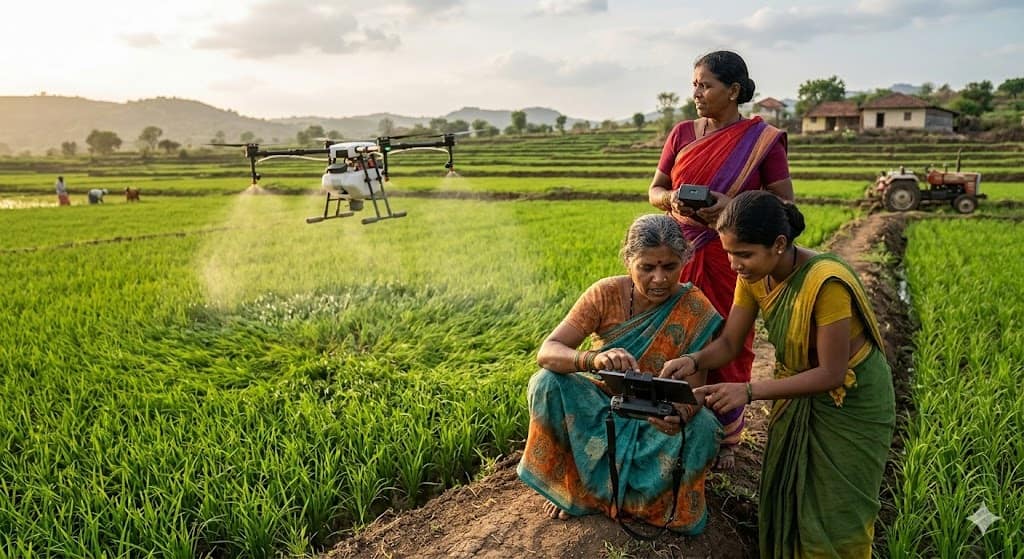
The Namo Drone Didi Scheme is a Government of India initiative that is emerging as a transformative step to empower rural women and modernise agriculture. Introduced in 2023, the scheme focuses on providing drone technology to Women Self-Help Groups (SHGs) so that they can offer services like spraying fertilisers and pesticides in agricultural fields.
Under this central government scheme, the government plans to distribute 15,000 drones to women SHGs across the country between 2023 and 2026, with a total budget of around ₹1,261 crore. The scheme provides 80% financial assistance (up to ₹8 lakh) for purchasing drones. In addition, women are given training programs to operate and manage drones effectively.
Karnataka Benefits from the Scheme
Karnataka is one of the major beneficiaries of this initiative. As per government data, the state has been allocated over 800 drones (around 824 units) for distribution among eligible women SHGs.
This is expected to:
- Increase income for rural women
- Promote modern farming practices
- Create employment opportunities in villages
Trained SHG women, known as “Drone Didis,” are becoming service providers. They offer drone-based spraying services to farmers across different districts. This reduces manual labour, saves time, and ensures efficient use of fertilizers and pesticides.
How Drones Help Farmers
Drone technology is bringing big changes in agriculture:
- Can cover 1 acre in just 7–8 minutes
- Reduces excessive use of chemicals
- Improves crop yield and efficiency
- Supports precision farming
Farmers who cannot afford drones can hire these services from SHGs, making advanced technology accessible even to small and marginal farmers.
Women Empowerment at the Core
This scheme is not just about technology—it is about economic and social empowerment of women.
- Women receive 15 days of drone pilot training
- SHGs can earn additional income through rental services
- Promotes financial independence and entrepreneurship
By training rural women as skilled drone operators, the scheme is helping them move from traditional roles to technology-enabled agricultural leaders.
Challenges
The scheme also faces some challenges:
- High maintenance and transport costs
- Need for continuous training and technical support
- Lack of awareness among farmers
However, with proper implementation and support, the scheme has the potential to revolutionise agriculture and rural livelihoods.
Very Important: How Rural Women in Karnataka Can Get This Benefit
Many rural women do not know where to get details about this scheme. Here is a simple guide:
Join a Self-Help Group (SHG)
- This scheme is not for individuals
- Only women SHGs (Stree Shakti Sangha) are eligible
- First step: Become a member of SHG
Contact Local Offices
Gram Panchayat Office
- Visit your village panchayat
- Ask: “Namo Drone Didi scheme details kodi”
- They will guide you to the right department
PM Kisan Samriddhi Kendra
- Available in most villages/taluks
- Provides:
- Scheme information
- Contact of agriculture officers
Contact Government Offices
KSRLM (Karnataka State Rural Livelihood Mission)
- This scheme comes under NRLM (Self Help Group program)
Contact:
- District Rural Development Office (DRDO)
- Taluk Panchayat Office
- Ask for: NRLM / SHG Officer
4. Official Websites (for information)
- https://lakhpatididi.gov.in
- https://aajeevika.gov.in
- These websites provide information, but direct application is not available for individuals
Important Reality
- You cannot apply online like other schemes
- Government selects SHGs based on demand
- Selection is done at district level
- Training and drones are given after selection
So women must:
- Stay active in SHG
- Attend meetings regularly
- Show interest in training
Whom to Contact
Rural women should approach:
- Gram Panchayat
- Taluk Panchayat Office
- KSRLM / NRLM Office
- Agriculture Officer
- PM Kisan Samriddhi Kendra
Active SHGs get priority.
Conclusion
The Namo Drone Didi Scheme is a powerful step towards combining technology, agriculture, and women empowerment. In Karnataka, it is creating new opportunities for rural women to earn, learn, and lead.
However, awareness is the key. If rural women actively participate in SHGs and approach the right offices, they can benefit from this scheme and become part of a new generation of tech-enabled women entrepreneurs in agriculture.