


Published: June 17, 2026 | Category: Business & Economy | Tags: Adani Ports, AI in Logistics, Port Automation, Kaleris, India Infrastructure
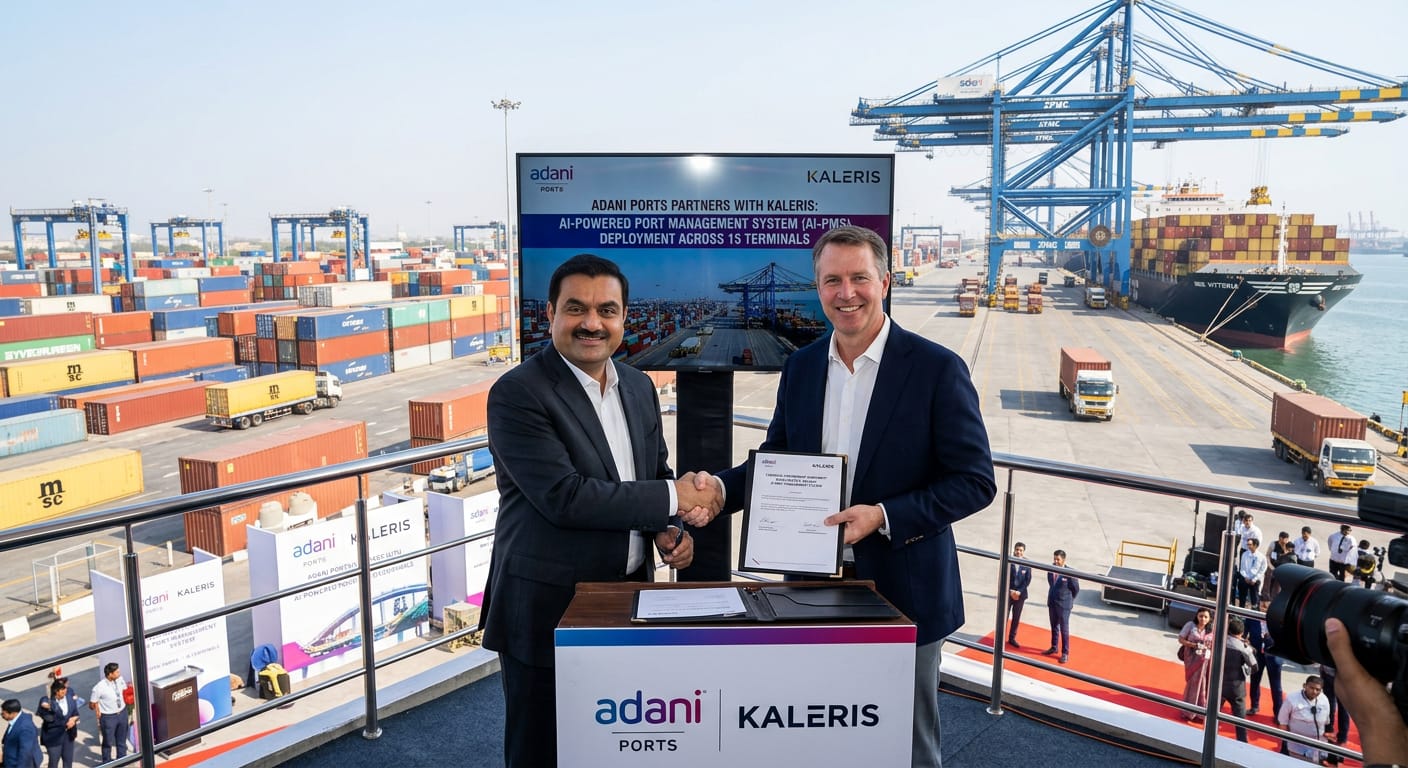
India’s largest port operator, Adani Ports & Special Economic Zone Ltd (APSEZ), has announced a major expansion of its strategic partnership with US-based supply chain software company Kaleris. The multi-year deal aims to deploy an AI-powered, plug-and-play operating platform across APSEZ’s vast maritime and logistics network — marking a significant leap in automated port management in India.
What Is the Adani-Kaleris Deal About?
Under the expanded agreement, Kaleris will implement its flagship N4 Terminal Operating System (TOS) along with advanced AI-augmented container handling solutions across 15 container terminals spanning nine domestic and international ports managed by Adani Ports.
This phase builds on a successful Phase 1 rollout that was already executed across six ports, signaling strong performance and confidence in the technology.
How Much Is Adani Investing in AI and Technology?
The Adani Ports–Kaleris collaboration forms a core part of APSEZ’s broader technology modernization strategy leading up to FY2031. The company has committed a $850 million capital investment toward technology upgrades and decarbonisation.
Of this, up to $100 million has been specifically earmarked for a two-phase automation rollout using Kaleris’ logistics architecture — focused on accelerating operational efficiency and AI-driven optimization.
What Are the Expected Benefits?
The AI-powered integration is projected to deliver measurable gains across operations:
- Up to 20% increase in Rubber Tyred Gantry (RTG) crane productivity
- Up to 14% improvement in terminal truck productivity
- An additional 91 million metric tonnes (MMT) of cargo handling capacity unlocked by 2030 — roughly a 10% boost over current baselines
These improvements are driven by the integration of Artificial Intelligence, Internet of Things (IoT), computer vision, and machine learning into port operations.
What Do the Leaders Say?
Adani Ports Whole-time Director & CEO Ashwani Gupta highlighted the strategic vision behind the move, stating that AI-enabled automation will define the next frontier of competitiveness in ports and logistics. He noted that while APSEZ has already deployed an end-to-end digital platform, the Kaleris integration will further enhance productivity, improve turnaround time, and deliver a better customer experience.
Kaleris President & CEO Kirk Knauff emphasized that the N4 Terminal Operating System and optimization tools will improve throughput accuracy and speed up vessel turnaround across APSEZ’s global footprint — which now includes international hubs in Australia, Israel, Tanzania, and Colombo.
Adani Ports’ Big 2030 Vision
Currently commanding 27% of India’s total port volumes, APSEZ operates with a capacity of 653 MMT per annum. The company’s long-term goal is to achieve a remarkable one billion tonnes of annual cargo handling capacity by 2030.
The Kaleris partnership is a key pillar in achieving that target, backed by a tightly integrated transport platform that spans marine fleets, rail networks, warehouses, and over 25,000 trucks.
Why This Matters for India’s Logistics Sector
This deal represents one of the largest AI-driven port modernization efforts in Asia. As India pushes to become a global logistics hub, initiatives like this — combining AI, automation, and smart infrastructure — will be critical in improving supply chain efficiency and reducing costs across the economy.
For businesses and investors, the Adani-Kaleris partnership signals that Indian port infrastructure is rapidly evolving to meet global standards.
Sources: Company statement, UNI India | Digital Waves News covers technology, business, and current affairs impacting India’s digital future.