


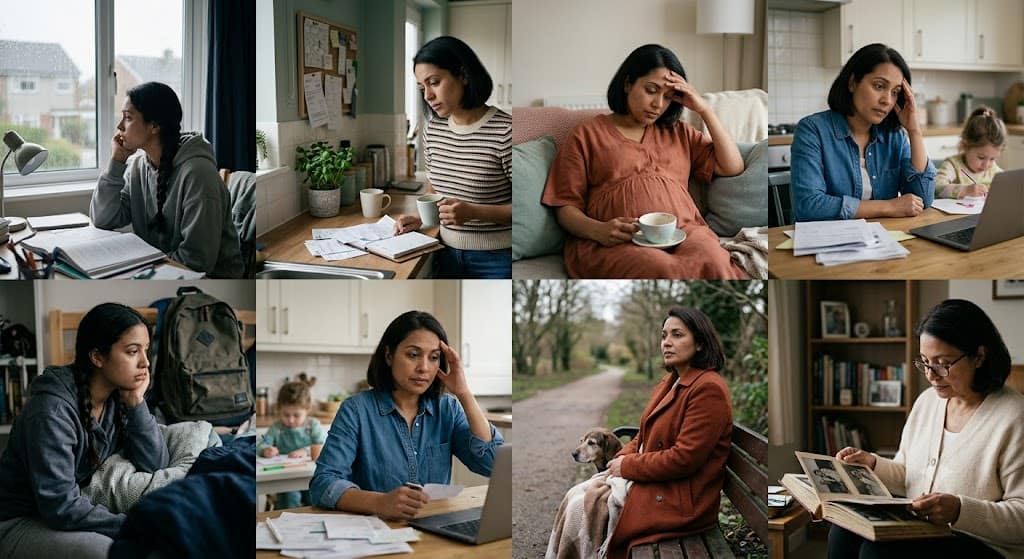
In India, we talk openly about a woman’s health when it comes to periods, pregnancy, or menopause — but almost always in physical terms. What rarely gets discussed is what’s happening in her mind during each of these stages. And yet, research shows that nearly 1 in 5 women in India will face some form of mental health condition — depression, anxiety, or something more serious — at some point in her life.
This isn’t a foreign or “Western” problem. It’s simply rarely named here. This article walks through what Indian women commonly experience at different ages, in plain language, and why our culture makes it harder — not easier — to notice.
Why Age Matters So Much for Women’s Mental Health
Unlike men, women go through several major hormonal shifts across their lifetime — puberty, the monthly menstrual cycle, pregnancy, childbirth, and menopause. Each of these shifts affects brain chemistry, not just the body. On top of this biology, Indian women also carry social pressures — expectations around marriage, family duty, appearance, and sacrifice — that shift at each life stage too. It’s really the combination of both — hormones and social pressure — that makes certain ages especially hard.
Teenage Years: The Silent Start
Puberty in girls usually begins around age 11–12, and it’s often the first time mental health struggles quietly begin — even if no one names them that way.
- Studies suggest around 45% of adolescent girls experience mood-related symptoms as their hormones shift.
- Common signs: mood swings, sudden tearfulness before periods, loss of interest in studies, headaches with no physical cause, and irritability.
- In India, these are frequently dismissed as “moodiness” or “attitude,” rather than recognised as a normal part of hormonal change that sometimes needs support.
Academic pressure, body image concerns, and — in many families — restrictions placed only on girls (curfews, dress, mobility) add another layer of stress that boys of the same age typically don’t face.
The Twenties: Marriage, Career, and the Pressure to “Settle”
This is often the age where two very different expectations collide: build a career, and get married. For many Indian women, this decade brings:
- Premenstrual Dysphoric Disorder (PMDD) — a severe form of PMS affecting 3–8% of women, causing intense mood swings, anxiety, and irritability in the days before a period.
- Anxiety around arranged marriage, in-law expectations, and loss of independence after marriage.
- Career-versus-family conflict, especially when families expect a woman to prioritise marriage over professional ambition.
- For many, this is also when the first anxiety or depressive episode appears — often unspoken, because “everything looks fine from outside.”
Pregnancy and New Motherhood: The Most Under-Discussed Stage
This is arguably the stage with the biggest gap between how much support women need and how little they receive.
- 35% of pregnant women report anxiety during pregnancy.
- 10–20% of new mothers experience postpartum depression — persistent sadness, exhaustion, and difficulty bonding with the baby that goes well beyond normal tiredness.
- A much rarer but far more serious condition, postpartum psychosis, affects roughly 1–2 in every 1,000 births — involving confusion, hallucinations, and a break from reality. It is a genuine medical emergency.
- Indian studies suggest as many as 41% of new mothers experience some form of postpartum mental health difficulty.
The reason this stage is so dangerous is cultural, not just medical: a new mother in India is expected to feel constant joy and gratitude. Anything else — exhaustion, resentment, sadness, fear — is treated as ungrateful or “unmotherly,” so women hide it instead of naming it. Family members are often present in the house, which can help — but can also mean symptoms get minimized or dismissed rather than taken to a doctor.
The Thirties and Forties: The Invisible Load
This stage is rarely spoken about in mental health conversations at all, yet it’s often when women are carrying the most:
- Managing children, ageing parents or in-laws, household responsibilities, and often a job — simultaneously.
- Chronic, low-grade anxiety and burnout that doesn’t reach “crisis” level, so it’s rarely treated, just tolerated.
- Loss of personal identity — many women describe feeling like they exist only in relation to others (wife, mother, daughter-in-law), with no space for their own needs, ambitions, or rest.
Because this stress builds slowly rather than arriving suddenly, it’s the easiest stage for both women themselves and their families to overlook.
Perimenopause and Menopause: Where Stigma Peaks
Indian women typically reach menopause between ages 40–46 — notably earlier than the global average of 45–55. This makes India’s menopause mental health gap even more urgent, and yet it may be the least discussed stage of all.
- 68% of women report mood changes during this transition, and 45% report increased anxiety.
- 23% go on to develop clinical depression during this period.
- In one large Indian study, 70% of women reported mental health symptoms like mood swings, anger, and sadness during menopause — but only 2% sought professional help.
- The most common reason: shame. Women describe being expected to keep their hormonal symptoms “under wraps,” as if managing them quietly were a test of character.
For many Indian women, menopause also coincides with an identity crisis tied to motherhood ending as a life stage — in a culture that has often measured a woman’s worth by her role as a mother.
Older Age: Loneliness Nobody Names
Mental health in elderly Indian women is perhaps the most neglected area of all. Common but rarely discussed struggles include:
- Loneliness and depression after children move away or a spouse passes away.
- Loss of financial independence and decision-making power within the family.
- Anxiety and low mood dismissed by families as “just old age,” rather than treated as depression that can genuinely improve with support.
Why This Stays Hidden in India
The biology behind all of this — hormones, brain chemistry, life transitions — is universal. What makes the Indian experience different is the layer on top of it:
- Stigma. Mental illness is still widely seen as a personal weakness or family shame, not a medical condition.
- Language. Many Indian languages don’t have a comfortable, non-stigmatizing word for “depression” or “anxiety” — everything gets compressed into “tension” or “stress.”
- Patriarchy. Women are often not given space to name ambition, exhaustion, resentment, or fear as legitimate feelings — because a “good” wife, mother, or daughter is expected to feel only gratitude and duty.
- Low awareness. Nationally, an estimated only 10–12% of people with a diagnosable mental health condition in India ever seek professional help.
The result is a pattern that repeats across every life stage: real psychological struggle, hidden behind silence, until it becomes a crisis instead of something treated early.
What Can Actually Help
- Naming it correctly. Calling it anxiety or depression, instead of “stress” or “mood,” is the first step toward taking it seriously.
- Routine screening, not just physical check-ups, especially during pregnancy, postpartum, and perimenopause.
- Family awareness that emotional distress at any age is a medical signal, not a character flaw.
- Normalising professional help the same way a fever or infection would be treated — early, and without shame.
Help & Resources (India)
If you or someone you know is struggling, these are free and confidential:
- iCall (TISS) Psychosocial Helpline: 9152987821
- KIRAN Mental Health Helpline (Govt. of India): 1800-599-0019
- Vandrevala Foundation Helpline: 1860-2662-345 / 1800-2333-330
FAQs
At what age are Indian women most vulnerable to mental health issues? There isn’t one single age — vulnerability rises at every major hormonal transition: puberty, the reproductive years, pregnancy/postpartum, and perimenopause/menopause. Each stage carries its own specific risks.
Why don’t Indian women seek help for mental health problems? Stigma is the biggest reason. Studies show that even when women recognise symptoms, only a small fraction seek professional help — for menopause specifically, one Indian study found just 2% did, despite 70% reporting symptoms.
Is postpartum depression common in India? Yes. Indian studies estimate that up to 41% of new mothers experience some form of postpartum mental health difficulty, ranging from mild mood changes to clinical depression.
Does menopause affect mental health, or just the body? Both. Hormonal changes during menopause directly affect brain chemistry, causing anxiety, mood swings, and in some cases clinical depression — not just physical symptoms like hot flashes.
This article is intended for information and awareness and is not a substitute for professional medical advice. If you are concerned about your own mental health or someone else’s, please consult a qualified doctor or mental health professional.
Sources
- Deccan Herald, “A woman’s mind, its own”
- The Week, “Menopause woes: Indian women are wired to serve”
- THIP Media, “Mental health of women in India requires attention”
- Elda Health, “State of Menopausal Health in India” report
- The BioScan, “Postpartum depression: Prevalence, India, Risk factors” (2026)
- World Health Organization, India depression prevalence data