


Washington/Tehran | June 14, 2026
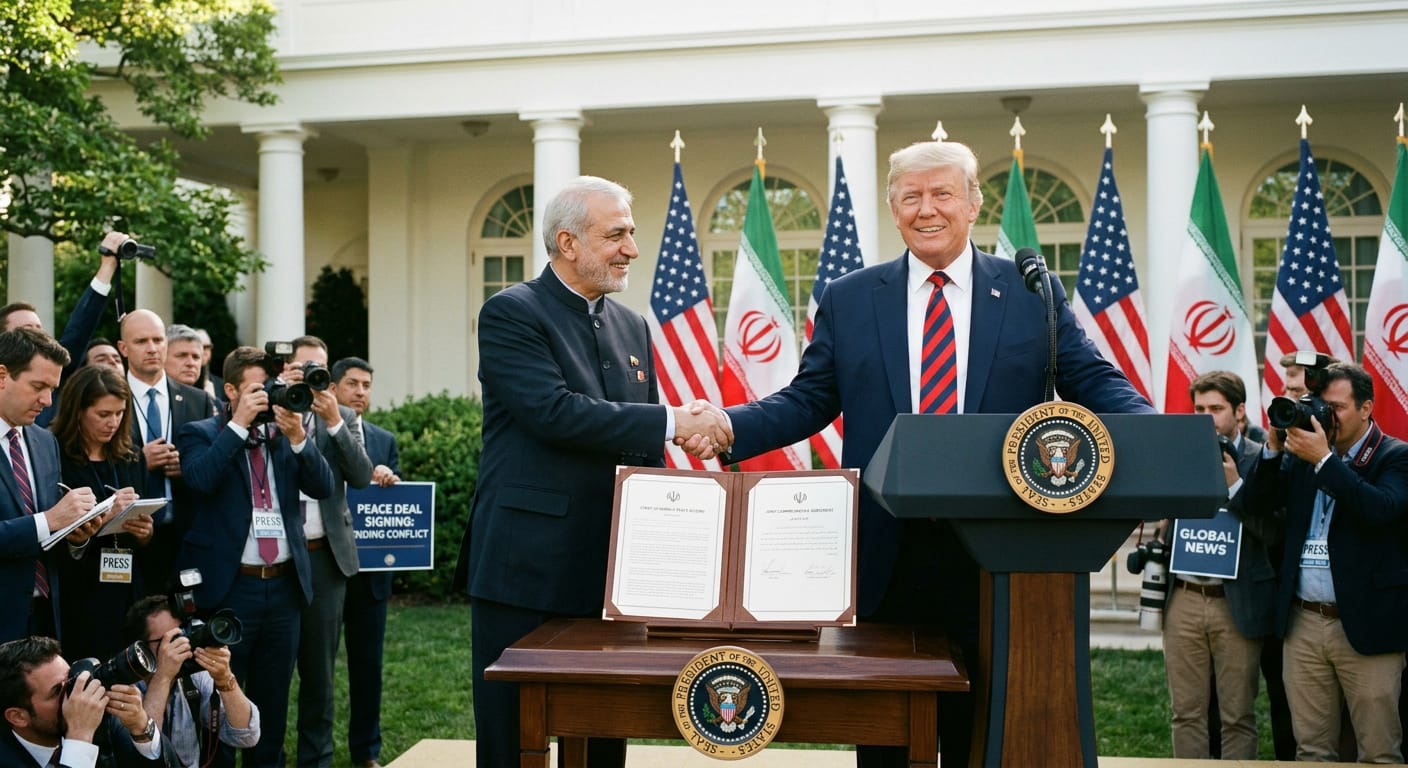
US Iran War 2026 has reached a decisive turning point. After more than 100 days of military conflict, drone strikes, and a global energy crisis triggered by the closure of the Strait of Hormuz, the United States and Iran appear to be on the verge of a historic agreement. President Donald Trump has announced that a peace deal is ready to be signed as early as Sunday, even as fresh military skirmishes continue near the vital waterway.
How the War Began
The conflict began with major US and Israeli strikes in late February 2026, leading to a temporary ceasefire in April and subsequent extensions. The Iranian Revolutionary Guard Corps (IRGC) closed the Strait of Hormuz, issued warnings forbidding passage, boarded and attacked merchant ships, and laid sea mines in the strait. Until the US-Israeli war against Iran, the Strait of Hormuz was open, with about 25% of the world’s seaborne oil trade and 20% of the world’s liquefied natural gas (LNG) passing through it.
The Ceasefire That Held — Barely
On April 8, Trump announced that both sides had agreed to a two-week ceasefire, claiming the US had already achieved its military goals and that the conflict could be close to resolution. Iranian Foreign Minister Abbas Araghchi also announced that Iran would agree to a ceasefire if attacks against Iran were halted.
Under the ceasefire framework, the US and Israel agreed to suspend the bombing of Iran for two weeks, provided Tehran ensured the reopening of the Strait of Hormuz for safe passage of global maritime traffic. The truce held in broad terms but was repeatedly punctuated by skirmishes and standoffs.
US Iran War 2026: What’s on the Table
As of June 12, both sides confirmed they had agreed on the text of a draft memorandum of understanding (MOU). Draft terms described by multiple sources to Reuters indicate the US would begin releasing billions of dollars in frozen Iranian assets and waive sanctions on Iran’s oil exports in return for Iran reopening the strait.
The US Iran War 2026 agreement includes a memorandum of understanding as a first phase, with broader talks expected within 30 to 60 days. A fragile ceasefire has been in place since April 8, punctuated by skirmishes as both nations continue to negotiate over the reopening of the Strait of Hormuz.
The deal is being jointly brokered by Qatar and Pakistan and, if signed, is expected to be known as the Islamabad Agreement.
Nuclear Issue: Major Sticking Point
Trump stated the agreement would also stop Iran from pursuing a nuclear weapon, writing: “My agreement with Iran is the exact opposite of the JCPOA — a WALL TO NO NUCLEAR WEAPON!” He added that Iran “no longer wants a nuclear weapon, nor will they have one, either through purchase, development, or any other form of procurement.”
However, Tehran told a different story. A senior Iranian source told Reuters that Tehran has not agreed to hand over its highly enriched uranium stockpile and that the nuclear issue was not part of the preliminary agreement. Iran’s Foreign Ministry added that nuclear issues would be discussed only after the initial MOU is signed — a significant gap between the two sides’ public positions.
Clashes Continue Even as Talks Progress
Despite the diplomatic momentum, hours after Iranian Foreign Minister Araghchi declared that “Iran is the winner of the war with the US”, US forces shot down multiple Iranian one-way attack drones heading toward the Strait of Hormuz. Araghchi had also warned that Iran’s “sword will always hang over the Strait of Hormuz” — underscoring that trust between the two sides remains fragile.
Signing Expected Sunday — Geneva the Likely Venue
A Western source said the deal could be signed as soon as Sunday by US Vice President JD Vance and Iran’s parliament speaker, Mohammad Baqer Qalibaf, with Geneva seen as the likeliest venue. However, Iran’s foreign minister indicated the deal would be signed remotely before any public announcement.
Trump also clarified that “no money will exchange hands”, appearing to walk back earlier reports that frozen Iranian assets would be released immediately as part of the deal.
US Secretary of State Marco Rubio, on a visit to India, also signalled optimism, saying he believes more developments on the Iran situation could emerge later on Sunday and that significant progress had been made over the last two days.
Global Impact: Energy Markets, Inflation, and Beyond
The closure of the Strait of Hormuz has sent shockwaves through global energy markets. A deal could end a conflict that has choked global energy markets and pushed US inflation to its highest level in years. When the initial April ceasefire was announced, global oil prices fell sharply and stock markets jumped, with benchmark Brent crude dropping below $100 a barrel, falling around 15.9% to $92.30, while US-traded oil dropped nearly 16.5%.
The US Iran War 2026 resolution, if permanent, could trigger a significant drop in global oil prices and bring much-needed relief to economies worldwide that have been struggling with fuel shortages and supply chain disruptions.
What Comes Next
The coming hours are critical. While both Washington and Tehran have signalled readiness to sign, significant gaps remain — particularly on nuclear commitments and the release of frozen assets. The deal, if finalised, would mark one of the most consequential diplomatic agreements of the decade.
The world is watching the US Iran War 2026 closely. A signing ceremony expected on Sunday could bring an end to a conflict that has reshaped geopolitics, energy markets, and the balance of power in West Asia.
This is a developing story. Updates will follow as more details emerge.
Sources: UNI India, Al Jazeera, Reuters, CBS News, CNBC, News on Air (AIR), Wikipedia.