


There’s a particular kind of grief reserved for things that can never be undone. You can mourn a lost love, a wasted decade, a war that should never have happened — and no amount of mourning will move the needle back. History belongs to that category. It is the one thing that is truly, permanently finished. And yet we keep treating it like unfinished business.
I think about this every time I walk somewhere old — a fort with its walls half-eaten by time, a riverbank that has watched a thousand generations fall in love exactly the way people still do today. The stones don’t argue with us. They don’t confess who wronged whom, or whether the empire that built them was as glittering as legend claims. They just stand there, indifferent, letting us project whatever story serves us best. That silence is the real lesson: the past cannot defend itself, and it cannot be prosecuted either. It can only be interpreted — and we get to choose how.
Most of the time, we choose badly. We choose the interpretation that keeps a wound open, because an open wound is easier to organize a grievance around than a closed one.
Japan Chose Differently
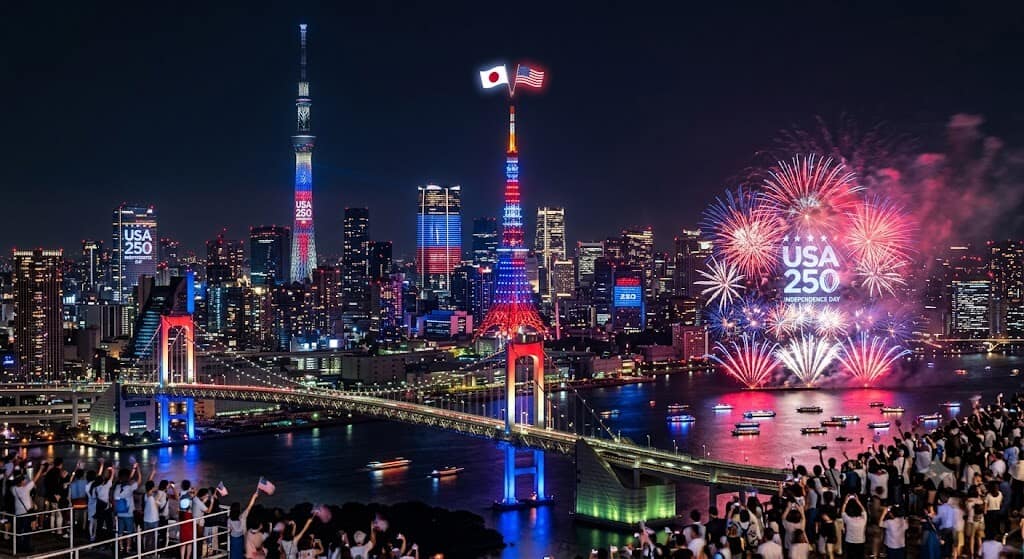
Which is what makes Japan’s example so striking. This past week, Tokyo lit up its skyline for America’s 250th birthday — Tokyo Tower glowing, drones tracing the faces of American leaders in the night sky, fireworks over the bay. This is a country that endured the only wartime use of nuclear weapons in human history. Hiroshima and Nagasaki are not footnotes to Japan; they are seared into its national memory, memorialized every single year without fail.
And still — the celebration. Still, the cherry trees sent to Washington, a quiet echo of the 3,000 trees gifted back in 1912, long before either country could have imagined what would pass between them. Still, the warm words from Japanese leadership about strengthening the bond between two nations that once tried to annihilate each other.
This isn’t amnesia. Japan hasn’t forgotten anything. What it’s done is more difficult than forgetting: it decided that carrying the grievance forward would cost more than it would ever earn back. Remembering and resenting are not the same act, and Japan figured out how to do the first without the second.
The Alternative Is Ukraine
Compare that to what happens when a nation can’t make that separation. Putin’s war didn’t emerge from Russia’s present interests — it emerged from a longing for a Soviet Union that no longer exists, an old map redrawn in someone’s head long after the world redrew it on paper. That nostalgia for a lost empire is now measured in bodies. The people paying for it aren’t the ones who miss the USSR. They’re just the people who happened to be standing on the land it once claimed.
This is the pattern, over and over: leaders who cannot let go of old maps, old borders, old identities, end up making living people pay the toll for dead history.
Sacred Ground, Contested Ground
It shows up in smaller, quieter ways too. A plot of land holds a temple, then a mosque, then perhaps a church — each generation building over the last, the way generations always have, everywhere, since the beginning of settled life. If we insist on excavating every layer to determine who deserves the ground today based on who stood on it centuries ago, we won’t run out of grievances. We’ll run out of centuries. Every inch of inhabited earth has been someone else’s before. That fact can be a source of endless conflict, or it can simply be a fact.
What We Owe the Next Chapter
None of this means erasing the past or pretending it didn’t happen. It means refusing to let the past write the next chapter’s plot. Japan didn’t forget Hiroshima; it just stopped asking Hiroshima to decide what 2026 should look like. That’s the discipline worth learning — not historical amnesia, but historical maturity. Knowing the difference between honoring what happened and being governed by it.
We get one life, lived entirely in the present tense. We can spend it relitigating centuries we never witnessed, or we can spend it building something the next generation won’t feel obligated to avenge. Japan picked the second option. It’s not a bad model to borrow.
On July 3, Tokyo marked the United States’ 250th Independence Day with illuminated landmarks, dancing fountains, fireworks over Odaiba, and a drone display honoring the two nations’ leaders — a tribute timed a day early because of the Pacific time difference. It followed Japan’s gift of 250 cherry trees to Washington, D.C. earlier this year, extending a tradition of goodwill that began with 3,000 trees in 1912 and has carried both countries from wartime enemies to close allies.
Japan didn’t just tell the story. It lived it.