


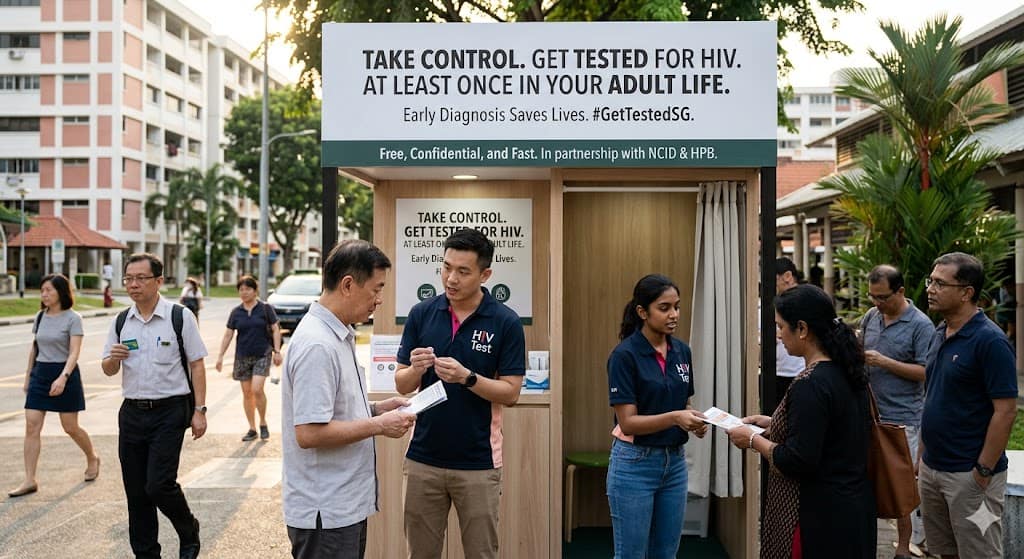
Singapore is sending a clear message to its residents: get tested for HIV at least once in your lifetime — not because you think you’re at risk, but precisely because you might not know that you are.
Singapore’s Communicable Diseases Agency (CDA) recommends that every adult get tested for HIV at least once in their lifetime, regardless of risk factors. For those who engage in at-risk sexual behaviours, the agency encourages testing every three to six months.
The call comes as Singapore reported a slight uptick in new infections. There were 166 new cases of HIV among Singapore citizens and permanent residents in 2025, up from 151 the previous year. While that number is still well below the 300 to 500 cases recorded annually between 2009 and 2019, health authorities are not treating it lightly.
The Real Worry: People Finding Out Too Late
The raw numbers are only part of the concern. What worries health officials more is when people are being diagnosed — and the picture there is troubling.
About 55.4 per cent of new cases in 2025, or 92 people, had late-stage HIV infection when they were diagnosed — a higher proportion than in 2024, when it was 51.7 per cent. Among the 2025 cases, 65.1 per cent were detected during the course of medical care, and the majority exhibited late-stage infection. Only 11.4 per cent were detected through self-initiated HIV screening.
In plain terms: most people in Singapore are finding out they have HIV not because they chose to get tested, but because something else went wrong with their health and a doctor caught it. By that point, the virus had often been silently progressing for years.
Minister of State for Health Rahayu Mahzam, speaking at a congress on sexually transmitted infections on May 23, was direct about what the numbers mean: “While we still fall below 200 cases, this represents a year-on-year increase. This shows that we cannot rest on our laurels.” She added that more than half of new diagnoses in 2025 being late-stage infections served as a reminder of the need to encourage earlier testing.
Early Testing Changes Everything
The medical case for early detection is straightforward. Knowing one’s HIV status enables a person to receive treatment early and prevent others from getting infected. For people living with HIV who are on regular treatment and maintain a consistent undetectable viral load for at least six months, there is no risk of transmitting the virus to sexual partners.
Early detection allows for prompt medical care, which can help slow the progression of the virus. Individuals diagnosed early can access antiretroviral therapy, which helps reduce the amount of virus in their blood and lowers the risk of transmission.
The challenge, as Singapore’s data makes clear, is that HIV is often invisible. HIV is frequently asymptomatic until the late stages, where AIDS may already be evident. By the time someone feels sick enough to see a doctor, significant damage may already have been done — and others may have been unknowingly exposed.
Making Testing Easier
Singapore has been steadily lowering the barriers to testing. Since 2025, HIV self-testing kits have been available for purchase at selected retail pharmacies nationwide. Testing is available at most GP clinics, polyclinics, the Department of Sexually Transmitted Infections Control clinic, and hospitals. Some sites provide anonymous or rapid testing services, where results can be available in as little as 20 minutes.
On affordability, more help is coming. Singapore will improve patient affordability for HIV drugs, with the Ministry of Health set to introduce new measures from June 1, 2026.
A Simple Ask With Big Consequences
Singapore’s HIV situation — while far better than it was a decade ago — illustrates a challenge that public health systems worldwide face: the people most in need of a diagnosis are often the least likely to seek one. An adult who has never engaged in what they consider “risky” behaviour may dismiss the need for testing entirely, not realising that the recommendation applies universally precisely for that reason.
The CDA’s guidance is clear: get tested at least once. If you engage in higher-risk sexual behaviour, make it a regular habit — every three to six months. One test could change everything.
Source: PTI