


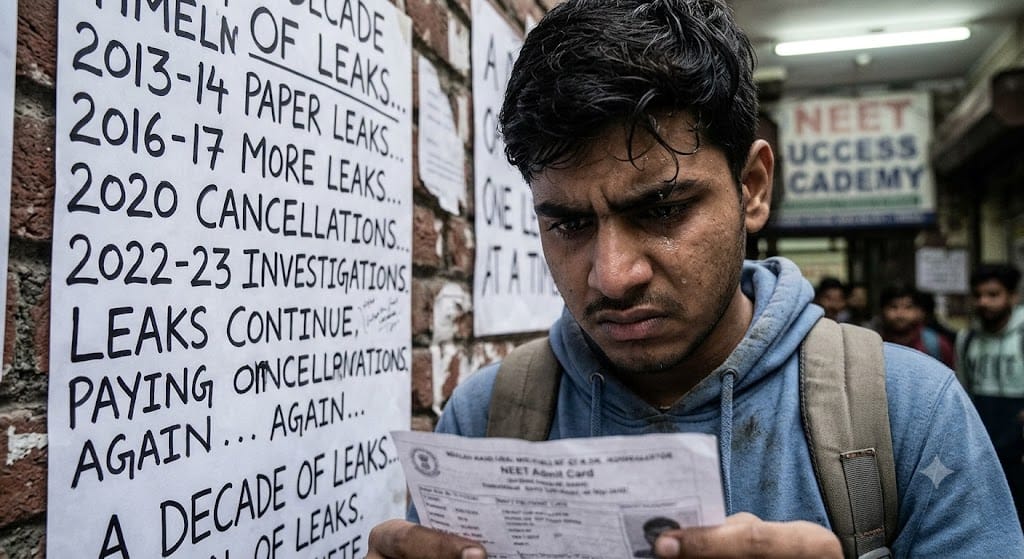
A Digital Waves News Investigation
Every year for nearly a decade, the same story has repeated itself: lakhs of students spend months, sometimes years, preparing for a single exam that decides whether they get to become doctors — and every few years, that exam is thrown into chaos by a leak, a glitch, or an irregularity that had nothing to do with how hard they studied.
This is the timeline of what NEET aspirants have actually lived through since the exam became compulsory nationwide — told from the side that rarely gets the final word in these stories: the students.
2016–2017: One Exam to Rule Them All
NEET was first introduced in 2013 but ran into legal challenges and was temporarily shelved. It was reinstated in 2016 and, from 2017 onward, made the single mandatory entrance test for every MBBS and BDS seat in the country — replacing a patchwork of state and institutional exams.
For students in states that taught in regional languages or followed state-board syllabi, this was an immediate disadvantage: they were now competing against CBSE-coached, English-medium peers on unfamiliar exam patterns.
The human cost showed up almost immediately. In 2017, S. Anitha, a Dalit student from Tamil Nadu who had scored 98% in her Class 12 exams, was denied a medical seat after NEET despite her academic record. She died by suicide shortly after the Supreme Court ruled against her state’s exemption plea. Her name became — and remains — a rallying point for students who feel a single exam erased years of hard work in state-board classrooms.
2019: A New Agency Takes Charge
Conduct of NEET was transferred from the CBSE to the newly created National Testing Agency (NTA), set up by the central government in 2017 with the promise of “tamper-proof exams.” That promise would be tested — and broken — repeatedly over the next seven years.
2021: Grief in Tamil Nadu, and the First Exemption Bill
On 12 September 2021, a 19-year-old medical aspirant named Dhanush died by suicide in Salem hours before he was to attempt NEET for the third time. The very next day, the Tamil Nadu Assembly passed the Tamil Nadu Admission to Undergraduate Medical Degree Courses Bill, 2021, seeking a permanent state exemption from NEET, with admissions based on Class 12 marks instead.
Within the same week, two more Tamil Nadu students — Kanimozhi and another 20-year-old — died by suicide, reportedly over exam-related stress. The bill passed with support from every party in the Assembly except the BJP. It was sent to the Governor, and later to the President for assent — where, five years on, it still sits unresolved.
Paper leak allegations also surfaced around NEET-UG 2021, with petitions reaching the Supreme Court seeking a re-exam — a pattern that would repeat almost annually from here on.
2022–2023: The Toll Keeps Rising
Student suicides linked to NEET continued to be reported across Tamil Nadu through this period. By August 2023, Chief Minister M.K. Stalin was writing directly to President Droupadi Murmu, citing 16 student suicides in the state and appealing for urgent presidential assent to the pending exemption bill — an appeal that, again, went unanswered.
2024: The Year NEET Broke Nationally
This was the controversy that finally made NEET’s problems impossible to ignore outside Tamil Nadu.
NEET-UG 2024 was held on 5 May for over 24 lakh candidates. When results were declared on 4 June, something looked immediately wrong: 67 students scored a perfect 720/720 — compared to just seven perfect scores across the entire 2020–2023 period combined. Six of those 67 toppers were from the same exam centre.
Within days, Bihar Police arrested 13 people, including four examinees, in connection with an alleged paper leak in Patna — accused of paying between ₹30 lakh and ₹50 lakh to obtain the paper in advance. It later emerged that answers had allegedly circulated on Telegram on the morning of the exam.
Students didn’t wait quietly. Protesters gathered at Delhi’s Jantar Mantar carrying signs reading “24 lakh students want exam, not scam.” The controversy also exposed a second issue: over 1,500 candidates had been quietly awarded “grace marks” under a compensation formula that was never announced before the exam.
The matter reached the Supreme Court, where hearings ran from June through August 2024. On 8 July, the Court stated plainly that the paper leak was “an undisputed fact” — a rare, direct acknowledgment from the bench. Yet on 2 August, the Court ultimately declined to order a full cancellation or nationwide retest, ruling there wasn’t evidence of a systemic breach large enough to compromise the exam for all 24 lakh candidates. For students who had watched the Court call the leak undisputed just weeks earlier, the final outcome felt like a contradiction they never got a satisfying answer to.
The fallout continued regardless: a CBI investigation was launched, more arrests followed (including an impersonation case in Bihar’s Purnea), and the government appointed a seven-member High-Powered Committee, headed by former ISRO chairman K. Radhakrishnan, to overhaul how NTA exams are conducted.
2025: Promises Made, Reforms Shelved
The Radhakrishnan Committee submitted its report in December 2024, recommending sweeping changes: NEET-UG conducted across multiple shifts or in computer-based mode, age limits and capped attempts, tighter controls on question-paper printing and transport, and — notably — that NTA stop conducting recruitment exams entirely and focus only on college entrance tests.
None of it was implemented for NEET-UG 2025. The exam went ahead on the old pattern, unchanged.
The cracks kept showing elsewhere too. A parliamentary standing committee report from December 2025 found that of 14 major exams NTA conducted in 2024, at least five had suffered serious problems — paper leaks, question errors, or postponed results. In January 2025, JEE Main had to withdraw 12 exam questions after errors were found in the answer key. And in Tamil Nadu, the deaths didn’t stop: in May 2025, a 17-year-old named Kayalvizhi was found dead at home on the morning she was due to travel to her NEET exam centre.
2026: History Repeats — Faster and Bigger
NEET-UG 2026 was conducted on 3 May for over 2.27 million candidates — the largest cohort yet. It lasted just nine days.
On 12 May 2026, NTA cancelled the exam outright after investigations found that a “guess paper” circulating before the test had significant overlap with the actual questions. The probe expanded across multiple states, including Rajasthan and Maharashtra, with the CBI and Rajasthan Police both involved and arrests made. Protests broke out in Delhi again, with additional security deployed near demonstration sites.
For the millions of students who had already sat the exam, NTA confirmed they wouldn’t need to re-register — but they would need to sit the entire test again, with new dates announced separately.
Only after this second nationwide collapse did the government finally act on the reforms proposed nearly two years earlier: Education Minister Dharmendra Pradhan announced NEET-UG would move to a five-to-six day, computer-based format from the following year — implementing, at last, what the Radhakrishnan Committee had recommended back in December 2024. Advocacy groups also pressed for compensation for the families of students who had died by suicide amid the ongoing exam stress across these cycles.
What This Timeline Actually Shows
Strip away the case numbers and committee names, and a simple pattern emerges: nearly every year since 2017, a NEET cycle has been disrupted by a leak, an error, or an irregularity — and nearly every time, it is students, not the exam administrators, who absorb the cost. They lose months to retests. They lose trust in a system that calls itself meritocratic. In the most tragic cases, some have lost their lives.
To be fair, the government has not been silent through any of this. Ministers have repeatedly promised accountability, ordered CBI probes, and set up expert committees. The 2026 announcement of a computer-based, multi-day exam format is, on paper, exactly the kind of structural fix students and experts have been asking for since 2024. The open question — the one students are still asking — is why it took two nationwide exam collapses, and years of documented suicides, for that fix to actually be scheduled.
For the students preparing for whatever comes next, the demand has stayed remarkably consistent across a decade: not the abolition of standards, but an exam system that doesn’t put their futures — and in the worst cases, their lives — on the line for administrative failures that were never theirs to begin with.