


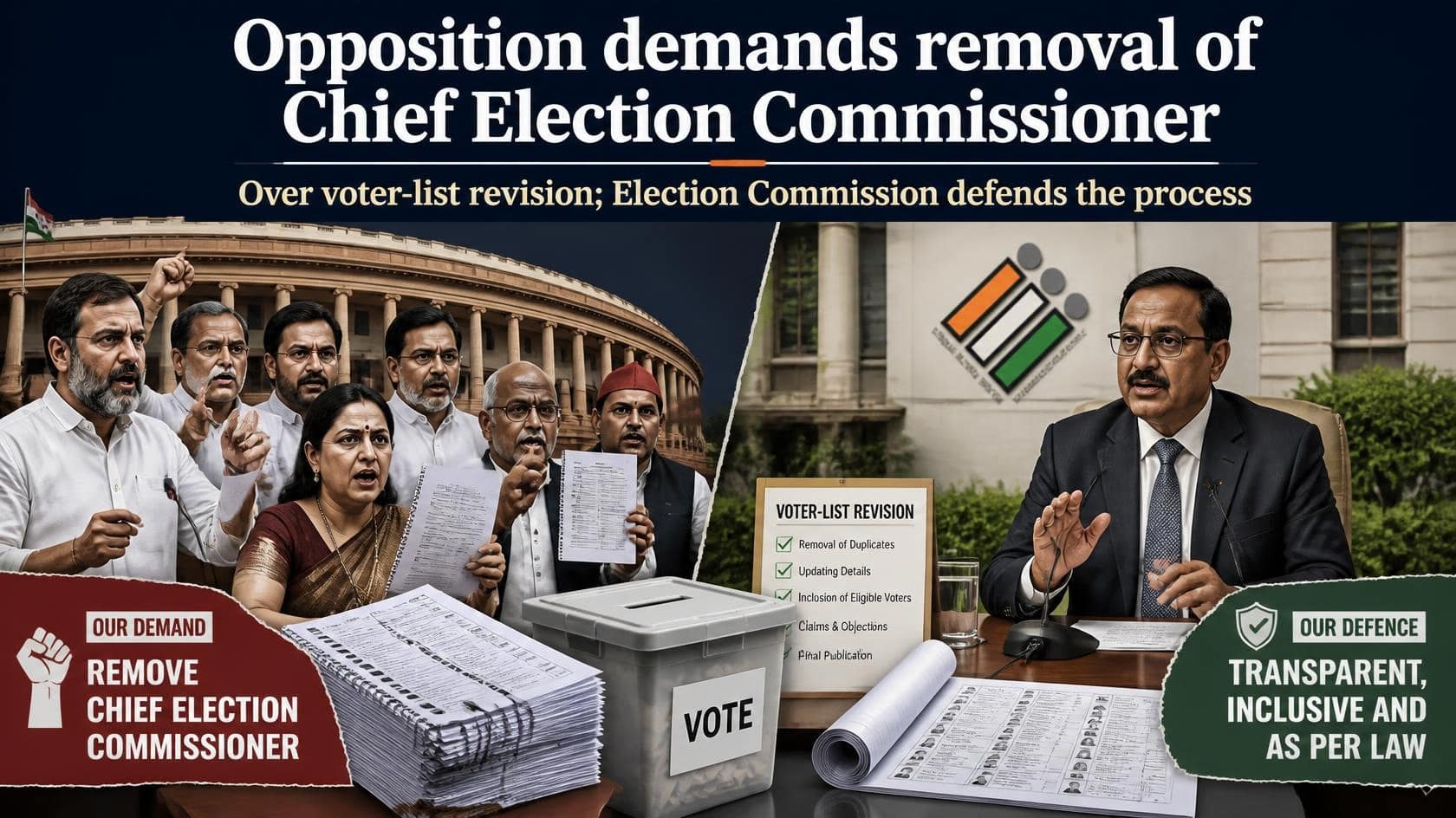
Since 2 October 2026, protesters in Delhi, Mumbai and other cities have been demanding that Chief Election Commissioner (CEC) Gyanesh Kumar step down. Opposition parties say the Special Intensive Revision (SIR) of voter lists has gone wrong under him. The Election Commission and the BJP reject the charge. Here is what each side says, and what the facts show so far.
What is happening?
- The protests. Opposition leaders and youth groups began rallying on 2 October. The youth-led Cockroach Janta Party joined them. Thousands marched in Mumbai on 4 October, led by Raj Thackeray and Uddhav Thackeray, and protests continued in Delhi.
- Police action. Reports say Delhi police detained hundreds of protesters and shut metro stations leading to central Delhi.
- In Parliament. On 6 October, INDIA bloc MPs marched in Delhi to demand his resignation and an independent inquiry. District-level “Save Democracy” marches run from 2 to 8 October, and more rallies are planned, including one in Delhi on 1 November.
- The impeachment route. Reports say the opposition is drafting a fresh notice to remove him. A similar notice was rejected in April by the Lok Sabha Speaker and the Rajya Sabha Chairman.
What are the allegations?
These are claims by his critics, not findings.
- Disagreement inside the Commission. An Indian Express investigation reported that the two other Election Commissioners, Sukhbir Singh Sandhu and Vivek Joshi, formally objected at least 14 times in 10 months. Their concerns covered decisions on adding, deleting and restoring names, appeals by deleted voters, and what they called the gradual centralisation of the voter database. The investigation shows that they raised these objections. It does not prove misconduct by Kumar.
- Large deletions. Critics say the exercise has removed a very large number of names, which Al Jazeera puts at more than 13 crore across all phases, and that the poor, minorities and migrants were hit hardest. I couldn’t check that total against Election Commission figures.
- Process problems. Critics also point to tight timelines, stress on booth-level officers, and the Commission’s decision on forms (see below).
- Bias. Opposition leaders accuse him of acting like a BJP spokesperson, and say he did not answer their questions about vote theft.
What are the “loopholes” critics point to?
- The burden is on the voter. People who cannot link their name to the old rolls, such as migrants, young people and those who moved, have to prove they are eligible.
- Forms and software. The Wire reports that the online Form 6 added a declaration asking for relatives’ details from an earlier roll, which critics say the 1960 rules do not require. Joshi reportedly warned in May against changing Form 6 without amending the rules. The Commission removed the extra declaration on 30 September in states where SIR is finished, but it remains where SIR is still running, including Karnataka. The Wire also says people who had shifted were told to use Form 6 instead of Form 8, and argues the forms do not work as intended during SIR.
- Transparency. The CEC has said that sharing machine-readable voter lists can breach privacy, citing a 2019 Supreme Court observation. Opposition parties want the data shared.
- Aadhaar. The Commission first did not accept Aadhaar in Bihar. It does so now, after the Supreme Court’s direction, but only as identity proof, not citizenship.
- Karnataka’s draft roll. About 19.4% of the earlier list was missing from the draft, and around 43 lakh people got notices. The CEO’s office has said that some voters could not find their names in the same part of the roll as before.
What does the Election Commission say?
- Legal duty. The CEC has said that cleaning voter lists is the Commission’s legal duty and that the SIR was not done in haste.
- The Supreme Court. On 27 May 2026 the Court upheld the SIR as legal, with safeguards.
- No deletion without notice. Officials say names cannot be deleted without notice and a hearing. Karnataka’s CEO says no one has been deleted so far.
- Corrections. On 2 October, the Commission directed officials to register eligible voters who were left out by mistake.
- The BJP. The BJP says the internal exchanges show healthy discussion within the Commission, and that the opposition is misrepresenting them. Both the Commission and the BJP deny the allegations of bias. As of 4 October, Kumar had not publicly responded to the resignation demands.
Can the CEC be removed?
Yes, but it is hard. The CEC can be removed only on the same grounds and in the same way as a Supreme Court judge, for proved misbehaviour or incapacity. A motion needs signatures from at least 100 Lok Sabha or 50 Rajya Sabha members, then an inquiry, then a two-thirds majority in both Houses. Opposition leaders have acknowledged that they lack the numbers.
What it means for you
- Check your name on the draft roll. Karnataka’s final roll is due on 27 October.
- If it is missing, file Form 6. If you got a notice, attend the hearing.
- Keep an open mind. The facts about the deletions, and whether eligible people were wrongly removed, will become clearer once final rolls are published and the cases are heard.
What to watch
- The final roll in Karnataka on 27 October, and how many names return.
- A new notice to remove the CEC, and whether it is admitted.
- The rallies on 10 October and 1 November.
- Court cases on deletions, and whether the Commission changes its forms and procedures.
The bottom line
Opposition parties say the SIR and the Commission’s leadership have damaged trust in the voter list. The Commission says it is doing its legal duty, and the Supreme Court has upheld the process. Both sides agree on one thing: every eligible voter should be on the list.
Sources: Al Jazeera, The Indian Express (as reported by Outlook and The Daily Pioneer), The Wire, The Tribune, Deccan Herald, The Week, The Statesman, News on Air and The News Minute, 2025 to October 2026.