


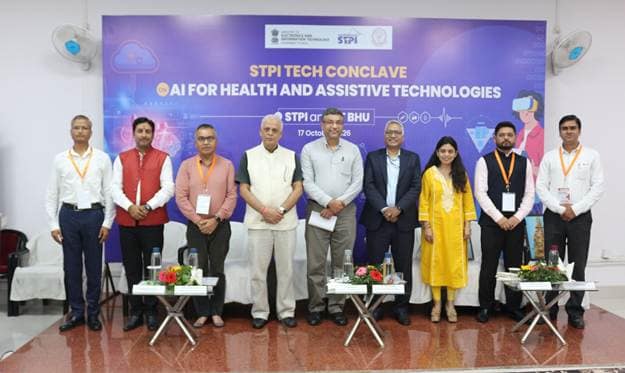
Can Indian-built artificial intelligence make healthcare more accessible, affordable and inclusive? That question was at the centre of the STPI Tech Conclave on “AI for Health & Assistive Technologies” at IIT BHU, Varanasi, which PIB reported on 18 October 2026.
What is the STPI Tech Conclave on AI for Health & Assistive Technologies?
The conclave was organised by Software Technology Parks of India (STPI), a premier S&T organisation under the Ministry of Electronics and Information Technology (MeitY), together with the Centre for Innovation, Incubation and Entrepreneurship (CIIE) at IIT BHU. It brought together government representatives, academic experts, healthcare professionals and startups. The goal was to explore how AI can advance healthcare, improve accessibility and support inclusion and citizen well-being through practical, scalable solutions.
How AI could transform diagnosis and patient care
In his keynote, MeitY Secretary S. Krishnan said AI can make healthcare more accessible, strengthen clinical decision-making and improve service delivery, especially for communities with limited access to healthcare. He named four applications:
- Disease screening: catching conditions earlier, especially where specialists are scarce
- Medical diagnostics: supporting clinicians in interpreting tests and scans
- Remote ICU monitoring: extending critical-care expertise beyond a single hospital
- AI-assisted surgical planning: helping teams prepare more carefully before surgery
He tied these to accessibility, affordability and quality of care. He also called for AI education to be integrated across disciplines, so that technology, medical sciences and research can converge on practical solutions.
Building India’s AI innovation ecosystem
Learning from India’s IT success
STPI Director General Arvind Kumar looked back at how STPI has helped grow India’s IT/ITeS industry since 1991. He said India now has a chance to repeat that success in AI through homegrown innovation and entrepreneurship. He noted that students once aimed mainly for campus placements, while today’s startup ecosystem lets young innovators become job creators.
He also highlighted:
- STPI’s industry linkages and its 27 Centres of Entrepreneurship
- The importance of translational research, intellectual property creation and market access
- The need to strengthen startup ecosystems beyond established technology hubs, particularly in emerging regions
Support for startups
The Secretary pointed to support available through the IndiaAI Mission and other MeitY initiatives. He also stressed STPI’s role in connecting startups with investors, venture capital networks and market opportunities.
The academic side
IIT BHU Director Prof. Amit Patra described how CIIE gives the institute a structured framework to nurture entrepreneurial thinking among students, faculty and aspiring innovators. He stressed connecting entrepreneurs with multiple funding sources and building a sustainable pipeline of startups.
Panel discussions: from research to real-world impact
Panel 1: “Empowering Citizens Through AI: Health, Inclusion & Well-being”
Panellists came from IIT BHU’s computer science, physics, biomedical engineering and pharmaceutical engineering departments, along with a startup founder (Arkision AI Pvt. Ltd.) and an STPI Additional Director. The discussion focused on more accessible and inclusive healthcare and on citizen well-being.
Panel 2: “From Innovation to Impact: Translating AI Research into Scalable Healthcare & Assistive Solutions”
Panellists included a MeitY Director, experts from IMS-BHU’s Centre of Biostatistics and BioNest BHU, the founder of LeminAi, and the COO of the STPI MedTech Centre of Entrepreneurship at SGPGIMS, Lucknow. The session followed the path from research to practical, scalable solutions.
The mix of government, academic, scientific, clinical and startup voices underlined one message: promising ideas reach real-world use faster through collaboration.
Key takeaways
- AI is being positioned as a practical tool for screening, diagnostics, remote ICU monitoring and surgical planning.
- The emphasis is on communities with limited access to healthcare, and on affordability and quality.
- IndiaAI Mission and MeitY support, plus STPI’s investor and market linkages, aim to help startups scale.
- Startup ecosystems beyond major tech hubs are a stated priority.
- The conclave’s closing message was to develop practical, responsible and scalable solutions for societal needs.
Frequently asked questions
What was the STPI Tech Conclave on AI for Health & Assistive Technologies?
It was an event organised by STPI and CIIE, IIT BHU, at IIT BHU, Varanasi. It explored AI applications in healthcare, accessibility, inclusion and well-being.
Which AI healthcare applications were highlighted?
Disease screening, medical diagnostics, remote ICU monitoring and AI-assisted surgical planning.
How does the government support AI healthcare startups?
Through the IndiaAI Mission and other MeitY initiatives, along with STPI’s role in linking startups to investors, venture capital networks and markets.
What is STPI?
Software Technology Parks of India is a premier S&T organisation under MeitY. It promotes the IT/ITES industry, innovation, R&D, startups and IP creation in areas such as AI, IoT, robotics, medtech and cybersecurity.
Source: Press Information Bureau, “STPI Tech Conclave highlights AI’s Potential in Healthcare & Assistive Technologies,” 18 October 2026 (link the original PIB release here).