


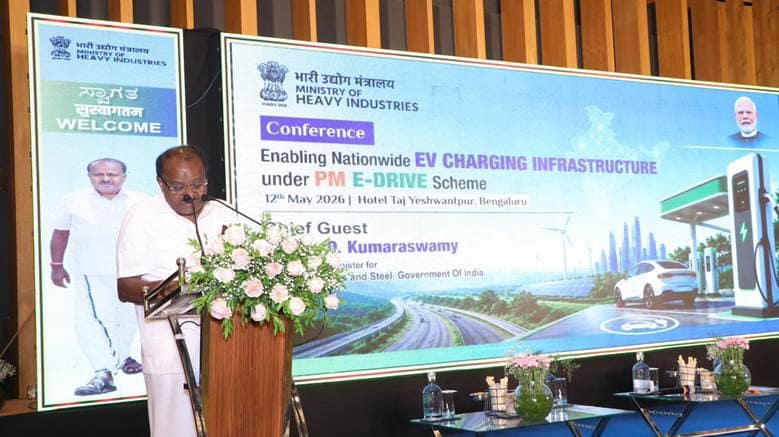
The Centre unveiled a ₹10,900 crore plan to blanket India with EV chargers. Karnataka alone gets 1,243 of them.
If you own an electric vehicle in India, range anxiety — that nagging fear of running out of charge with no plug in sight — has probably crossed your mind. The government heard you. And on May 12, it chose Bengaluru to announce that the waiting is over.
The Ministry of Heavy Industries organised a National Conference on “Enabling Nationwide EV Charging Infrastructure under PM E-DRIVE Scheme” in Bengaluru on 12 May 2026. The message from the top was unambiguous: India is getting serious about electric mobility, and the infrastructure to support it is coming — fast.
What Was Announced
Union Minister for Heavy Industries and Steel H.D. Kumaraswamy stated that the Government of India is committed to creating a modern and reliable EV charging ecosystem to support the country’s clean mobility transition. He emphasised that strengthening EV charging infrastructure is essential to accelerating large-scale EV adoption.
The numbers announced at the conference were substantial. EV charging proposals with a total financial outlay of ₹503.86 crore have been approved so far, covering the installation of 4,874 EV chargers across various states and Central Public Sector Enterprises. The approved proposals include major CPSEs such as HPCL, IOCL, and BPCL, as well as states including Rajasthan, Andhra Pradesh, Uttar Pradesh, Gujarat, Kerala, Telangana, Karnataka, and Tamil Nadu.
For Karnataka specifically, the news was even better. The Minister announced approval for Karnataka’s proposals involving 1,243 EV chargers with an outlay of ₹123.26 crore. That’s a significant vote of confidence in one of India’s fastest-growing EV markets.
The Scale of PM E-DRIVE
This conference was built around the PM E-DRIVE Scheme — and the scheme itself is enormous in ambition.
Under the PM E-DRIVE Scheme, the Government of India has approved a total outlay of ₹10,900 crore for promoting electric mobility and supporting EV ecosystem development across multiple vehicle segments.
Here is how that money breaks down:
Around 24.79 lakh electric two-wheelers and approximately 3.16 lakh electric three-wheelers — including e-rickshaws, e-carts, and L5 category vehicles — are proposed to be supported under the scheme. Support of ₹4,391 crore has been envisaged for deployment of over 14,028 electric buses. Dedicated support has also been included for e-ambulances and e-trucks to encourage adoption in commercial and public service segments.
Out of the total outlay, ₹3,679 crore has been earmarked for demand incentives for e-2Ws, e-3Ws, e-ambulances, e-trucks, and other emerging EV categories. ₹2,000 crore has been earmarked specifically for development of EV Public Charging Infrastructure across the country. An additional ₹780 crore has been allocated for modernisation and upgradation of vehicle testing agencies.
This is not a pilot programme. This is a full-scale national rollout.
Why This Matters Right Now
India’s EV adoption has been growing rapidly, but charging infrastructure has consistently lagged behind. Buyers hesitate to go electric when they are not sure they can charge their vehicle at work, on highways, or in their apartments. The government’s push addresses exactly this bottleneck.
Dr. Hanif Qureshi, Additional Secretary at the Ministry of Heavy Industries, stated that the PM E-DRIVE initiative is laying the foundation for a seamless and future-ready EV charging network across India, with support for chargers covering electric two-wheelers, three-wheelers, cars, buses, and trucks.
The conference underscored the importance of close coordination among state governments, Central Ministries, Oil Marketing Companies, OEMs, Charge Point Operators, and implementation agencies to ensure scale, interoperability, standardisation, and reliability of EV charging infrastructure across the country.
In simpler terms: the government wants every charger, from every brand, in every state, to work the same way — so that an EV driver anywhere in India never has to worry about compatibility.
States Stepping Up
What made this conference different from a typical policy announcement was the presence of state officials who came not just to listen, but to share what is already working on the ground.
Senior officials from Telangana, Kerala, Karnataka, and Odisha attended and shared their experiences, policy initiatives, and state-level strategies for scaling up EV charging deployment and strengthening charging accessibility.
This ground-up approach — states learning from each other, not just receiving instructions from Delhi — is exactly the kind of collaborative governance that large infrastructure rollouts require.
The Bigger Picture
The EV push is not happening in isolation. Beyond PM E-DRIVE, the Ministry of Heavy Industries is running several other schemes to promote EVs — PLI Auto (₹25,938 crore), PLI ACC for advanced cell chemistry batteries (₹18,100 crore), a Payment Security Mechanism (₹3,435 crore), and a Scheme for Rare Earth Magnets (₹7,280 crore).
Add it all up, and India is committing tens of thousands of crores to become a serious electric mobility nation — not just for passenger cars, but for buses, trucks, rickshaws, and ambulances.
The Ministry of Heavy Industries reiterated its commitment to supporting states in the timely rollout of EV charging infrastructure, which remains critical for accelerating India’s transition to clean mobility and advancing the national vision of Viksit Bharat, Aatmanirbhar Bharat, and achieving Net Zero emissions by 2070.
For a country still heavily dependent on petrol and diesel, this is a turning point. And the fact that Bengaluru — a city choking on traffic and pollution — was chosen to host this announcement feels like more than coincidence. It feels like a signal.