


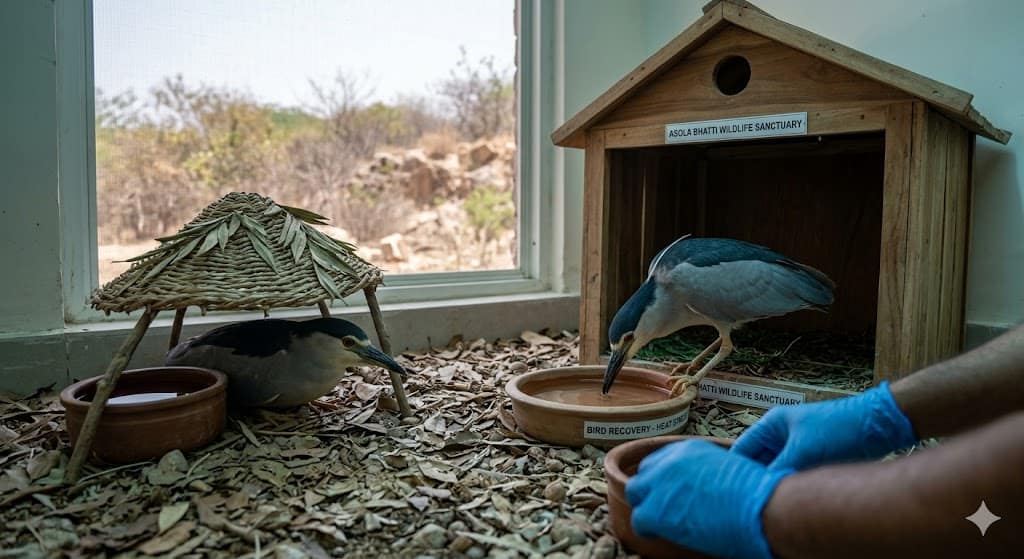
The Indian capital is baking. As temperatures in Delhi climbed past 42 degrees Celsius this April, the suffering wasn’t limited to humans wilting at bus stops or office workers dreading the walk to their cars. Across the city, something more distressing was unfolding — birds were literally falling from the sky, and the animals that share Delhi’s streets had nowhere to turn.
Birds Dropping Mid-Flight
Delhi’s Forest Department received around 50 reports of injured birds, reptiles and other animals being brought to the Asola Bhatti Wildlife Sanctuary, with roughly 30 of those reports specifically involving birds that had collapsed mid-flight due to the intense heat. The Forest Department has since been setting up water stations and shade shelters in the Southern Delhi Ridge area to try and stem the tide.
It’s not just a Delhi problem. Wildlife rescue teams across urban India have reported a sharp rise in birds collapsing due to lack of water and shelter, with animal hospitals in Ahmedabad alone treating thousands of birds in just a few weeks, many suffering from severe dehydration and heat stress.
Veterinarians say the pattern is consistent and alarming. “In birds, we often see cases of heat stress when they become disoriented and collapse from trees or suffer fatal dehydration,” said Dr Raghav Joshi, adding that stray animals without regular access to water or shade are particularly at risk.
Why Animals Struggle More Than We Realise
Most people understand that heat is uncomfortable. Few appreciate how quickly it becomes fatal for animals.
Animals, especially dogs and cats, regulate their body temperature differently from humans — they do not sweat the way we do. Dogs primarily cool themselves through panting, but when the surrounding air is too hot and humid, panting becomes far less effective, causing their bodies to overheat rapidly.
Symptoms of heatstroke include excessive panting, drooling, weakness, vomiting and diarrhoea — and veterinarians across Delhi have been seeing dogs, cats, cows and even birds like pigeons and crows come in with symptoms of severe dehydration and heat exhaustion.
For birds like black kites, the danger is compounded by behaviour. “Kites have a tendency to fly at higher altitudes and are more prone to excessive heat,” said Kartick Satyanarayan, co-founder and CEO of Wildlife SOS. The NGO has been running rescue operations through the summer, saving around 140 birds suffering from exhaustion and dehydration since March, including 30 kites and more than 70 pigeons.
Rescue Teams on the Ground
Wildlife SOS reported that in one month alone, over 40 heat-affected birds were rescued — including black kites, sparrows and blue rock pigeons — along with several monkeys and squirrels. Symptoms observed included laboured breathing, drooling, lying down, hyperthermia and in some mammals, conjunctivitis.
Treatment is intensive. Wildlife SOS veterinarians provided immediate care using oral hydration solutions — water mixed with glucose and electrolytes — while mammals received IV drips, antipyretic drugs to bring down body temperature, and multivitamins.
One rescue in Chanakyapuri stood out: a black kite fledgling was found lying motionless on the ground in a private garden, unable to fly, with the excessive heat having made its condition critical. The Wildlife SOS team first gave the bird water to hydrate it before carefully transporting it to a transit facility.
What You Can Do
Vets and rescue organisations are urging ordinary citizens to take small but meaningful steps.
Kartick Satyanarayan of Wildlife SOS said: “Simple actions such as placing bowls of water in shaded areas can provide much-needed relief for birds and small animals.”
For pet owners, the advice is more specific: always ensure pets and strays have access to cool, clean drinking water; walk dogs only in the early morning or late evening when temperatures are lower; and never leave pets inside parked cars, even briefly, as the temperature inside can become deadly very quickly.
Anyone who spots a bird or animal in distress can contact the Wildlife SOS emergency rescue helpline at +91-9871963535.
A Bigger Warning
What’s happening on Delhi’s streets this summer is a small but vivid window into a larger crisis. Climate scientists have long warned that heatwaves in South Asia are becoming more frequent, more intense and longer-lasting. For the city’s wildlife — the sparrows on windowsills, the kites circling above markets, the strays sleeping under parked cars — there is no air conditioning to retreat to. They endure whatever the sky delivers.
That a bird can fall from flight simply because the air has grown too hot to survive in is, in its own quiet way, one of the starkest images of what unrestrained heat does to living things. Delhi would do well to pay attention.
SOURCE: PTI