


International Desk | May 13, 2026
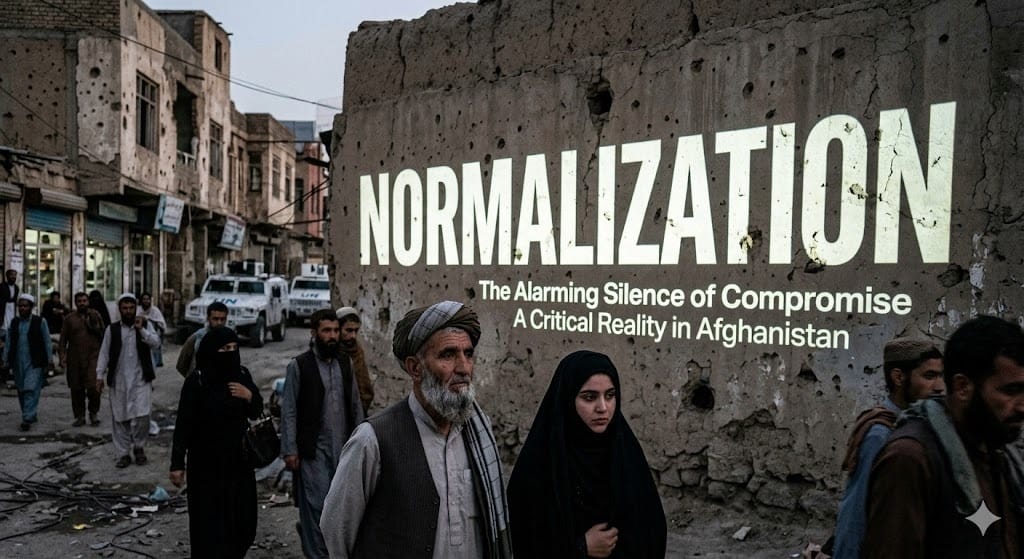
There is a word that keeps appearing in UN reports, human rights briefings, and academic papers about Afghanistan right now. That word is “normalization.” And it may be the most alarming word of all.
Four years after the Taliban seized power in Kabul, the systematic erasure of Afghan women from public life has reached a point where international observers are sounding a different kind of alarm — not just about what is happening, but about the world’s shrinking sense of outrage about it.
Banned at the Gates
The Taliban’s refusal to allow female workers into UN and UNICEF offices is one of many examples of bans on qualified women from entering places where they can deliver urgent care and assistance. The scene repeats itself daily across the country — women in healthcare, aid work, and education turned away at the door, their expertise locked out of a system that desperately needs them.
Male workers are limited in the ways they can assist female patients due to Taliban gender norms and restrictions, so support for women cannot simply be reassigned to them. This affects healthcare, food distribution, and protection systems — and delegates the burden of unmet needs to households where women must provide unpaid labour and caregiving.
The consequences are cascading. In Afghanistan, where women are limited in who they can interact with and where female staff are largely absent from outreach, surveys and home visits, data becomes incomplete. Poor data leads to incomplete distribution of assistance and mismatched aid allocation. As a result, the most vulnerable populations — particularly women-headed households in remote and rural areas — can remain invisible in official assessments.
A Country Eating Itself
The numbers tell a story of a society in freefall. Around 21.9 million people — approximately 45 percent of Afghanistan’s population — are projected to require humanitarian assistance this year. During the dry season from November 2025 to March 2026, over 17 million Afghans faced food insecurity. Nearly four million children are malnourished — approximately one in five — and about one million need medical treatment to survive.
More than 400 health facilities closed in 2025 because of a lack of funds. Cuts to aid have also jeopardized critical online education and scholarship programmes for girls and women.
Women civil servants who had been ordered to stay home since the Taliban takeover in August 2021, while receiving a reduced salary, were told in January 2026 that they would no longer be paid and their employment was effectively terminated — with minimal transparency, no due process, and no mitigation measures.
An Entire Generation Written Off
Perhaps the most devastating long-term consequence is what is happening to the next generation. Future generations of female professionals have already been eliminated by the Taliban’s ban on girls attending school. UNICEF estimates this ban could cost Afghanistan 25,000 teachers and healthcare workers.
The Taliban maintained a ban on secondary and higher education for girls and women, and in September prohibited universities from teaching books written by women. In November 2025, medical graduation examinations were held without the participation of women for the second consecutive year, after women were banned from medical institutes since December 2024.
In a country where women are prohibited from receiving care from male providers, this creates what experts are calling a profound and irreversible medical emergency. Afghanistan is ranked last — 181st out of 181 countries — for women’s wellbeing by the Georgetown Institute for Women, Peace, and Security.
The Normalization Trap
One of the greatest risks facing Afghan women right now is normalization — the risk that the world becomes used to the restrictions women face. When we start to accept this as normal, we stop believing it can change, and we stop seeing it.
Humanitarian organizations now face a stark choice: operate under restrictive conditions and risk legitimizing them, or withdraw and leave people without support. The longer the situation persists, the more the exclusion of women in Afghanistan risks becoming a normalized structure rather than an emergency.
UN Women faces a 50 percent funding gap for their work in Afghanistan in 2026, where UN operations overall face a $500 million shortfall. Under the 2026 Humanitarian Needs and Response Plan, partners aim to support 17.5 million people, including more than five million women — requiring $1.7 billion, including nearly $500 million for women alone.
The question being asked now in Geneva, New York, and humanitarian circles around the world is no longer simply how to help Afghan women. It is whether a system that was built with women’s participation can ever be rebuilt once they have been completely removed from it — and whether the international community still has the will to try.
Source: The Conversation, OHCHR, UN Women, Human Rights Watch | Compiled by International Desk