


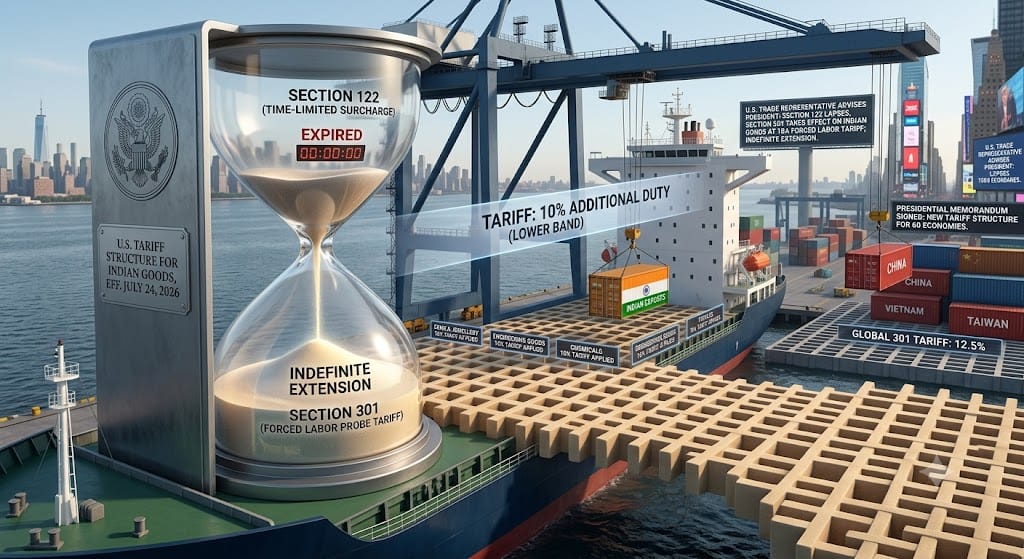
The Latest: One Tariff Expires, Another Takes Its Place
July 24, 2026, was supposed to bring relief for Indian exporters. The 10% across-the-board tariff the US had imposed on India under Section 122 of the Trade Act of 1974 hit its statutory 150-day limit that day and lapsed automatically. For a few hours, it looked like roughly 92% of India’s $87.2 billion in annual merchandise exports to the US would fall back to normal, WTO-compatible most-favoured-nation (MFN) rates.
That relief was short-lived. In a notice issued July 23, the Office of the US Trade Representative (USTR) announced it would shift the same 10% surcharge onto a different legal footing — Section 301 of the Trade Act — using a forced-labour investigation as justification. India was placed in a group of 17 economies now facing a 10% Section 301 duty, out of 60 economies covered by the new measure overall.
The practical difference matters more than the headline number. Section 122 is a temporary, capped emergency tool — 15% maximum, 150 days, unless Congress extends it. Section 301 has no such built-in expiry; it can remain in force until the US actively modifies or withdraws it. In effect, Washington has converted a temporary tariff shock into a more durable, rules-based trade barrier.
For most Indian exporters, the immediate financial impact is similar to what they were already paying — but the legal basis is now open-ended, which keeps pressure on India-US trade talks rather than resolving it.
How We Got Here: A Timeline of the US-India Tariff Rollercoaster
Indian exporters have lived through six distinct phases of tariff changes in a little over a year:
- Early-mid 2025: Baseline reciprocal tariffs of around 25-27% announced on Indian goods as part of a broader global tariff push, with exemptions for pharmaceuticals, semiconductors, electronics, energy products, and critical minerals.
- August 2025: The US added a further 25% penalty tariff on India, citing India’s continued purchase of Russian oil, taking the combined rate to 50% on a wide range of goods — among the highest US tariff rates imposed on any major trading partner.
- February 2026: The US Supreme Court struck down the reciprocal tariffs that had been imposed under the International Emergency Economic Powers Act (IEEPA). Days later, President Trump imposed a fresh 10% global tariff under Section 122, initially signaling it could rise to 15%.
- February 2026 (separately): India and the US struck an interim trade deal, with Washington agreeing to lower its reciprocal tariff on India from 25% to 18%, in exchange for India addressing non-tariff barriers and cutting its own tariffs on select US goods to zero.
- July 24, 2026: The Section 122 10% surcharge expired on schedule — and was immediately replaced by a 10% Section 301 duty, this time justified on forced-labour grounds rather than trade-balance grounds.
Throughout, sector-specific “national security” tariffs under Section 232 — 50% on steel and aluminium, 50% on copper, and 25% on certain auto components — have stayed in place, layered on top of whatever the general rate happens to be at any given time.
What Indian Exporters Actually Pay Today
As of July 24, 2026, most Indian goods entering the US face:
- The normal MFN tariff rate, plus
- A 10% Section 301 duty (for most manufactured and labour-intensive goods), plus, where applicable,
- Steeper Section 232 sectoral tariffs of 25-50% on steel, aluminium, copper, and certain auto components.
A separate group of products — pharmaceuticals, semiconductors and electronics, and select energy and critical-mineral products — remains largely exempt from the additional duties, protecting roughly a third of India’s US-bound exports from the worst of the increases.
Which Sectors Are Feeling the Most Pressure
Not all of India’s $100+ billion in annual exports to the US are affected equally. The sectors most exposed share a common trait: heavy reliance on the US as a single dominant market, combined with thin margins that leave little room to absorb a 10-50% cost increase.
Textiles and apparel — one of India’s most labour-intensive export sectors, employing an estimated 45 million workers — has been especially exposed, since around a third of the sector’s exports go to the US and India doesn’t enjoy a significant tariff advantage over competitors other than Bangladesh.
Gems and jewellery has also been hit hard. The US buys over $10 billion of Indian gems and jewellery annually, and the sector — which contributes meaningfully to India’s GDP and employs around 5 million workers — has reported sharp declines in turnover during the highest-tariff periods, pushing many exporters to redirect shipments to Europe and the Gulf.
Marine products (particularly shrimp), leather and footwear, carpets, and engineering goods round out the list of sectors analysts flag as most at risk, largely because of how concentrated their exports are toward the US market.
Steel, aluminium, and auto components continue to carry the heaviest tariff burden of all, since they sit outside the general tariff regime entirely and are taxed separately under Section 232 national-security provisions.
On the other side, pharmaceuticals, electronics, and semiconductors — which together make up a substantial share of India’s US exports — have remained largely shielded throughout, preserving critical supply chains on both sides.
The Numbers: What’s at Stake
Trade think tank the Global Trade Research Initiative (GTRI) has tracked the toll in real time. During the peak 50% tariff period in mid-to-late 2025, India’s monthly exports to the US fell sharply — including a steep month-on-month decline as the higher rate took full effect — and GTRI estimated that if the 50% tariff regime persisted through the end of FY2026, India could lose $30-35 billion in US-bound exports, a significant hit given the US accounts for close to a fifth of India’s total goods exports.
Under the current, comparatively milder Section 301 regime, the estimated damage is smaller but still real: durable tariff analysts suggest the new 10% duty, layered on MFN rates, could still trim India’s US exports by roughly 5-7%, with textiles, chemicals, and engineering goods bearing the brunt.
There is a partial silver lining. Because competing exporters such as Vietnam, Taiwan, and China have faced their own steep US tariffs at various points, India has picked up some trade-diversion gains in sectors like electronics assembly and apparel — though analysts caution these gains have so far been limited and depend on India’s ability to compete on cost and logistics, not just tariff differentials.
India’s Response So Far
New Delhi has largely avoided retaliatory tariffs, instead pursuing a three-track strategy: diplomatic negotiation, formal challenges through bodies like the USTR’s Section 301 committee (where Indian industry groups such as FICCI and CII have testified that the forced-labour findings underpinning the new duties are legally unsupported), and encouraging exporters to diversify into markets such as the European Union, the Middle East, and Southeast Asia.
India’s own tariffs on US goods have seen limited change by comparison — reduced to zero on select categories under the February 2026 interim deal, but otherwise largely intact — as India has prioritized preserving negotiating room over matching US moves tariff-for-tariff.
What Comes Next
The shift from Section 122 to Section 301 tells its own story: Washington appears to be moving away from temporary, capped tariff tools toward more durable, harder-to-reverse legal mechanisms. For Indian exporters, that means less likelihood of another sudden expiry-driven swing like the one that briefly looked possible this week — but also less certainty about when, or whether, current rates will come down.
Much now depends on the pace of the ongoing India-US trade negotiations. A broader bilateral trade agreement, if concluded, could supersede the current patchwork of Section 301 and Section 232 duties altogether. Absent that, exporters in the most exposed sectors — textiles, gems and jewellery, and engineering goods — are likely to keep treating US tariff policy as a persistent, rather than temporary, cost of doing business, and continue the shift toward alternative markets that’s already underway.
Sources: Office of the US Trade Representative, The Week, Business Today, Global Trade Research Initiative (GTRI), CNBC, White House Fact Sheet (February 2026).