


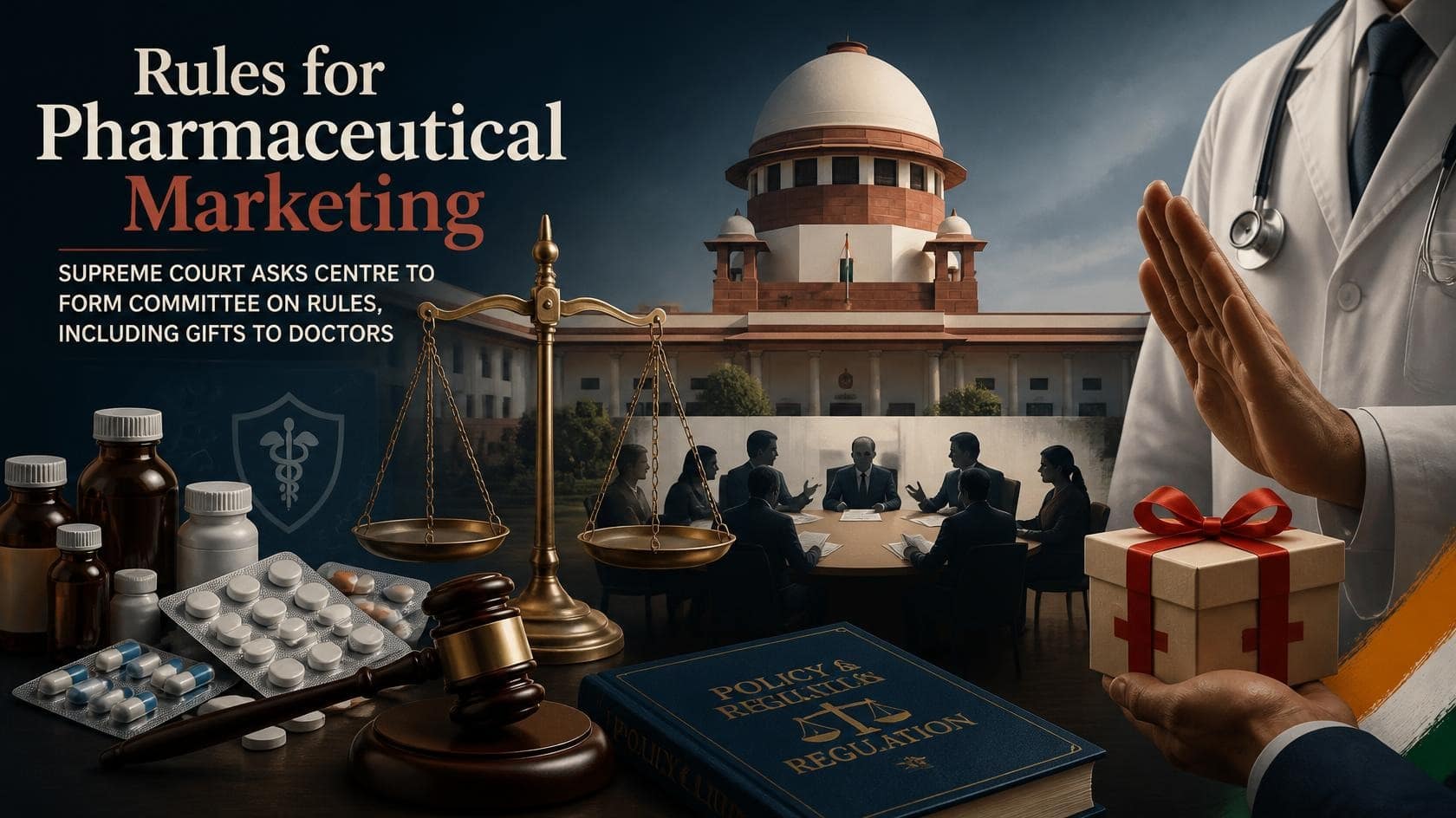
When your doctor prescribes a particular brand of medicine, you assume the choice is based only on what is best for you. The Supreme Court has now asked the government to look more closely at whether drug companies’ marketing practices, such as gifts and hospitality for doctors, can influence that choice.
What happened?
On Thursday, 8 October 2026, a Supreme Court bench of Justices Vikram Nath and Sandeep Mehta directed the Centre to set up a committee. The committee is to examine and recommend legally binding rules on how pharmaceutical companies market their products, including gifts and other benefits offered to doctors.
The committee will consider suggestions and representations and make recommendations to the Union government. The case comes up again on 29 January 2027, when the Court will look at the Centre’s compliance affidavit.
Who brought the case?
The petition was filed by the Federation of Medical and Sales Representatives’ Associations of India (FMRAI) and others. They want a legally enforceable framework to regulate how companies promote medicines to healthcare professionals.
What is the concern?
The dispute is about drug companies giving doctors gifts, hospitality, travel, money or other benefits as part of product promotion. The worry raised in court is that such benefits can influence what doctors prescribe, which could mean more prescriptions of particular medicines and higher costs for patients.
These are allegations about certain practices. They are not findings against every doctor or every company.
What rules exist today?
- A voluntary code. The Department of Pharmaceuticals issued the Uniform Code for Pharmaceutical Marketing Practices (UCPMP) in March 2024. It bars companies and their agents from giving doctors and their families personal gifts, money and hospitality, and restricts travel facilities for conferences and similar events. It builds on an earlier 2015 code.
- No enforcement. The Court has earlier questioned whether the code has adequate enforcement and whether it should get statutory backing. In an earlier hearing, it observed that a voluntary system leaves consumers at a disadvantage.
- Rules for doctors. The Centre told the Court that existing regulations already allow disciplinary action against doctors who accept gifts, travel, hospitality or money from drug companies.
- The petitioners’ point. They argue there is no comparable legal mechanism to penalise the companies that offer such inducements.
The 2022 judgment
The petitioners relied on a 2022 Supreme Court judgment in Apex Laboratories v. Deputy Commissioner of Income Tax. In it, the Court held that pharma companies cannot claim tax deductions for freebies given to doctors, and noted that such benefits can influence prescriptions. It mentioned examples such as gold coins, electronic goods and funding of foreign trips and medical conferences.
The petitioners also said the Centre told the Court in 2022 that a high-level committee had already examined whether a legally enforceable mechanism is needed.
What did the Centre say?
Solicitor General Tushar Mehta said the Centre proposed a three-member committee to examine whether a statutory framework is needed and, if so, what form it should take. The reports I found do not say who is on the committee or how long it has to report.
What could it mean for patients?
These are possibilities, not guarantees:
- More transparent prescribing, if a law makes companies accountable.
- Possibly lower costs, if prescriptions are driven less by incentives and more by medical need and price.
- A better chance to complain, if there is a legal route to challenge unethical promotion.
Meanwhile, you can ask your doctor why a particular brand was chosen and whether an equivalent generic medicine is suitable. Do not stop or change any medicine without medical advice. This is general information, not medical advice.
What to watch
- Who sits on the committee and what deadline it gets.
- Whether it recommends a law, and what penalties it proposes for companies.
- The 29 January 2027 hearing, when the Centre’s compliance affidavit is examined.
- A separate Supreme Court matter on cancer drug margins, which is listed for 12 October. It also concerns the cost of medicines, but it is a different case.
The bottom line
The Supreme Court has not made new rules. It has asked the government to study whether the voluntary code should become a law with real penalties. If it does, how drug companies promote medicines to doctors could change, and patients could benefit from more transparent prescribing.
Sources: Business Standard, Bar & Bench, Madhyamam, Indian Masterminds, LiveLaw and Wikipedia (UCPMP), November 2025 to October 2026.