


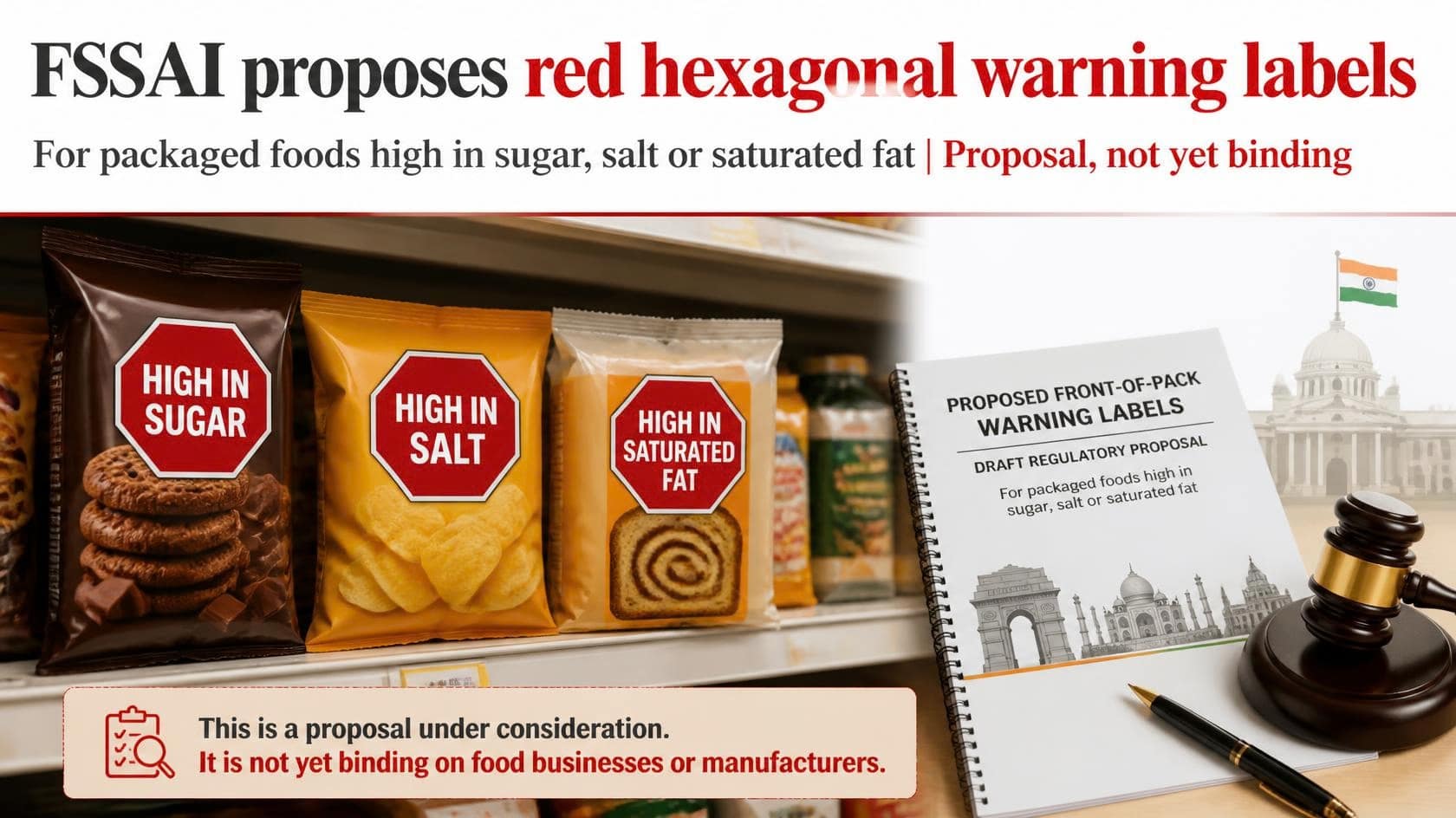
The Food Safety and Standards Authority of India (FSSAI) has proposed red hexagonal warning labels on the front of packaged foods that are high in sugar, saturated fat or salt. It did so in a Supreme Court case, after the Court criticised the regulator’s delay.
Note: this is a proposal. It has to go through the regulatory process before it becomes binding, and the details may change.
What FSSAI has proposed
According to LiveLaw’s report on the affidavit:
- A red hexagonal label would appear on products high in two or more of three nutrients: added saturated fat, added sugar and salt.
- Thresholds would be based on the Dietary Guidelines for Indians 2024 from ICMR-NIN.
- Labels could say “High Fat”, “High Sugar”, “High Salt” or “Highly Sweetened Beverage”.
- The warning would be in a font one point larger than the one used in the nutrition table on the back of the pack.
Two phases
- Phase I: products high in two or more of the nutrients, plus specified sweetened beverages.
- Phase II: extended to products high in any one nutrient.
FSSAI says the phasing gives the industry time to reformulate products while protecting consumers’ right to information, especially children.
What would be exempt
Single-ingredient foods and foods that are naturally rich in fat, sugar or salt would be left out. The affidavit names ghee, edible oil, salt, sugar, jaggery and honey. They would still follow other labelling rules.
How the Supreme Court got involved
The case is 3S and Our Health Society v Union of India, a PIL seeking mandatory front-of-pack warnings.
- February 2026: the Court told FSSAI to seriously consider warning labels and respond within four weeks.
- August 13: the Court gave the Centre two weeks to state its final decision and warned of further directions.
- Mid-August: a Bench of Justices JB Pardiwala and K Vinod Chandran criticised FSSAI’s earlier proposal to show daily recommended limits in pictorial form instead of warning labels. The Bench asked whether the regulator was giving in to industry pressure, and why India should remain underdeveloped by not adopting global norms.
- August 28: FSSAI filed the red-label proposal.
Why this has been slow
FSSAI first proposed a “Indian Nutrition Rating” star system in a 2022 draft, which would have been voluntary for 48 months before becoming mandatory. The new proposal is a warning system rather than a rating.
What it means for consumers
- Nothing changes on shelves yet.
- Until labels are final, check the nutrition table on the back of the pack, especially added sugar, saturated fat and sodium.
- If the proposal goes ahead, a red hexagon would mean a product is high in at least two of those nutrients, but products in exempt categories like ghee wouldn’t carry it.
What we don’t know yet
- The exact numerical thresholds
- When Phase I would start
- Whether the Court will accept FSSAI’s version or order a stronger one
- How the industry will respond
Key takeaways
- FSSAI has proposed red hexagon warnings for foods high in sugar, salt and saturated fat.
- It came after Supreme Court criticism over delay.
- The proposal is phased and has exemptions.
- It is not yet binding, and the petitioners want changes.
FAQ
Are red warning labels mandatory now?
No. They are proposed and still need to go through the regulatory process.
Which products would carry them?
Products high in two or more of added sugar, added saturated fat and salt in Phase I, and sweetened beverages. Phase II would cover products high in any one.
Which foods are exempt?
Single-ingredient and naturally rich foods such as ghee, edible oil, salt, sugar, jaggery and honey.
Who filed the case?
3S and Our Health Society.
.