


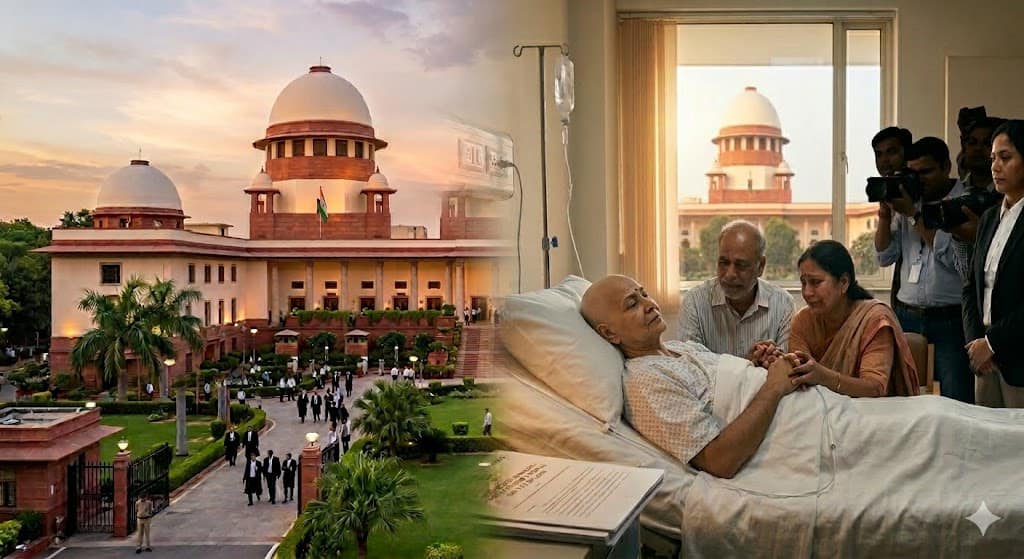
In a landmark decision, India’s Supreme Court has approved the country’s first individual case of passive euthanasia, permitting the removal of artificial life support from a 32-year-old man who has been in a vegetative state for over 12 years. The ruling was delivered by a bench of Justices J. B. Pardiwala and K. V. Viswanathan, following a petition filed by the patient’s father to discontinue life-sustaining treatment.
The patient, Harish Rana from Uttar Pradesh, suffered critical head injuries after falling from a building in 2013. Since that tragic incident, he has remained in a persistent vegetative state, requiring round-the-clock medical care. Medical experts who examined his condition concluded that he showed no meaningful response to the outside world and had virtually no possibility of recovery.
Harish was entirely dependent on others for basic daily needs and was being kept alive through clinically administered nutrition and continuous medical support. Doctors advised that prolonging such treatment would not improve his condition in any way, prompting his family to seek legal permission to withdraw life support.
Passive euthanasia refers to the withdrawal or withholding of medical treatment, allowing death to occur naturally. India legally recognised this practice in 2018 following a historic Supreme Court ruling that established strict guidelines and safeguards. That ruling also recognised the right to die with dignity as part of the fundamental right to life under the Indian Constitution.
The absence of a “living will”—a legal document in which individuals express their medical wishes in advance—often makes such cases legally complicated. In Harish’s case, the court carefully reviewed medical reports and the family’s request before granting its approval.
The debate around euthanasia in India is not new. It gained widespread national attention during the case of Aruna Shanbaug, a nurse who spent over four decades in a vegetative state following a brutal assault in 1973. Although the Supreme Court rejected a petition to end her life in 2011, her case played a pivotal role in shaping India’s legal approach to passive euthanasia.
Euthanasia remains a deeply sensitive ethical and legal issue across the world. Supporters argue that terminally ill patients deserve the right to choose a peaceful and dignified end to their suffering. Opponents, however, stress the sanctity of human life and the importance of strict legal safeguards. In India, active euthanasia — where a substance is directly administered to cause death — continues to remain illegal.