


Published: June 27, 2026
Introduction
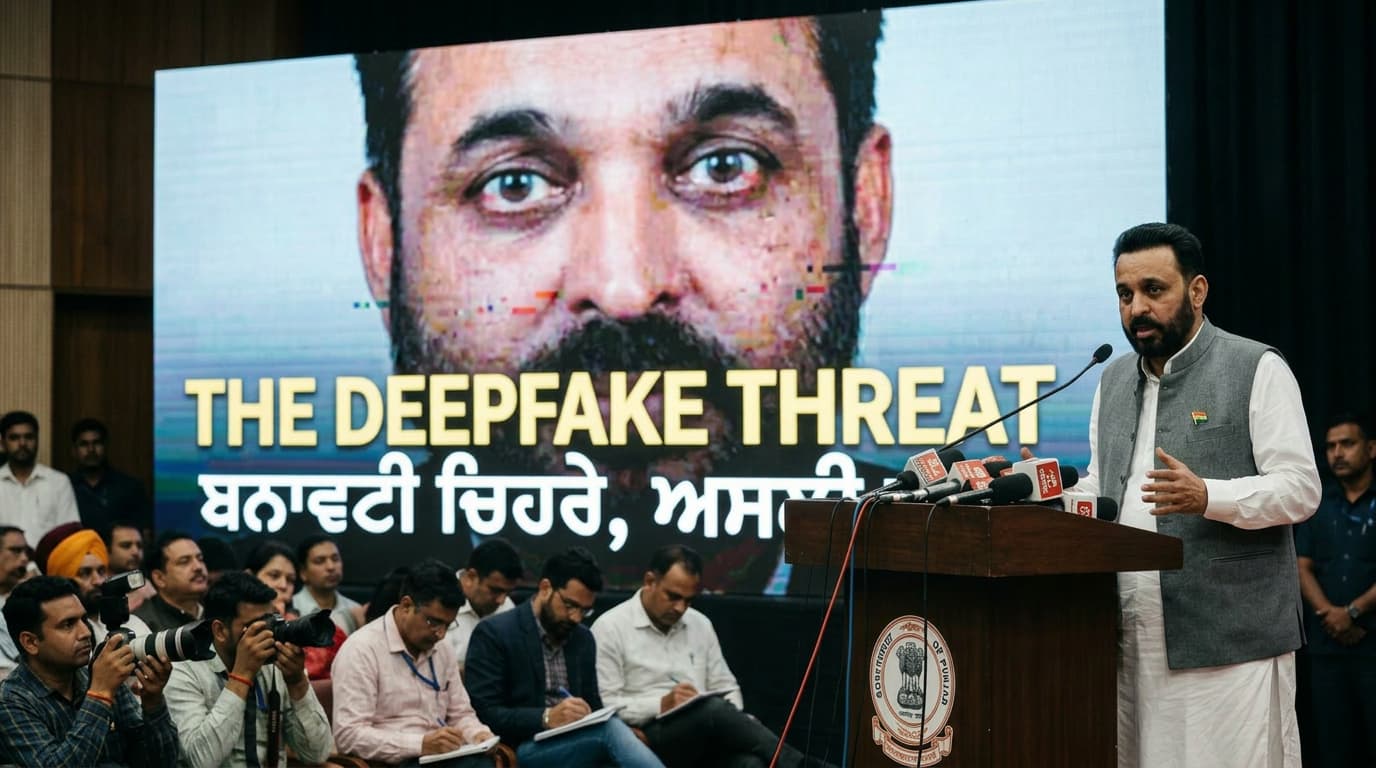
Artificial intelligence has entered Indian politics in a deeply troubling way. Across the country, AI-generated deepfake videos are being weaponised to damage reputations, inflame religious sentiments, and distract voters from real issues. Nowhere has this been more visible — or more consequential — than in Punjab, where a single viral video has triggered a political and religious crisis that continues to shake the state.
The Punjab Video Row: What Happened
The controversy began in October 2025, when a Canada-based NRI, Jagmandeep Singh, uploaded a video online purportedly showing Punjab Chief Minister Bhagwant Mann holding a glass of liquor in front of portraits of Sikh Gurus, with alcohol allegedly splashing onto the sacred images.
The ruling Aam Aadmi Party (AAP) immediately dismissed the footage, claiming it was entirely AI-generated — a deepfake engineered by political opponents to damage the Chief Minister’s reputation. The Shiromani Akali Dal (SAD) and several Sikh religious organisations condemned the video and demanded an independent forensic investigation.
The crisis escalated sharply when the Akal Takht — the highest temporal and spiritual seat of the Sikh community — declared CM Mann “Guru-Dokhi” (one who has offended the Guru) and “Panth Virodhi” (anti-community) based on the video. Mann appeared before the Akal Takht on January 15, 2026 — barefoot — carrying two bags of documents asserting that the clip was fabricated using AI, and that forensic examination was needed to establish the truth.
In June 2026, the Akal Takht Jathedar stated that multiple forensic examinations had found no evidence of AI manipulation, declaring the video authentic. The AAP disputed these findings. Days later, Gurugram Police arrested two individuals in connection with allegations that forensic reports had been forged to support the Chief Minister’s defence — adding a new and deeply serious layer to the controversy.
A Broader Pattern: AAP vs SAD Deepfake War
The Bhagwant Mann video is not an isolated incident. According to The Tribune, AAP and SAD are engaged in an escalating deepfake social media war, aggressively circulating manipulated videos, personal attacks, and AI-generated content targeting each other’s leaders — all while critical issues such as drugs and crime in Punjab take a back seat.
Senior advocate Dilip Batish noted that the fundamental right to free speech does not extend to damaging the reputation of public figures, and that India’s IT Act remains the primary legal foundation for complaints involving deepfake content.
The National Picture: Tharoor Goes to Court
Punjab is not alone. In May 2026, Congress MP Shashi Tharoor approached the Delhi High Court seeking urgent intervention against the circulation of AI-generated deepfake videos falsely showing him praising Pakistan and making statements he never made. The Delhi High Court issued summons to X (formerly Twitter), Meta Platforms, and the Government of India. Tharoor’s legal team told the court that despite prior takedown requests, the content continued to resurface across digital platforms.
What Does the Law Say?
India currently does not have a standalone deepfake law. Complaints involving manipulated political videos are handled under the Information Technology Act, 2000, which covers electronic fraud, defamation, and the creation of false digital records. Legal experts have called for specific legislation addressing AI-generated misinformation, particularly in electoral contexts.
What Every Citizen Should Know
As AI tools become more accessible, every Indian voter must develop a habit of digital scepticism. Here is what to keep in mind:
- Do not share unverified videos. A video that looks real is not necessarily real. Wait for credible forensic verification before drawing conclusions.
- Check the source. Who uploaded the video? When? What is their political affiliation or motivation?
- Look for official responses. If a political figure has publicly disputed a video, seek the outcome of any investigation before forming an opinion.
- Report suspicious content. In India, report AI-generated misinformation to the Cyber Crime portal at cybercrime.gov.in or call 1930.
Conclusion
The Punjab deepfake controversy is a landmark moment in Indian political history — one that reveals how AI can be used not just to deceive individuals, but to destabilise governments, wound religious communities, and corrode public trust. Whether or not the Bhagwant Mann video is proven to be AI-generated or authentic, the damage to political discourse has already been done.
As India prepares for future elections, the question is no longer whether deepfakes will be used in politics — they already are. The question is whether citizens, courts, and lawmakers will move fast enough to protect democracy from the machines designed to undermine it.
Found this article useful? Share it with someone who needs to read it.
Source: The Tribune, GrowJustIndia, The Statesman, OpIndia, PTC News, Aryan Age.