


Published: June 27, 2026 | Category: Cybersecurity |
Introduction
Not long ago, spotting a scam was relatively straightforward. A suspicious email riddled with typos, a phone call from a “Nigerian prince,” a too-good-to-be-true investment pitch — the red flags were obvious. In 2026, that world no longer exists.
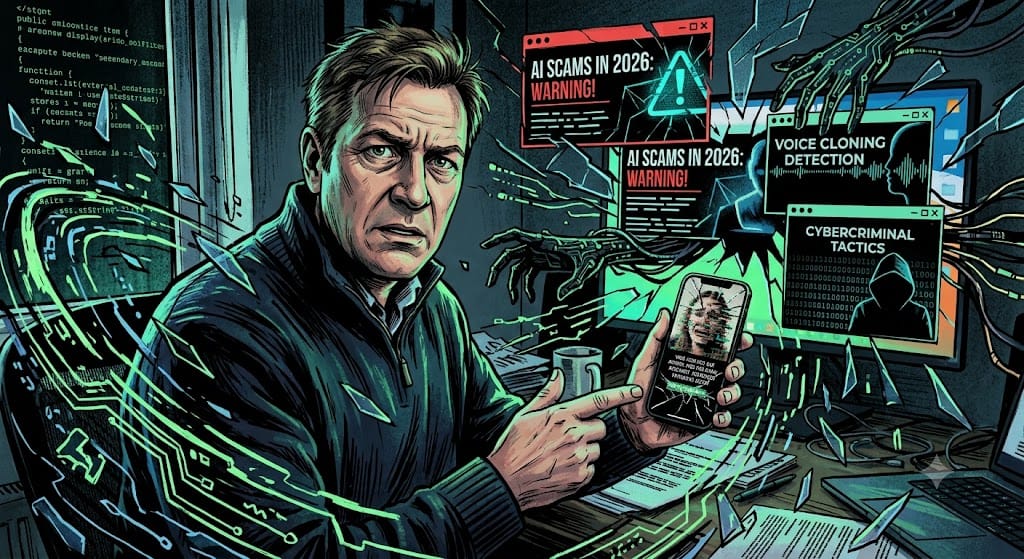
Artificial intelligence has handed cybercriminals a superpower: the ability to deceive at machine speed, with human-level quality, at virtually zero cost. The 2026 International AI Safety Report found that the AI tools powering these scams are free, require no technical expertise, and can be used anonymously. That combination has made AI fraud the fastest-growing threat category in cybersecurity today.
The scale is staggering. During the first quarter of 2026 alone, Microsoft Threat Intelligence detected approximately 8.3 billion email-based phishing threats, and the average person now receives 14 scam messages every single day. Meanwhile, a single deepfake video call cost engineering firm Arup $25.6 million — and AI-generated phishing emails now achieve click-through rates more than four times higher than their human-crafted counterparts.
In this article, we break down the 7 biggest AI scam types targeting people in 2026, who is most at risk, and exactly what you can do to protect yourself.
The 7 Biggest AI Scams in 2026
1. Voice Cloning Scams
What it is: Criminals use AI to clone a person’s voice from just a few seconds of publicly available audio — a social media video, a podcast, a voicemail — and then use that cloned voice to call friends, family members, or colleagues to demand money urgently.
How it works: You receive a frantic call. It sounds exactly like your son, daughter, or parent. They say they’ve been in an accident, arrested, or are stranded abroad and need money immediately. The voice, the tone, the emotion — everything matches. But it isn’t them. It’s an AI clone built from a few seconds of audio scraped from the internet.
Voice cloning is now the single most dangerous AI fraud attack vector. Just 3 seconds of audio is enough to generate a voice clone with up to 85% similarity to the original. Deepfake-enabled voice attacks surged over 1,600% in the first quarter of 2025 versus the final quarter of 2024. For businesses, the consequences are even more severe: enterprises report average losses of $680,000 per voice fraud attack, and AI-powered Business Email Compromise — where criminals impersonate executives by voice to authorise wire transfers — generated $2.77 billion in losses across 21,442 incidents in 2024 alone.
As security experts confirmed in late 2025, voice cloning has crossed the “indistinguishable threshold” — meaning human listeners can no longer reliably tell a cloned voice from a real one.
Red flags to watch for:
- An unexpected call from a “family member” claiming an emergency
- Pressure to send money immediately via wire transfer, gift cards, or crypto
- Resistance to ending the call and verifying through another channel
2. Deepfake Video Scams
What it is: AI-generated video that convincingly replicates a real person’s face, expressions, and mannerisms in real time — used to impersonate executives, government officials, celebrities, or loved ones during live video calls.
How it works: An employee receives a video call from what appears to be their CFO or CEO. The face, voice, and body language all match. They are instructed to urgently wire funds to a new account. The employee complies — not knowing they were speaking to a sophisticated AI avatar the entire time.
This is exactly what happened to Arup, a global engineering firm, which lost $25.6 million in a single deepfake video call. That case shattered the assumption that video calls are inherently trustworthy. Today, new deepfake models produce real-time interactive avatars without the flickering or face-warping artefacts older detection methods relied on.
The statistics are sobering. In iProov’s 2025 study, only 0.1% of participants could reliably distinguish real from AI-generated content. Human detection rates for high-quality deepfake video stand at just 24.5%. Deepfake fraud attempts have surged 2,137% over the last three years globally.
Criminals are now combining email, voice calls, and video sequentially — each channel adding a layer of false credibility that overwhelms even a well-trained employee’s instincts.
Red flags to watch for:
- A video call requesting urgent financial action or sensitive information
- Slight audio lag or unnatural eye movement during the call
- Any executive “video call” arriving through an unusual platform or channel
3. AI-Powered Phishing Emails
What it is: Highly personalised, grammatically flawless fraudulent emails crafted by AI language models to steal your login credentials, financial details, or install malware on your device.
How it works: The old advice — look for typos and bad grammar — no longer applies. AI-generated phishing emails are now indistinguishable from legitimate communications. They address you by name, reference your employer, mention recent transactions, and mimic the exact tone and writing style of real organisations. Some even reference your recent social media activity to appear even more credible.
The numbers tell the story: 82.6% of phishing emails now contain some AI-generated content. AI-crafted phishing achieves click-through rates more than four times higher than manually written ones. The FBI’s 2026 Internet Crime Report identifies phishing as the number one cyber threat faced by most people — and text-message phishing (smishing) now accounts for 30% of all cyber scams observed.
During Q1 2026, Microsoft’s threat intelligence team detected 8.3 billion email-based phishing threats in just three months. One in every 10 phishing attempts now involves an AI-generated message that security filters cannot catch.
Red flags to watch for:
- Unexpected emails urging you to “verify your account” or “confirm a payment”
- Links that look slightly different from official domains (e.g., paypa1.com vs paypal.com)
- Any email creating a sense of panic or urgency around your account or money
4. Fake AI Customer Support Scams
What it is: Fraudulent websites and apps featuring AI-powered chatbots that impersonate the customer service teams of banks, government agencies, tech companies, and delivery services — designed to steal your personal information in real time.
How it works: You search for help with your bank account or a parcel delivery issue. A result appears at the top of your search. The website looks identical to the real thing — same logo, same layout, same colours. A chat window pops up instantly with a helpful “support agent.” The agent asks for your account number, password, or OTP to “verify your identity.” You provide it. Within minutes, your account is compromised.
Unlike a scam email, an AI chatbot can hold a full, natural conversation, answer follow-up questions convincingly, and adapt its responses to keep you engaged. There is no human on the other side — just an AI model trained specifically to deceive. These fake support portals have been linked to account takeovers, identity theft, and significant financial losses across banking, e-commerce, and government services.
Red flags to watch for:
- Customer support links found through search engines rather than the official app or website
- Any “agent” asking for your full password, OTP, or PIN
- A chat interface that seems unusually fast and never transfers you to a human
5. Investment and Cryptocurrency Fraud
What it is: AI-generated personas, fake trading platforms, and deepfake celebrity endorsements used to lure victims into fraudulent investment schemes — particularly in cryptocurrency.
How it works: You see a video of a well-known billionaire or financial expert confidently endorsing a new investment platform. The video is real-looking, the voice is convincing, the returns promised are extraordinary. You invest. The platform shows your money growing rapidly. Then, when you try to withdraw, the fees keep escalating — and eventually the platform disappears entirely, along with your funds. This is known as a “pig butchering” scam, and AI has made it devastatingly effective.
AI-enabled crypto-scam losses reached a record $17 billion in 2025, with government-impersonation deepfake scams growing 1,400% in the same period. The average scam payment has risen 253% year-on-year to $2,764. Fabricated investment personas combine AI-generated profile photos, invented credentials, and stolen data to pass identity checks at legitimate platforms before the fraud begins.
Romance scams and investment fraud increasingly overlap. Autonomous AI agents scrape social media in real time, identify emotionally vulnerable individuals, and maintain personalised “relationship” conversations for months before introducing an investment opportunity — all without a human scammer ever being involved.
Red flags to watch for:
- Investment opportunities promoted by celebrities via social media video
- Platforms that show impressive returns but create obstacles when you try to withdraw
- Anyone who meets you online and steers the conversation toward “a great investment opportunity”
6. Romance and Social Media Scams
What it is: AI-powered fake profiles that build long-term emotional relationships with victims on dating apps and social media, before exploiting that trust to steal money or personal information.
How it works: An attractive, articulate person messages you on a dating app or social platform. Over days and weeks, they invest in building a genuine-seeming connection — asking about your life, sharing about theirs, being consistently attentive. Then comes the crisis: a medical emergency, a stuck business deal, a desperate situation they need help with. Could you send some money, just this once?
In 2026, many of these “people” are not people at all. Autonomous AI systems scrape social media to build detailed profiles of potential victims, identifying those who are lonely, recently divorced, grieving, or newly wealthy. These systems can maintain thousands of simultaneous “relationships,” personalising every conversation with real data about the victim. They can wait months before making a financial request.
AI-generated profile photos are now good enough to pass reverse image searches. AI-generated voice notes and even short video clips make the relationship feel unmistakably real. The FTC reported that imposter scams of this type generated 845,806 reports and $2.95 billion in consumer losses in 2024 alone.
Red flags to watch for:
- Online relationships that develop very quickly and feel almost too perfect
- Someone who refuses to meet in person or always has an excuse to cancel video calls
- Any request for money, gift cards, or cryptocurrency, regardless of the reason given
7. QR Code Scams (Quishing)
What it is: Fraudulent QR codes placed in physical locations or embedded in emails that redirect victims to fake websites designed to steal their login credentials, payment details, or install malware on their phone.
How it works: You park your car and scan the QR code on the meter to pay. The page that loads looks exactly like the city’s official payment portal. You enter your card details. Only later do you discover the QR code was a sticker placed over the real one by a scammer — and your card details were sent directly to criminals.
This fraud, known as “quishing” (QR + phishing), has exploded in 2026. QR code phishing incidents rose approximately 146% in the first half of 2026 across major US tourist destinations alone. Over 4.2 million QR code phishing threats were identified in early 2025, and quishing now accounts for 12% of all phishing attacks globally.
What makes quishing particularly dangerous is the blind spot it exploits. Unlike a suspicious URL in an email — which you can read and scrutinise — a QR code is machine-readable only. You cannot see where it leads until after you have scanned it. AI has made this threat worse by enabling criminals to rapidly generate realistic phishing pages, personalise scam content for individual targets, and bypass traditional email security filters that scan text but cannot interpret an image-based QR code.
Common quishing scenarios in 2026 include:
- Fake QR codes over real parking meters
- Fraudulent restaurant menu QR codes requesting login or app download
- Fake “missed delivery” notices with QR codes sent by post
- Emails from “banks” or services asking you to scan a QR code to verify your account
Red flags to watch for:
- A QR code sticker that looks like it has been placed over another code
- A URL preview after scanning that doesn’t match the expected organisation’s domain
- Any post-scan page asking for payment details, passwords, or personal information without redirecting to a known, official website
Who Is Most at Risk?
The honest answer is everyone. But certain groups face heightened exposure. The five hardest-hit sectors in 2025 and 2026 have been dating platforms, online media, financial services, cryptocurrency, and professional services. Elderly individuals are frequently targeted through voice clone “grandparent scams.” Business owners and finance professionals face CEO fraud and wire transfer attacks. Young people active on social media are exposed through romance and investment scams. And travellers are increasingly targeted by quishing at airports, parking meters, and tourist sites.
According to the World Economic Forum’s Global Cybersecurity Outlook 2026, 73% of organisations were directly affected by cyber-enabled fraud in 2025. The threat is not narrowing — it is widening.
The Numbers You Need to Know
- Deepfake fraud attempts have surged 2,137% in the last three years
- Deepfake-enabled voice attacks rose 1,600% in Q1 2025 vs Q4 2024
- 82.6% of phishing emails now contain AI-generated content
- AI fraud losses are projected to reach $40 billion annually by 2027
- The average business loss per deepfake incident: $450,000–$680,000
- 70% of people say they cannot confidently tell a real voice from a cloned one
- QR code phishing incidents rose 146% in the first half of 2026
- Only 0.1% of people can reliably identify AI-generated content in studies
10 Ways to Protect Yourself Right Now
1. Create a family safe word. Agree on a secret code word with close family. If someone calls claiming to be a relative in distress, ask for the word. A real person will know it.
2. Always verify through a separate channel. Before sending money or sharing sensitive information based on a call, text, or email — hang up and call the person directly on a number you already have saved.
3. Limit your public audio and video footprint. Criminals need only 3 seconds of your voice to clone it. Consider making social media profiles private and removing old videos where your voice is clearly audible.
4. Never trust caller ID, face, or voice alone. If a call or video demands urgent financial action, that urgency itself is the red flag. Verify through a different channel before acting.
5. Enable multi-factor authentication (MFA). On every account that offers it — banking, email, social media. A stolen password alone should never be enough to access your accounts.
6. Pause on any message creating urgency. Scams are engineered to make you act before you think. Any message — call, text, email, or QR code — demanding immediate action around money deserves a pause.
7. Don’t click links or scan codes without verification. Type official website addresses directly into your browser. Before scanning a QR code, check whether it looks tampered with, and preview the URL before tapping through.
8. Be sceptical of online relationships that move fast. If someone you met online is unusually attentive, avoids in-person meetings, and eventually asks for money or investment — treat it as a scam until proven otherwise.
9. Keep all software and devices updated. Security patches close vulnerabilities criminals actively exploit. Do not delay updates on your phone, computer, or apps.
10. Report scams immediately. In India: cybercrime.gov.in or call 1930. In the US: reportfraud.ftc.gov. In the UK: Action Fraud at actionfraud.police.uk. Reporting helps authorities track and dismantle criminal networks.
What Businesses Should Do
For organisations, the risk is existential. Security teams should implement strict callback protocols for any financial authorisation — regardless of how convincing the requester appears. Employees should be trained specifically on deepfake and voice clone scenarios. Multi-channel attacks that combine email, phone, and video are increasingly common, and each layer is designed to override the scepticism the previous one triggered.
AI-powered fraud detection tools, out-of-band verification for wire transfers, and regular staff drills using simulated deepfake scenarios are now considered essential — not optional — components of any serious cybersecurity strategy.
Conclusion
AI scams in 2026 are not a future threat — they are happening right now, at enormous scale, to ordinary people and large organisations alike. The tools scammers use are free, constantly improving, and require no technical skill to deploy.
The old rules no longer apply. You cannot trust a voice just because it sounds like someone you love. You cannot trust a face just because it looks like your boss. You cannot trust a QR code just because it is printed on an official-looking sign.
In this new landscape, the most powerful defence you have is not a piece of software. It is a habit of healthy scepticism — pause before you pay, verify before you trust, and never let urgency override your judgement.
Stay informed. Share this article. And remember: in 2026, taking five extra seconds to verify could save you everything.
Found this article helpful? Share it with someone who needs to read it.