


A Digital Waves News Explainer
After more than three years of stop-start negotiations, the India–UK Comprehensive Economic and Trade Agreement (CETA) — better known as the India-UK Free Trade Agreement — officially came into force on 15 July 2026. It’s being called India’s most comprehensive trade agreement with a G7 nation, and the UK’s biggest bilateral trade deal since Brexit.
But headlines about “historic deals” rarely answer the question that matters most to ordinary readers: who actually benefits?
This explainer breaks down the agreement in plain terms — what’s changing, who gains, who’s protected, and who might be left out.
The Deal, in Brief
- Signed: 24 July 2025, in London, by Commerce Minister Piyush Goyal and UK Business Secretary Jonathan Reynolds, in the presence of PM Narendra Modi and PM Keir Starmer
- In force: 15 July 2026
- Companion agreement: The Double Contribution Convention (DCC) on social security, signed 10 February 2026, also took effect the same day
- Current bilateral trade: Around $56 billion; both governments are targeting $100 billion by 2030
- Scope: 99% of Indian exports get duty-free access to the UK; India will cut tariffs on roughly 90% of UK tariff lines
Who Benefits in India
Exporters and manufacturers
India has secured duty-free access to the UK market on almost all of its tariff lines. Officials say this puts sectors like textiles, leather goods, marine products, gems and jewellery, engineering goods, and processed foods on a level footing with competitors who already enjoyed easier access to Britain. Labour-intensive industries — garments, footwear, toys, sporting goods — are expected to see the biggest export boost, since these sectors compete directly on price with countries that already had trade advantages with the UK.
Services professionals
The Double Contribution Convention removes a long-standing headache for Indian companies sending employees to the UK on short-term assignments: paying social security contributions in both countries at once. Under the new rules, that exemption period has been extended to five years, and the Indian government estimates it will benefit more than 75,000 professionals and over 900 companies — mostly in IT and consulting, where UK deployment is common.
MSMEs and niche manufacturers
The government has specifically highlighted small and medium enterprises — makers of sporting goods, toys, and artisanal products — as beneficiaries, arguing that removing UK import duties gives them a genuine price edge they didn’t have before.
Indian consumers — selectively
Consumers won’t see broad price drops, because India has been careful about what it opened up. But categories like consumer electricals and select machinery imported from the UK may get marginally cheaper over time as tariffs phase down.
Who Benefits in the UK
Whisky and spirits
This is the deal’s headline win for Britain. Import duty on Scotch whisky and gin drops immediately from 150% to 75%, then phases down further to 40% over ten years. For an industry that has lobbied for Indian market access for over a decade, this is a genuine breakthrough — India is one of the world’s largest whisky markets by volume.
Automobiles
Tariffs on British-built cars fall from over 100% to 10%, though only under a quota system that will loosen gradually. Luxury and performance brands — Jaguar Land Rover, Aston Martin, Rolls-Royce, McLaren — are best placed to benefit, since India’s mass-market car segment remains shielded by the quota structure.
Everything else on the “cheaper in India” list
Cosmetics, medical devices, aerospace components, lamb, salmon, chocolates, biscuits, and soft drinks all get tariff reductions, some phased, some immediate. India’s average tariff on UK goods falls from around 15% to 3% overall.
UK consumers
On the flip side, British shoppers could see cheaper prices on Indian clothing, footwear, and food items like frozen prawns, as the UK liberalises its own tariffs on Indian goods.
What’s Deliberately Left Out
Trade deals are as much about what’s excluded as what’s included, and this one is no different.
India has kept its most politically sensitive sectors off the table — dairy, cereals, millets, apples, and edible oils are all excluded from tariff cuts. This isn’t an oversight; it’s a long-standing Indian negotiating position. Officials have pointed out repeatedly that India hasn’t opened its dairy sector in any FTA, including deals with the EFTA bloc, because the average Indian dairy farm is a smallholding with just a handful of animals — nothing like the industrial-scale dairy operations of countries such as Australia or New Zealand.
On the UK side, the dairy question cuts the other way. Britain’s National Farmers’ Union has welcomed the deal’s gains for lamb exporters but flagged real concern that the agreement gives India’s dairy sector liberalised access to the UK market without a matching concession from India — a pattern the NFU says has now repeated across three separate UK trade agreements.
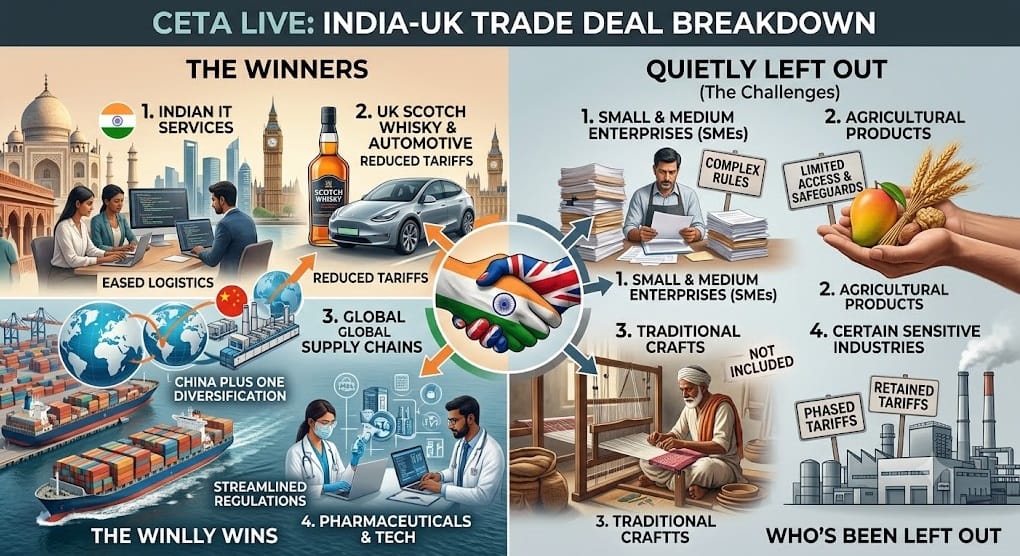
So, Who Really Wins?
Strip away the diplomatic language, and the honest answer is: it depends which seat you’re sitting in.
- Large exporters and services firms on both sides are the clearest winners — they get bigger markets and lower costs almost immediately.
- Scotch whisky producers and luxury carmakers have landed one of the best market-access wins of any recent UK trade deal.
- Indian textile, leather, and marine exporters, along with MSMEs, gain a genuine competitive opening in a large, wealthy market.
- Farmers on both sides are the most exposed. Indian dairy and cereal farmers are shielded — for now — by the sectors India kept off the table. But UK dairy farmers have been given no equivalent protection, and their industry body has said so publicly.
- Consumers get modest, gradual gains — some imported goods will get cheaper over years, not overnight, as tariff cuts are phased in rather than applied all at once.
The UK government’s own estimate is that the deal adds about £4.8 billion a year to UK GDP in the long run — a meaningful but not transformative number, and larger than the boost from comparable post-Brexit deals with Australia or New Zealand. India hasn’t published an equivalent GDP estimate, but has framed the deal around jobs and export competitiveness rather than headline growth figures.
The Bottom Line
The India-UK FTA is a genuine milestone — the product of 14 rounds of negotiation and three years of political will on both sides. But like most trade deals, its benefits are unevenly distributed. Big exporters, premium brands, and mobile professionals stand to gain quickly and visibly. Smallholder farmers, on both sides of the deal, are watching from the sidelines — protected in India’s case, exposed in Britain’s.
Whether “who benefits” changes over the coming decade will depend less on the text of the agreement and more on how each government manages the sectors it chose to protect — and how long it can keep protecting them.
Have questions about how this deal affects a specific industry? Write to us at Digital Waves News and we’ll dig into it.