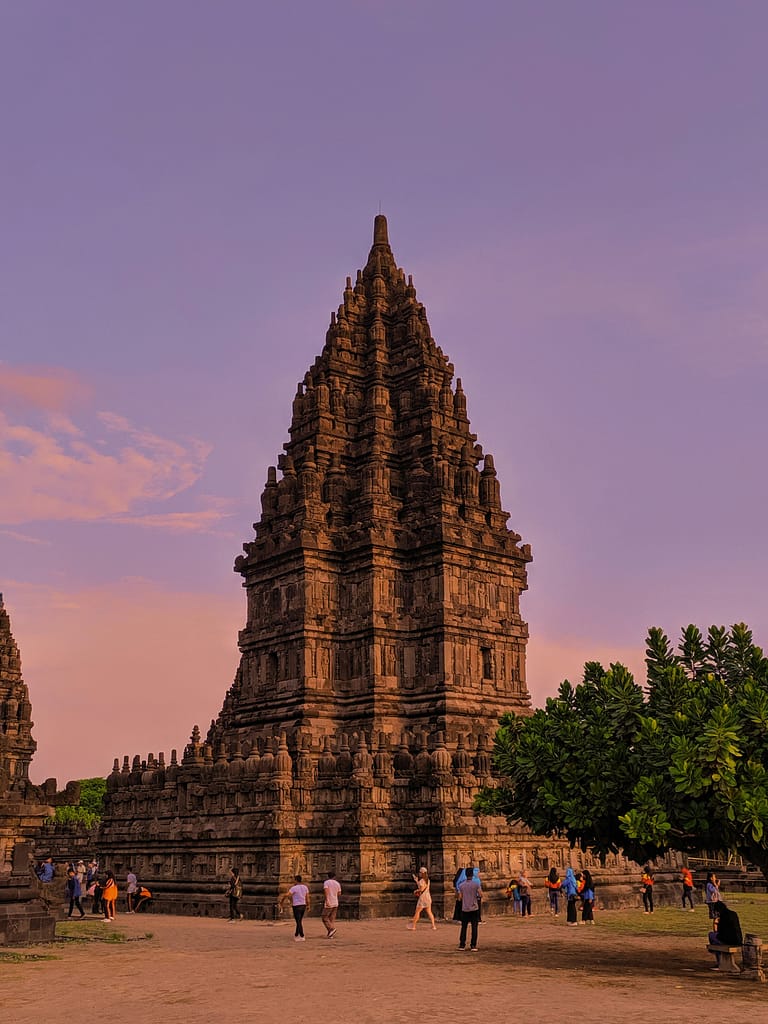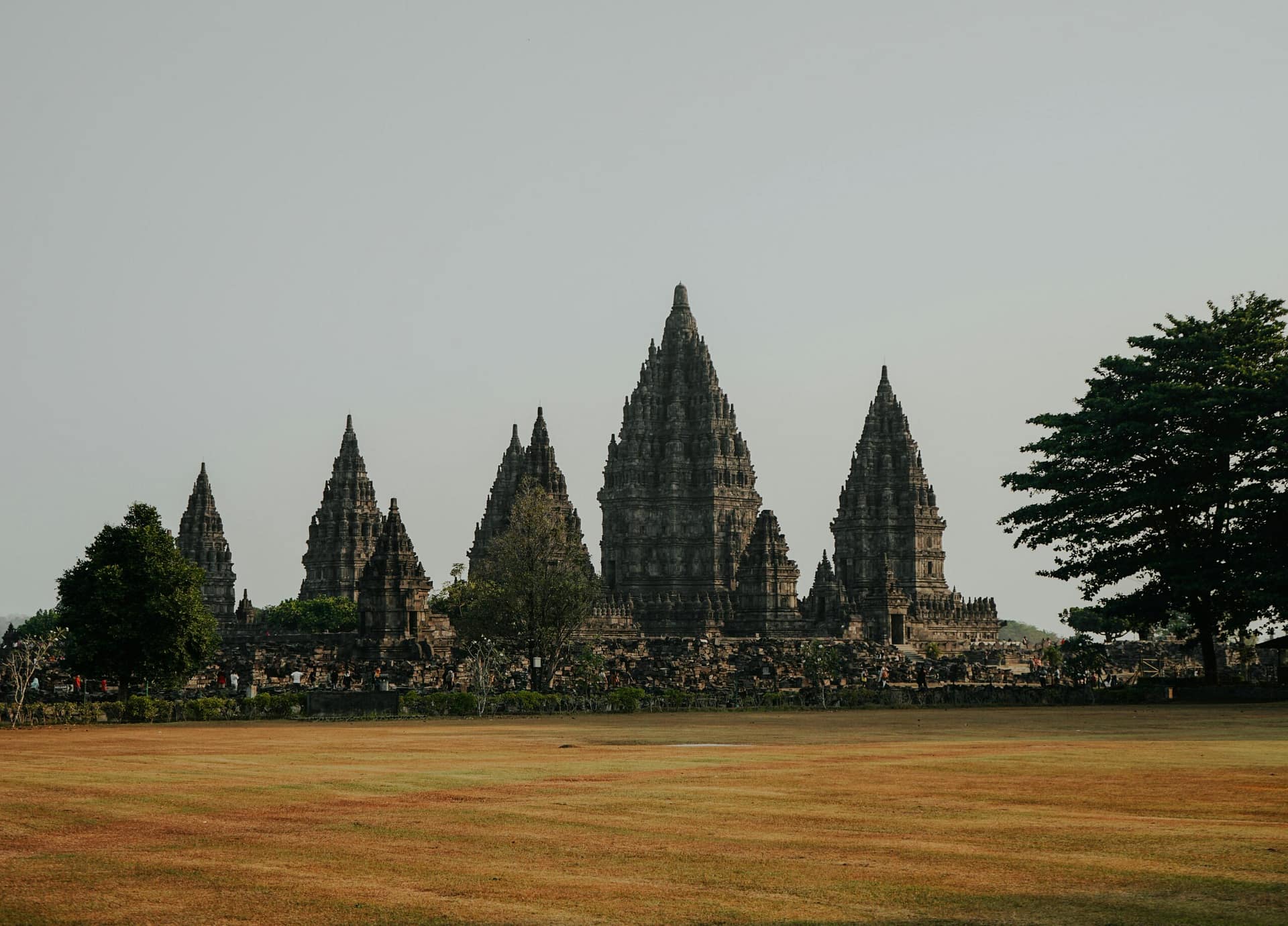
Just 17 kilometers northeast of Yogyakarta, a cluster of soaring stone spires pierces the Javanese skyline — the last great monument of a Hindu civilization that once flourished across the Indonesian archipelago. This is Prambanan, the largest Hindu temple complex in Indonesia and one of the most extraordinary surviving examples of classical Hindu architecture anywhere in Southeast Asia. Its story — and the broader story of how Hinduism took root in Indonesia at all — is one of trade, diplomacy, and cultural exchange rather than military conquest.
What Is Prambanan Temple?
Prambanan, also known locally as Candi Prambanan or Roro Jonggrang (“Slender Maiden”), sits on the border of the Special Region of Yogyakarta and Central Java. It is officially recognized as a UNESCO World Heritage Site and stands as the second-largest Hindu temple complex in Southeast Asia, surpassed only by Cambodia’s Angkor Wat.
At its heart is the towering Shiva Temple, rising 47 meters into the sky — five meters taller than the famous Buddhist stupa of Borobudur nearby. The temple was originally dedicated to Shiva under the name Siwagrha, meaning “House of Shiva,” a name recorded in the Siwagrha Inscription of 856 CE.
Who Built Prambanan — and Why?
Construction began around 850 CE under King Rakai Pikatan of the Ancient Mataram (Medang) Kingdom, with later expansions carried out by his successors, including King Lokapala and King Balitung. Pikatan belonged to the Hindu Sanjaya dynasty, historic rivals of the Buddhist Sailendra dynasty, which had built Borobudur just 19 kilometers away only decades earlier.
Many historians interpret Prambanan as a deliberate statement — a Hindu revival monument built to mark the Sanjaya dynasty’s return to power after a long period of Sailendra-led Buddhist dominance in Central Java. Whether or not it was a direct architectural “answer” to Borobudur, the two monuments today stand as twin symbols of Java’s rich Hindu-Buddhist past.
Inside the Temple: Architecture and Design
Prambanan originally comprised 240 individual temples, arranged in concentric courtyards that reflect Hindu cosmology and the sacred geometry of Mount Meru. At the center stand three principal shrines dedicated to the Hindu Trimurti:
- Shiva Temple — the tallest and most sacred, housing statues of Shiva, the goddess Durga, the elephant-headed Ganesha, and the sage Agastya
- Brahma Temple — dedicated to the creator god, decorated with reliefs from the Ramayana
- Vishnu Temple — dedicated to the preserver god, featuring scenes from the Krishnayana
Three smaller temples honor the animal vehicles of these gods — Nandi the bull for Shiva, the swan for Brahma, and Garuda the eagle for Vishnu. Intricate stone reliefs throughout the complex narrate the Ramayana in extraordinary detail, offering one of the finest visual records of the epic anywhere in the Hindu world.
Decline, Ruin, and Rediscovery
By the 10th century, Java’s political center had shifted eastward, and Prambanan was gradually abandoned. Centuries of earthquakes, eruptions from nearby Mount Merapi, and encroaching jungle reduced much of the complex to rubble.
The site resurfaced in written colonial records in 1733, though local communities had never entirely forgotten it — preserving its memory through the enduring legend of Roro Jonggrang. Formal restoration began in the late 19th century, accelerated in 1918, and was interrupted by the Japanese occupation during World War II. A landmark moment came in 1953, when the restored Shiva Temple was formally inaugurated by Indonesia’s first president, Sukarno. Restoration continues to this day, particularly following damage from the 2006 Yogyakarta earthquake.
In 1991, UNESCO inscribed Prambanan as a World Heritage Site, cementing its status as one of the great monuments of world religious architecture.
How Did Hinduism Actually Reach Indonesia?
Prambanan raises an obvious question: how did a Hindu kingdom come to rule part of Java in the first place? Did Indian armies conquer the archipelago?
The historical record says no. There is no credible evidence that Indian emperors — not Ashoka, not the Guptas, not any dynasty — ever militarily conquered or colonized Indonesia. Instead, historians describe a centuries-long process known as “Indianization”: the voluntary adoption of Indian religion, language, and political ideas by local Southeast Asian rulers who found them useful and prestigious.
Trade Came First
Beginning around the 1st century CE, Indian merchants — particularly from Tamil Nadu, Odisha, Andhra Pradesh, and Gujarat — sailed the monsoon winds across the Bay of Bengal to Indonesian ports, trading spices, textiles, and precious stones. Many settled permanently, married into local communities, and became part of the social fabric of coastal trading towns.
Brahmin Priests Legitimized Local Kings
The most widely accepted scholarly theory holds that Brahmin scholars were the primary vehicle for Indianization. Traveling along routes already opened by traders, these priests offered local rulers something valuable: religious legitimacy. By performing Hindu coronation rituals and framing kings as earthly representatives of divine order, Brahmins gave Southeast Asian rulers a powerful new tool of statecraft — one that came without demanding territorial submission to any Indian throne.
Notably, while local elites eagerly adopted Sanskrit titles, Hindu law, and temple-building traditions, ordinary Indonesians never adopted the Indian caste system — clear evidence that this was cultural borrowing by choice, not colonization.
Buddhist Monks Traveled the Same Routes
Buddhism spread through Indonesia alongside Hinduism, often via the same trade networks and sometimes patronized by the very same royal families. This is precisely why Java is home to both the Hindu Prambanan complex and the Buddhist Borobudur monument, built within decades of each other by rival dynasties.
Local Kings Drove the Process Themselves
Perhaps the most important point historians emphasize: Indonesian rulers were not passive recipients of Indian culture — they were active adopters. Kingdoms such as Kutai (4th century), Tarumanagara, Kalingga, Mataram, Srivijaya, and later Majapahit all incorporated Indian religious and political models while remaining entirely independent, Indonesian-ruled states.
Was There Ever Direct Contact Between Indian and Indonesian Rulers?
Trade and religious exchange connected the two regions for centuries, and diplomatic contacts and traveling scholars are well documented — the Chinese monk Yijing, for instance, famously studied at Srivijaya before continuing on to India’s Nalanda university.
There is, however, one notable exception to the “no conquest” rule: in the 11th century, the Chola dynasty of South India launched naval raids against the Srivijaya empire in Sumatra, briefly capturing its king in a bid to control lucrative maritime trade routes through the Malacca Strait. The Cholas withdrew afterward without establishing lasting rule, making this a rare military episode rather than the norm — and it remains the closest history comes to direct Indian-Indonesian royal conflict.
Why Hindu Culture Still Echoes Through Modern Indonesia
Although Indonesia is now the world’s largest Muslim-majority nation — following the gradual, trade-driven spread of Islam from the 13th to 16th centuries — Hindu heritage remains deeply woven into national identity:
- Bali remains predominantly Hindu to this day
- Indonesia’s national airline is named Garuda Indonesia, after Vishnu’s mythical mount
- The Garuda appears on Indonesia’s national emblem
- Wayang Kulit shadow puppetry continues to stage the Ramayana and Mahabharata
- The Ramayana Ballet is performed regularly beside the Prambanan complex, exactly where it was first staged for royal audiences centuries ago
The Legend of Roro Jonggrang
No account of Prambanan is complete without its most famous legend. According to Javanese folklore, Prince Bandung Bondowoso demanded to marry Princess Roro Jonggrang, who agreed only if he could build a thousand temples in a single night using supernatural spirits. As he neared completion, the princess tricked the spirits into believing dawn had broken by having villagers light fires and pound rice early — the spirits fled, leaving exactly 999 temples finished. Enraged at the deception, the prince cursed Roro Jonggrang, turning her to stone. Local tradition holds that the Durga statue inside the Shiva Temple is the princess herself, forever transformed.
Final Word
Prambanan is far more than a tourist landmark — it is physical proof of one of history’s most remarkable examples of cultural diffusion without conquest. Indian merchants, Brahmin priests, and Buddhist monks carried ideas, not armies, across the Indian Ocean, and Indonesian kings built entire civilizations on the foundations those ideas provided. More than a thousand years later, Prambanan’s towering spires still stand as a monument to that exchange — a uniquely Indonesian expression of a shared Asian heritage.
Quick Facts: Prambanan Temple
| Feature | Details |
| Location | Border of Yogyakarta & Central Java, Indonesia |
| Built | c. 850 CE |
| Founder | King Rakai Pikatan, Sanjaya Dynasty |
| Original Name | Siwagrha (“House of Shiva”) |
| Main Deity | Lord Shiva |
| Height of Main Temple | 47 meters |
| Original Number of Temples | 240 |
| UNESCO Status | World Heritage Site (inscribed 1991) |