


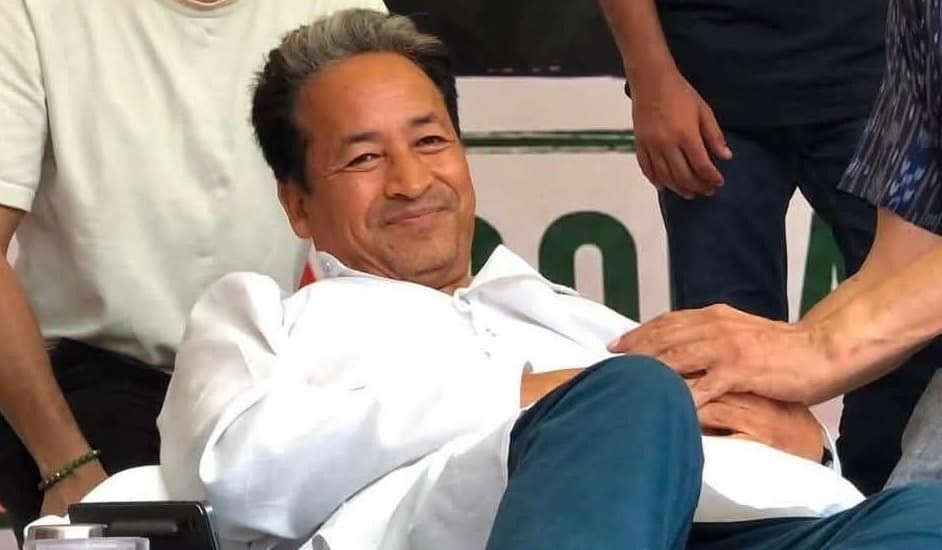
A climate activist demands Education Minister Dharmendra Pradhan’s resignation over alleged NEET paper leak and exam irregularities; doctors report continued weight loss and falling blood pressure
New Delhi: Educator and climate activist Sonam Wangchuk is continuing his indefinite hunger strike at Delhi’s Jantar Mantar, with the protest now stretching well into its third week and his health showing signs of steady decline, according to medical bulletins issued by attending doctors.
What Is Happening at Jantar Mantar
The sit-in protest, organised by the Cockroach Janta Party (CJP), began on June 20 over allegations of examination irregularities and paper leaks, including the NEET-UG paper leak controversy. Wangchuk joined the demonstration on June 28, launching his own indefinite fast in solidarity with students and volunteers demanding accountability from the government.
The core demand of the protest is the resignation of Union Education Minister Dharmendra Pradhan, whom organisers hold responsible for what they describe as systemic mismanagement of national competitive exams. CJP founder Abhijeet Dipke has been a central figure alongside Wangchuk, with the outfit also issuing an open letter urging Prime Minister Narendra Modi to intervene.
Wangchuk’s Health Under Close Watch
Medical bulletins shared by CJP show Wangchuk’s condition has worsened steadily since the fast began:
- By the ninth day of his fast, Wangchuk had lost around 6.9 kg, with blood pressure recorded at 107/67 mm Hg and blood glucose at 72 mg/dL.
- By his 16th day, weight loss had climbed to 8.2 kg, with blood glucose dropping further to 67 mg/dL and blood pressure at 107/70 mm Hg.
Doctors say they are conducting periodic check-ups so that emergency intervention can be taken quickly if his condition deteriorates further. Wangchuk has said his hunger has “stabilised” after the initial days of the fast but has acknowledged feeling progressively weaker.
Other Protesters Also Affected
Wangchuk is not the only one fasting at the protest site. Several members of the CPI(ML) Liberation-affiliated All India Students’ Association (AISA) have been holding a parallel indefinite hunger strike on a separate stage at Jantar Mantar. JNU Students’ Union joint secretary Danish Ali and AISA activist Hrishikesh Talukdar were both hospitalised after their health deteriorated during the strike, underlining the toll the extended protest is taking on participants.
“I Am No Modern Gandhi,” Says Wangchuk
Distancing himself from the hero status many supporters have given him, Wangchuk described himself as “just an ordinary citizen” and urged people not to wait for leaders to act on their behalf. He linked the protest to student suicides that CJP has attributed to alleged examination irregularities, appealing to the public to participate rather than remain spectators.
He has also called on citizens to join a planned march to Parliament on July 20, aimed at pressing lawmakers to raise the protesters’ demands directly. “You don’t have to remain hungry for 24 days like us. Come after having your meal, but take responsibility as citizens and join us,” he said.
Political and Public Response
The protest has drawn visits and statements of support from opposition leaders. An AAP delegation led by former Delhi Chief Minister Atishi visited the site, while CPI(M) MP Amra Ram and senior party leaders from Andhra Pradesh and Rajasthan also extended their backing. CJP has also raised concerns about alleged surveillance of women volunteers at the protest site by police personnel.
Background: Wangchuk’s History of Hunger Strikes
This is far from Wangchuk’s first hunger strike. The Ladakh-based innovator — whose life partly inspired the character Phunsukh Wangdu in the Bollywood film 3 Idiots — has previously undertaken multiple extended fasts demanding statehood for Ladakh and its inclusion under the Sixth Schedule of the Constitution, including a 21-day fast in Leh in March 2024 and a 35-day fast in Leh in 2025 that was called off amid violent unrest. Those protests eventually led to an in-principle agreement between the Ministry of Home Affairs and Ladakh leaders on constitutional safeguards.
His decision to now front a protest over national examination reforms marks a shift in focus from regional to national issues, further raising his profile as one of India’s most prominent civil-society protest leaders.
What’s Next
With no resolution yet from the government and Wangchuk’s health continuing to decline, pressure is mounting on the Centre to respond. The proposed July 20 march to Parliament is expected to be a key flashpoint in the coming days, as organisers seek to widen public participation and force a political response.
This is a developing story. Follow our channel for the latest updates on Sonam Wangchuk’s hunger strike and the Jantar Mantar protest.