


Introduction
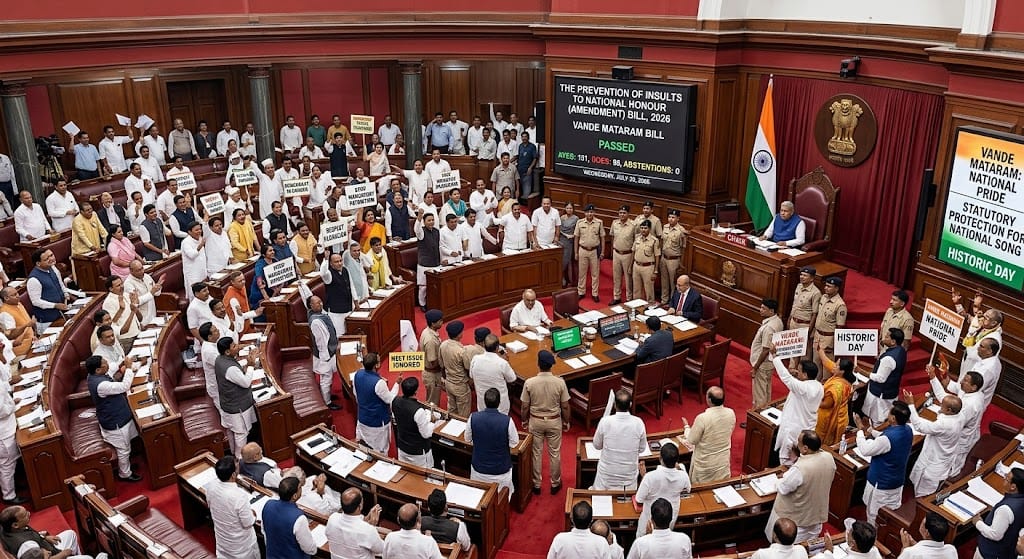
The Rajya Sabha on Wednesday, July 29, 2026, passed the Prevention of Insults to National Honour (Amendment) Bill, 2026 — popularly known as the Vande Mataram Bill. Piloted by Union Home Minister Amit Shah, the bill places India’s National Song on the same legal footing as the National Anthem, National Flag, and Constitution. It passed by voice vote after opposition protests and a walkout.
What’s In the Bill
It amends the Prevention of Insults to National Honour Act, 1971 — the law that already criminalizes disrespect toward the National Flag, the Constitution, and the National Anthem — to extend the same protection to Vande Mataram.
- Criminal penalty: Anyone who intentionally obstructs, disturbs, or insults the singing of Vande Mataram at an official gathering can now face prosecution.
- Punishment: Up to three years’ imprisonment, a fine, or both — matching the penalty for disrespecting the National Anthem.
- Full version encouraged: The bill promotes singing the complete six-stanza version at official occasions, not just the commonly used first two stanzas.
- Legal parity: The government calls this an extension of existing protections, not a new offence.
How the Vote Unfolded
The bill was taken up after two adjournments earlier in the day. Opposition parties protested and raised slogans, demanding a response from Amit Shah over police action against NEET paper-leak protesters in Delhi. Deputy Chairman Harivansh Narayan Singh pressed ahead despite the disruptions, and opposition MPs later staged a walkout. Replying to the debate, Minister of State Nityanand Rai defended the bill and accused the Congress of “appeasement politics” in opposing it. It passed by voice vote, and the House adjourned till 11 am Thursday.
Why the Government Introduced It
The government says the goal is to reinforce respect for national symbols and close a legal gap — extending protections that already apply to the flag, Constitution, and anthem. Supporters say it will promote patriotism and deter disrespect toward India’s cultural legacy.
Why It’s Controversial
- Constitutional concerns: Critics argue the bill blurs a distinction that’s traditionally existed between the Anthem and the National Song, which never carried identical legal status.
- Religious freedom angle: The song’s later stanzas invoke Hindu goddess imagery — part of why only the first two stanzas became standard for public use. Critics worry pushing the full version could sit uneasily with religious-freedom guarantees for citizens of other faiths.
- Political sparring: Opposition members pointed to past incidents of disrespect toward national symbols and questioned the ruling party’s freedom-movement credentials; the BJP defended the bill as strengthening respect for the song.
How Big a Deal Is This, Really?
For everyday citizens, the practical impact is narrow — it mainly adds criminal penalties for disrupting or insulting Vande Mataram at official events. It doesn’t touch the economy, welfare, or daily governance. Its real significance is symbolic and political: elevating a song central to India’s independence movement while reigniting debate over religious inclusivity and how far the law should go in legislating patriotism.
Bottom Line
With the Rajya Sabha’s approval on July 29, the bill has cleared one of the two houses of Parliament it needs before becoming law.