


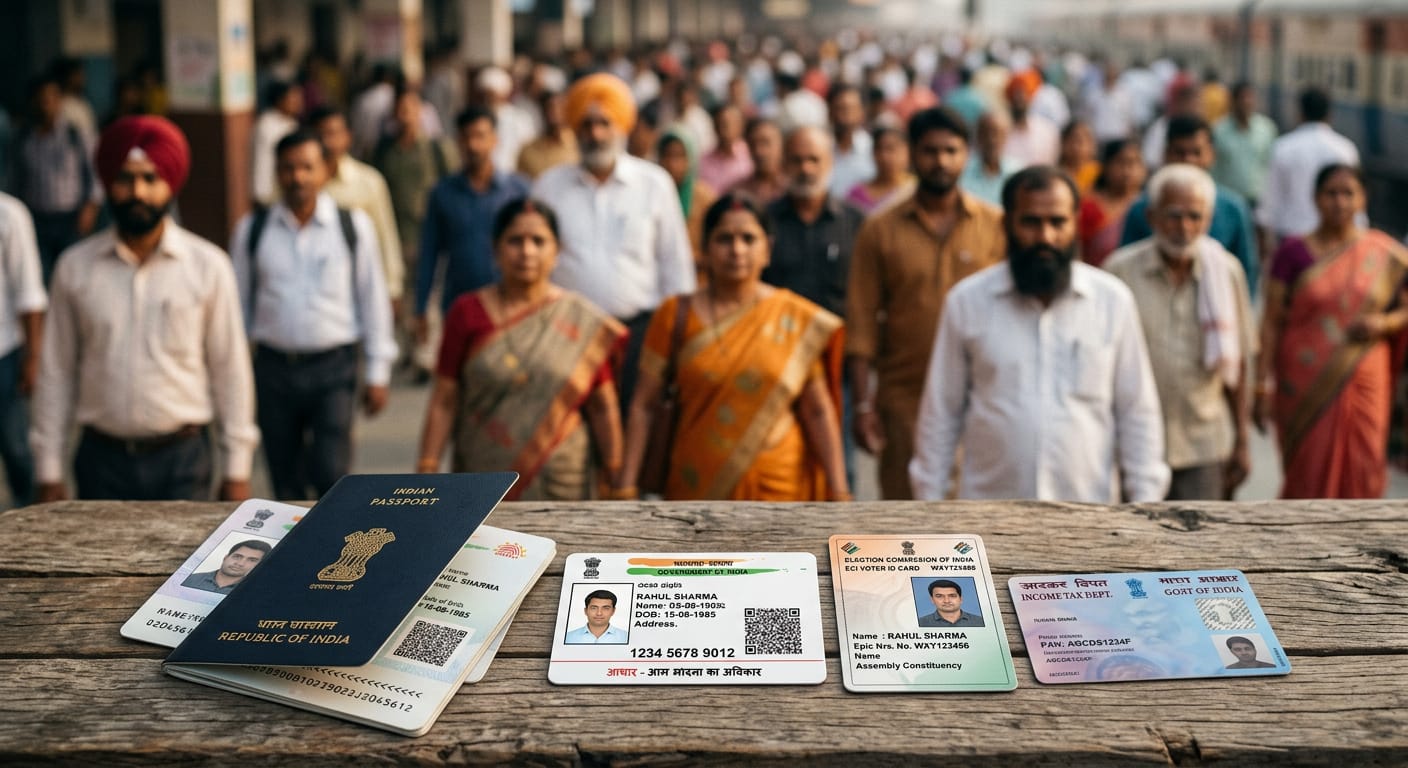
Introduction: A Question That Should Never Have Been Asked
You were born here. Your parents were born here. You have an Aadhaar card, a ration card, a voter ID, and a passport. You vote in every election. You pay your taxes.
And yet, in 2026, the Government of India has officially confirmed: none of these documents conclusively prove that you are an Indian citizen.
Not your passport. Not your Aadhaar. Not your voter ID.
This is not a rumour. It is the legal position of the Ministry of External Affairs, confirmed publicly in June 2026, and upheld by the Supreme Court of India in May 2026.
For millions of ordinary Indians — the poor, the elderly, the rural, the daily wage worker — this is not just a legal technicality. It is a deeply unsettling question: If I cannot prove my citizenship, what happens to me?
This article explains, in plain language, exactly what is happening, why it is happening, and what it means for you.
Part 1: What Just Happened — The June 2026 Controversy
In June 2026, the Ministry of External Affairs made a statement that sent shockwaves across India: an Indian passport is a travel document, not proof of citizenship.
The statement came in the context of the Special Intensive Revision (SIR) — an exercise by the Election Commission of India to verify and update electoral rolls across the country. As part of this exercise, citizens were being asked to produce documents to establish their eligibility to vote.
When people asked whether their passport was enough, the government’s answer stunned them: legally, no.
The Supreme Court, in its judgment of 27 May 2026, upheld the constitutional validity of the SIR, while limiting the Election Commission’s role to determining eligibility for electoral rolls — not citizenship itself.
The reaction was immediate and nationwide. If your passport — the document you show to foreign governments to prove you are Indian — does not prove you are Indian in your own country, then what does?
Part 2: What the Law Actually Says
The Citizenship Act, 1955
Indian citizenship is governed by the Citizenship Act, 1955 — not by Aadhaar, not by the Passports Act. The law defines who is a citizen based on the circumstances of birth:
Born before 1 July 1987:
You are automatically an Indian citizen by birth, regardless of your parents’ nationality. No conditions apply.
Born between 1 July 1987 and 3 December 2004:
You are a citizen if at least one parent was an Indian citizen at the time of your birth.
Born after 3 December 2004:
You are a citizen only if both parents are Indian citizens, or one parent is a citizen and the other is not an illegal migrant.
What Your Documents Actually Prove
| Document | What It Proves | What It Does NOT Prove |
|---|---|---|
| Aadhaar Card | Identity and residence | Citizenship |
| Voter ID | Prior registration on electoral rolls | Citizenship |
| Passport | Entitlement to travel | Citizenship (conclusively) |
| Ration Card | Residence and family unit | Citizenship |
| PAN Card | Tax identity | Citizenship |
| Birth Certificate | Date and place of birth | Citizenship (on its own) |
The honest truth, as confirmed by the government itself: India does not currently have a universal, standardised citizenship document available to every citizen. This gap has existed for decades. The current debates are simply making it visible.
Part 3: Then What DOES Prove Citizenship?
According to the Citizenship Act, courts, and administrative precedent, citizenship is established through a combination of documents, not one single paper. These include:
- Birth certificate showing you were born in India
- Parents’ birth certificate or school records establishing their Indian origin
- School leaving certificate or educational records showing your name, place of birth, and years of study in India
- Legacy documents — older voter ID entries (pre-1971 for Assam; varies elsewhere), land records, and census slips showing your family’s presence in India over generations
- Domicile certificate issued by state governments
- Naturalisation or registration certificate (for those who acquired citizenship through those routes)
The stronger the combination, and the deeper the paper trail of your family’s roots in India, the more conclusively citizenship can be established.
Part 4: The NRC — What It Is and Why It Frightens People
What Is the NRC?
The National Register of Citizens (NRC) is meant to be an official list of all legal Indian citizens. Its stated purpose is to identify and separate illegal immigrants from genuine citizens.
The NRC was first prepared in 1951 after Partition. In recent years, the government proposed updating it — first in Assam, and eventually across all of India.
The Assam NRC — A Warning
The only state where the NRC exercise has been completed is Assam. The results were deeply troubling:
- After years of effort, Supreme Court supervision, and ₹1,500 crore in public money spent, the final draft was published in August 2019.
- 19.06 lakh people — out of 3.29 crore applicants — were left out.
- Of those excluded, a large number were Bengali-speaking Hindus — the very community the exercise was supposedly designed to protect.
- The NRC draft was so widely criticised — by both supporters and opponents of the exercise — that it remains in legal limbo to this day, with the final register still not officially published.
Former Chief Election Commissioner S Y Quraishi has noted that scaling the Assam exercise to India’s full population of 145 crore would be an almost unimaginably complex and expensive undertaking.
The Nationwide NRC
The BJP included a promise to implement the NRC nationwide in its 2019 election manifesto. Home Minister Amit Shah declared in the Rajya Sabha that NRC would be extended to the entire country. However, as of 2026, a nationwide NRC has not been implemented. The Centre has also clarified it will not update the National Population Register (NPR) during Census 2027 — the NPR being the first step in the NRC process.
Part 5: The CAA — How It Connects
The Citizenship Amendment Act, 2019 (CAA) amended the Citizenship Act to provide a fast-track route to Indian citizenship for persecuted minorities — Hindus, Sikhs, Buddhists, Jains, Parsis, and Christians — who migrated from Pakistan, Bangladesh, and Afghanistan before 31 December 2014.
The CAA reduces the required period of residence in India for citizenship from 11 years to 5 years for these groups.
Why the CAA + NRC Combination Alarmed People
Taken individually, each policy has a stated rationale. But critics — including constitutional scholars, former bureaucrats, and civil society groups — pointed out that together, NRC and CAA create a troubling combination:
- NRC could potentially exclude millions of Indians who lack documents.
- CAA provides a path back to citizenship for non-Muslims from three specific countries.
- Critics feared this combination could be used to selectively disenfranchise Muslim citizens who fail to produce documents, while offering a safety net to others.
Supporters argued that NRC is about identifying illegal immigrants and has nothing to do with religion, and that CAA is a humanitarian measure for persecuted minorities.
The debate remains deeply divided along political and community lines.
Part 6: How This Affects Ordinary People — Real Consequences
The Document Problem
The core issue is brutally practical. Proving citizenship through a combination of documents sounds reasonable — until you consider who actually has those documents.
Elderly people — especially women — in rural India often have no birth certificate. Births were recorded by memory, not by the state. Many women were married young and moved to their husband’s village, losing whatever records existed.
Daily wage workers and migrant labourers move constantly. Their children may be born in one state, educated in another, and working in a third. Tracing a paper trail of residency and origin across decades is nearly impossible.
Flood-prone and disaster-hit regions — Assam, Bihar, parts of Bengal and Odisha — have seen entire villages lose their documents to floods, fires, and displacement. For these families, “produce your father’s school certificate” is not a bureaucratic inconvenience. It is an impossible demand.
Urban slum dwellers may have Aadhaar and a ration card, but may lack older legacy documents that prove their family’s roots in the country — especially if they or their parents migrated from rural areas decades ago.
The Human Cost in Assam
The Assam NRC experience showed what this looks like in practice. People who had voted in every election, whose children served in the Indian Army, found themselves on the wrong side of a list because they could not produce the right combination of documents. Detention centres were established. Families were split. The psychological toll on entire communities — the anxiety of not knowing whether you would be declared stateless in your own homeland — was enormous.
The Shame You Feel Is Not Yours
Millions of Indians feel it today — the quiet humiliation of being asked to prove, in their own country, that they belong here. That shame is real. But it was never yours to carry. It belongs to a system that spent decades issuing documents to its people, and then turned around and said none of them are enough. It belongs to a government that made citizens feel like strangers in their own homeland. The shame is collective — and it sits squarely on the failure of the state, not on the shoulders of the people it was built to serve.
A citizen who has lived, worked, paid taxes, and voted in India for their entire life should not need to excavate documents from three generations ago to prove they belong here. The emotional weight of this demand falls disproportionately on those who are already the most vulnerable.
Part 7: Where Things Stand in 2026
- The Special Intensive Revision (SIR) of electoral rolls is currently underway. The Election Commission has clarified that passports continue to be accepted as supporting documents for voter registration — but the debate around what conclusively proves citizenship remains open and unresolved.
- A High Level Committee on Demographic Changes was constituted by the Union Government in May 2026. Its mandate includes examining citizenship-related issues, and its eventual recommendations could shape the future of any NRC-type exercise.
- The Supreme Court’s judgment of May 2026 upheld the SIR while limiting its scope, but did not resolve the deeper question of what document proves citizenship for ordinary Indians.
- The government has confirmed it will not update the NPR during Census 2027, effectively pausing — at least temporarily — the first administrative step toward a nationwide NRC.
Part 8: What Should India Do?
Many experts, across the political spectrum, agree on one thing: India needs clarity, not confusion.
The country has spent decades issuing documents — Aadhaar to 140 crore people, passports to crores more, voter IDs to nearly every adult — and then turned around and said that none of them is conclusive proof of the most fundamental status of all: being an Indian.
A credible path forward, as suggested by constitutional experts and former bureaucrats, would involve:
- Making the birth certificate the universal foundation of all identity, properly implemented through the Registration of Births and Deaths Act, 1969.
- Creating a clear, standardised citizenship document that is accessible to every Indian, rather than relying on a confusing combination of records that disadvantages the poor and the old.
- Ensuring any NRC-type exercise is conducted with iron-clad safeguards against wrongful exclusion, with a clear and accessible appeals process.
- Transparency about the government’s actual intentions — whether a nationwide NRC is being planned, and on what timeline — so that citizens can prepare rather than live in anxiety.
Conclusion: Your Citizenship Is Real. The System Needs to Catch Up.
If you were born in India before 1 July 1987, the law recognises you as a citizen unconditionally. If you were born between 1987 and 2004, you are a citizen as long as at least one parent was Indian. Your citizenship is real, even if the paperwork that proves it is not as simple as it should be.
But you are right to be angry. In a country of 145 crore people — many of them poor, many of them old, many of them displaced — demanding that every individual prove citizenship through a bureaucratic paper trail is not just impractical. It is unjust.
India’s cities have expanded vertically. Its population has grown and moved and changed. And somewhere along the way, the system that was supposed to serve citizens began asking citizens to serve it — to prove, document by document, what they have always known: that they are home.
That is a blunder. And ordinary Indians deserve better.
This article is for educational and informational purposes. It does not constitute legal advice. If you have specific concerns about your citizenship status, please consult a qualified legal professional.