


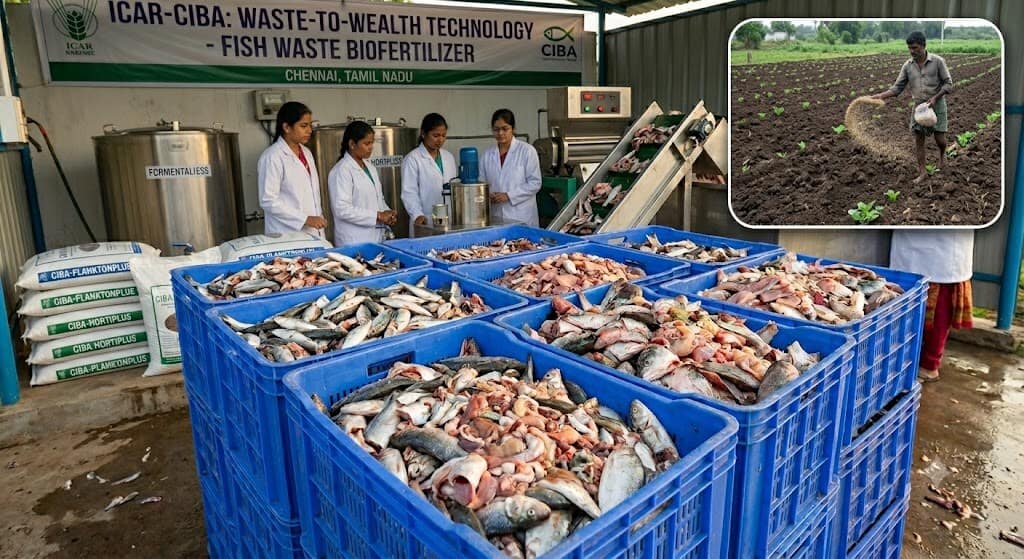
ICAR-CIBA Chennai has developed two fish waste-based biofertilisers — CIBA-PlanktonPlus and CIBA-HortiPlus — offering a sustainable, cost-effective alternative to chemical fertilisers amid a global fertiliser crisis.
Introduction
As the world grapples with soaring fertiliser prices and growing concerns over chemical-intensive farming, scientists in Chennai have found an unlikely solution — fish waste. The Indian Council of Agricultural Research – Central Institute of Brackishwater Aquaculture (ICAR-CIBA) has developed two innovative biofertiliser products entirely from fish market waste, offering farmers a sustainable and affordable alternative to conventional chemical fertilisers.
The Products: CIBA-PlanktonPlus and CIBA-HortiPlus
ICAR-CIBA has developed two distinct products from fish waste:
CIBA-PlanktonPlus is a value-added product developed from fish waste and trimmings using a unique technology that helps maintain healthy phytoplankton and zooplankton blooms in shrimp and fish culture ponds while also aiding in efficient feed management.
CIBA-HortiPlus is a nutrient-rich organic manure developed from processed fish waste. Field trials showed that applying 1.5 to 2.0 tonnes per hectare increased potato yields by up to 23.8 per cent and effectively replaced 100 to 150 kg of DAP fertiliser per hectare, while simultaneously improving soil fertility and enhancing mineral content.
Addressing India’s Fish Waste Problem
India’s fishing industry generates an enormous amount of waste that has long been an environmental burden. India currently produces nearly 195 lakh tonnes of fish annually, generating more than 60 lakh tonnes of fish waste. Scientists estimate this untapped resource has the potential to produce approximately 48 lakh tonnes of CIBA-PlanktonPlus and 3 lakh tonnes of CIBA-HortiPlus every year – transforming a major environmental burden into a valuable agricultural input.
Proven Results in the Field
The biofertilisers have demonstrated strong results across multiple crops. Field trials in paddy and vegetable crops showed substantial reductions in chemical fertiliser use without compromising productivity. Foliar application of CIBA-PlanktonPlus enabled significant savings in nitrogen fertiliser (urea) in paddy cultivation, while vegetable crops, including beans, spinach, cabbage, cauliflower, and beetroot recorded notable yield improvements.
Empowering Coastal Communities
Beyond agriculture, this technology is also transforming livelihoods. The Nambikkai Fisher Group in Pattinapakkam, Chennai, established a startup fish waste processing unit in 2019 with technical support from ICAR-CIBA. The group earned ₹15 lakhs per year from this technology between 2019 and 2021, generating employment for more than 40 coastal families. More than 355 fisherfolk and farmers were trained in recycling fish waste into value-added products.
The technology has since spread across the country. ICAR-CIBA’s PlanktonPlus technology helps promote zero-waste fish markets, uplifts the livelihood status of fisherfolk, and supports the Swachh Bharat Mission.
A Win-Win for Agriculture and the Environment
This innovation addresses two pressing challenges simultaneously — the responsible disposal of fish waste and the urgent need for eco-friendly fertilisers that reduce India’s dependence on expensive imported chemicals. With global fertiliser prices remaining volatile, CIBA-PlanktonPlus and CIBA-HortiPlus offer Indian farmers a locally produced, scientifically proven, and environmentally responsible alternative.
Source: UNI