


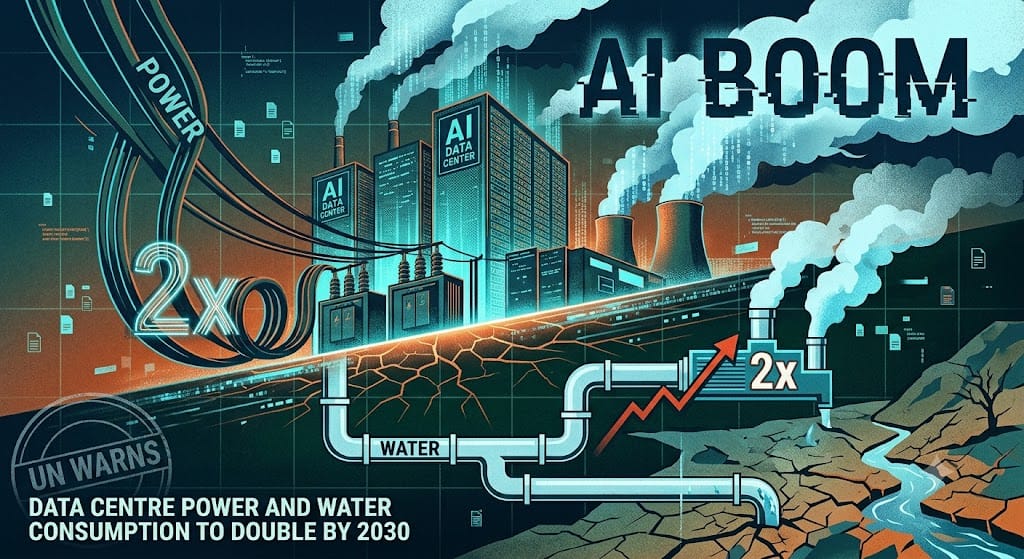
A new UN report warns that AI-driven data centre expansion will double global power and water consumption by 2030, raising urgent concerns about environmental sustainability.
Introduction
Artificial intelligence is no longer just a software revolution — it is rapidly becoming one of the world’s most resource-hungry physical industries. A landmark report by the United Nations University Institute for Water, Environment and Health has sounded the alarm: data centres are on track to consume twice as much power and water by 2030 as they race to meet surging AI demand.
The Scale of the Problem Today
The environmental footprint of data centres is already enormous. Last year, data centres consumed 448 terawatt-hours of electricity globally — more than the entire country of Saudi Arabia — with AI accounting for one-fifth of that total.
The water impact is equally staggering. Data centres consumed 4.5 trillion litres of water in the same period — enough to meet the needs of over 600 million people in Sub-Saharan Africa — while generating 189 million tonnes of CO₂ emissions.
What the Numbers Look Like by 2030
The UN report’s projections paint a stark picture of what unchecked AI expansion could mean for the planet:
Annual power consumption from data centres is projected to double to 945 TWh by 2030 — roughly equivalent to Japan’s entire electricity consumption — with AI’s share rising to 40% of the total. Water consumption is forecast to reach 9.3 trillion litres, while CO₂ emissions are expected to climb to 399 million tonnes.
Land use is also set to expand dramatically. The data centre land footprint is forecast to grow from 6,900 square kilometres last year to over 14,500 square kilometres by 2030.
AI Is Physical Infrastructure, Not Just Software
A core message of the UN report is that policymakers and the public need to rethink how they view AI. As one researcher noted, “The public debate still often treats AI as software, but AI is also physical infrastructure: data centres, electricity generation, cooling systems, transmission networks, chips, minerals, land and water.
Can AI Be Part of the Solution?
There is a silver lining. AI has the potential to improve efficiency by optimising power grids and reducing waste — but overall electricity and water demand is still likely to rise as countries and corporations race to build new capacity.
The report cautions that the drive for growth is currently overshadowing sustainability principles: “Right now, the competition for growing faster than others overshadows the very basic principles of sustainable growth.
The Bottom Line
Unless governments take heed of AI’s rising environmental costs, the rapid rollout of data centres could strain scarce land and water resources and generate mountains of electronic waste, the UN researchers warned.
The message is clear: building for the AI future must go hand-in-hand with building sustainably. Governments, corporations, and urban planners need to factor in energy, water, and land constraints before the next wave of data centre construction begins.
Source: Reuters