


Introduction
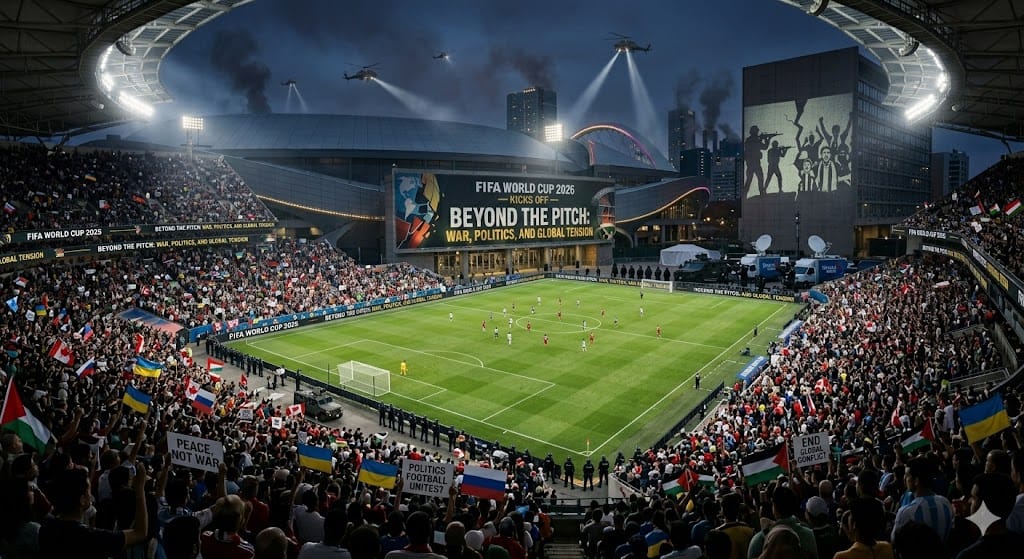
Football has always been more than a sport. But as the 2026 FIFA World Cup prepares to kick off on June 11, the world’s most-watched sporting event is unfolding against a backdrop of unprecedented geopolitical turbulence — armed conflict, fractured alliances, immigration crackdowns, and a deeply divided global order.
The 100-day countdown to the biggest World Cup in history arrived against a chaotic backdrop of global unrest: US-Israeli strikes on Iran, surging violence in Mexico, and mounting anxiety over Donald Trump’s domestic agenda. What was meant to be football’s grandest celebration has become, in many ways, a mirror of the fractured world hosting it.
The Biggest World Cup Ever — At the Worst Possible Time
When the expanded 48-team FIFA World Cup kicks off in North America on June 11, 2026, it will be the largest sporting event ever staged, with matches taking place across the United States, Canada, and Mexico, involving millions of spectators and a global television audience expected to exceed five billion.
A record 48 teams — up from 32 in 2022 — and millions of fans are set to descend on the three host nations. A total of 104 matches will be played across 16 venues and four time zones, with the bulk of the action taking place in the United States, which will host 78 games.
Yet the scale of the event has done little to shield it from global chaos.
Iran: The Tournament’s Biggest Off-Field Question
The most pressing geopolitical story hanging over the World Cup is Iran’s uncertain participation. The US and Israel went to war with Iran, and so far there is no indication that Iran plans to withdraw — whether to boycott or for other reasons. Iran is one of the stronger squads in Asia and is set to play its seventh World Cup this year.
FIFA has confirmed that Iran has relocated its planned World Cup training base from the US to Mexico amid security concerns. Meanwhile, FIFA’s World Cup chief operating officer stated the tournament is “too big” to be postponed due to the global turmoil caused by the US and Israeli war against Iran, saying the situation is being monitored closely and “the World Cup will go on.”
The stakes are extraordinary: there is a real possibility that if both the US and Iran finish second in their respective groups, they could face each other in the round of 32.
Trump’s Shadow: Tariffs, Travel Bans, and ICE at the Gates
The storylines piling up include Iran’s possible non-participation, Trump’s close relationship with FIFA President Gianni Infantino — who awarded Trump the FIFA Peace Prize — and simmering tensions between the US and fellow host nations Mexico and Canada, fuelled by Trump’s tariffs and divisive rhetoric.
Trump’s travel bans could keep some fans out, there has been fury over soaring ticket prices, and Immigration and Customs Enforcement agents could be present at games as the Trump administration continues its anti-immigration crackdown.
Many participating nations have been hit by tariffs. Some are facing travel restrictions. Denmark, which can still qualify through playoffs, has been shaken by Trump’s calls for the US to take over Greenland.
Mexico: Violence, Security, and the Weight of History
The greatest footballing show on earth kicks off on June 11 at Mexico City’s Estadio Azteca and will conclude on July 19 at the 82,500-seater MetLife Stadium just outside New York. But Mexico’s hosting role comes with its own shadows. Security concerns around cartel violence have loomed large, with authorities deploying significant military resources to protect players, officials, and fans throughout the tournament.
Football Has Always Met Politics — But Not Like This
It’s not unusual for international politics to overshadow a global sports event. In 2022, Qatar’s treatment of migrant workers and the LGBTQ+ community drew headlines. In 2018, LGBTQ+ rights, Russia’s annexation of Crimea, and the poisoning of a spy in Britain were in focus. In Brazil in 2014 and South Africa in 2010, concerns centred on crime and security.
But 2026 feels different in scale and intensity. The tournament is unfolding against a geopolitical backdrop that few planners anticipated: a major war in the Middle East involving the United States and Israel against Iran, Iranian retaliation across the region, and an increasingly assertive US foreign policy.
With Washington deeply engaged in a war in the Middle East, calls for symbolic boycotts have begun circulating among political figures and football federations in parts of the Global South and the Middle East.
India’s Angle: A Last-Minute Broadcast Deal
For Indian fans, the tournament brings its own drama. Weeks before the tournament was set to begin, World Cup broadcast rights for India remained completely unresolved, nearly leaving over a billion football fans in the dark. Zee Entertainment ultimately secured rights just 10 days before kick-off in a deal valued at over USD 40 million — covering Unite8 Sports and ZEE5 — a last-minute save that ensures Indian viewers can follow all 104 matches.
Conclusion: Can the Beautiful Game Rise Above the Chaos?
History suggests it can — and perhaps must. The World Cup has survived Cold War boycotts, political protests, and hosting controversies before. At its best, the tournament has a rare power to transcend geopolitics, to put rival nations on the same pitch and let the game speak louder than governments.
But 2026 arrives at a moment when the gap between football’s aspirational unity and the real world’s fractures has rarely felt so wide. Whether the beautiful game can bridge it — even for 39 days — is perhaps the most compelling storyline of all.
Source: UNI