


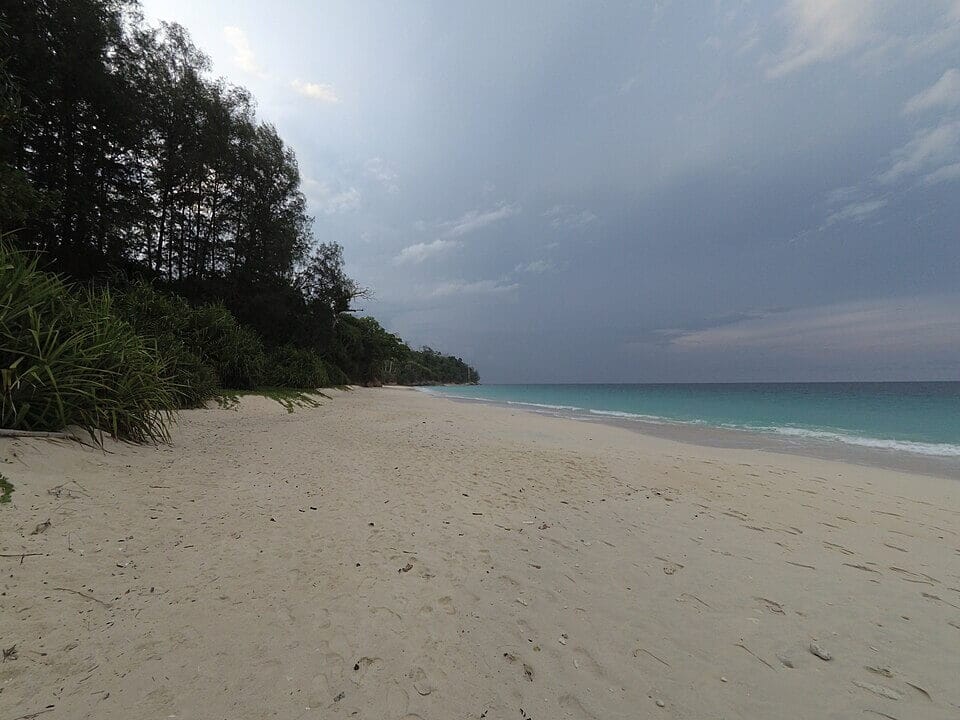
At the southernmost edge of Indian territory, where the Bay of Bengal meets the Andaman Sea, one of the country’s most consequential and contested development projects is taking shape. The Great Nicobar Island Development Project — a ₹72,000–81,000 crore (approximately USD 9–10 billion) megaproject — promises to transform a remote, ecologically rich island into a strategic hub rivalling the world’s great port cities. But the vision comes at a cost that scientists, indigenous rights advocates and environmentalists say India cannot afford.
What Is the Great Nicobar Island Development Project?
Conceptualised by NITI Aayog in March 2021 and officially titled “Holistic Development of Great Nicobar Island”, the project is being implemented by the Andaman and Nicobar Islands Integrated Development Corporation (ANIIDCO). It envisions four major pieces of infrastructure at the island’s southern tip: a deep-water transshipment port at Galathea Bay, a dual-use international airport serving both military and civilian purposes, a gas-and-solar power plant, and a township designed to accommodate up to 650,000 residents. The total project footprint spans approximately 166 sq km — roughly one-fifth of the island’s entire landmass.
India’s Strategic Logic: The China Factor
The project’s driving force is as much geopolitical as economic. Great Nicobar’s location — close to Indonesia’s Sumatra and within a few hundred kilometres of Myanmar, Thailand and Malaysia — places it at one of the most strategically valuable points in the Indian Ocean. The Galathea Bay port is positioned to capture traffic from the Malacca Strait, through which nearly a third of global maritime trade passes annually.
Indian officials have been candid that China’s expanding naval presence in the Indian Ocean underpins the urgency. Some policymakers and analysts have described the vision as creating India’s own “Hong Kong” in the Indian Ocean — a logistics, trade and military node that asserts Indian dominance over the region’s critical sea lanes.
The Environmental Cost: A Million Trees, 130 Square Kilometres of Forest
The scale of ecological disruption proposed is staggering. The project requires the diversion of around 130 sq km of forest land and the felling of nearly one million trees. Great Nicobar is home to dense tropical rainforests and sits within a UNESCO Biosphere Reserve, sheltering rare and endemic species found nowhere else on earth. Conservationists warn that the destruction of this biodiversity hotspot would be effectively irreversible.
The island also lies on one of India’s most seismically active zones. The epicentre of the catastrophic 2004 Indian Ocean tsunami — which killed over 230,000 people across fourteen countries — was only 130 kilometres away. Critics argue that building a township for hundreds of thousands of people in such a zone, without independently verified long-term safety assessments, raises grave questions about the project’s viability.
The Shompen People: A Community in the Crosshairs
Perhaps the most sensitive dimension of the project is its impact on the Shompen, a Particularly Vulnerable Tribal Group (PVTG) who have inhabited Great Nicobar for thousands of years with minimal contact with the outside world. With a population of only a few hundred, the Shompen are among the most isolated indigenous communities on the planet, and experts warn that large-scale contact and habitat disruption could be catastrophic for their survival — both culturally and physically.
Tribal groups who had previously granted consent to the project in November 2022 subsequently withdrew it, alleging that the government had deliberately withheld crucial information about the project’s scope and impact. The withdrawal has added a significant legal and ethical dimension to the debate.
Legal Clearances and Continuing Criticism
India’s National Green Tribunal dismissed petitions challenging the project, ruling that adequate environmental safeguards had been considered. The project has also received forest and coastal regulatory clearances, giving it a legal path forward. However, critics contend that the speed and manner of these clearances bypassed the rigour that a project of this ecological sensitivity demands. Independent scientists have called for a comprehensive, transparent environmental impact assessment reviewed by international experts — something that has not yet taken place.
The Numbers at a Glance
The project’s estimated cost stands between ₹72,000 and ₹81,000 crore. It will affect approximately 130 sq km of forest and require felling close to one million trees. The island currently has a population of roughly 8,000 people; the planned township is designed for 300,000 to 650,000 residents. It is being implemented by ANIIDCO under the broader vision of NITI Aayog.
A Project That Defines India’s Choices
The Great Nicobar Island Development Project is, at its core, a test of how India balances competing national priorities in the 21st century. The strategic imperative is real: an India that projects power in the Indian Ocean and secures its maritime trade routes is a more secure India. But the methods matter. A project that displaces an ancient indigenous community, destroys a UNESCO biosphere, and builds a city of half a million people on one of the world’s most earthquake-prone coastlines raises questions that go well beyond any single government’s term in office.
As construction planning advances, the project remains one of the most closely watched — and fiercely debated — development decisions in modern Indian history.