


The city that was once India’s garden paradise is now baking. Here’s what’s happening and what must change.
Not long ago, people moved to Bengaluru partly for its weather. The city sat at a comfortable elevation, enjoyed cool breezes, and rarely saw the brutal summers that scorched Delhi or Chennai. That reputation is fading fast.
Once a retirement paradise known for its mild climate, Bengaluru recorded a maximum temperature of 36 degrees Celsius in April 2026, while average minimum temperatures rose to 23.55 degrees Celsius. Experts say the rise in night-time temperatures is particularly concerning — the heat is no longer just a daytime problem.
And with a new El Niño event expected to emerge as early as May–July 2026 according to the World Meteorological Organization, the worst may still be ahead.
What El Niño Does to Bengaluru’s Heat
El Niño begins thousands of kilometres away — in the warm waters of the Pacific Ocean — but its consequences land squarely on Indian cities. When the Pacific Ocean warms up, it causes changes in global weather patterns. Reduced rainfall and higher temperatures are common outcomes, which further intensify heat conditions in cities like Bengaluru.
A previous El Niño helped drive average global temperatures in 2024 to a record 1.55°C above pre-industrial levels. The last 11 years were Earth’s warmest years on record, with 2024 being the hottest and 2025 the second or third warmest. The next El Niño, already forming, is expected to push those records further.
For India specifically, El Niño typically leads to reduced southwest monsoon rains, raising serious concerns about below-normal rainfall from June to September. Less rain means less relief from the heat — and a longer, more punishing summer.
Why Bengaluru Feels 7°C Hotter Than Surrounding Villages
El Niño is only part of the story. The city itself has made things dramatically worse through decades of unchecked development.
In villages, rainwater seeps into the soil, which helps cool the land. In cities like Bengaluru, rainwater is quickly diverted into drainage systems, preventing natural cooling and increasing surface heat. Concrete absorbs heat during the day and releases it at night — which is why the city no longer cools down after sunset the way it once did.
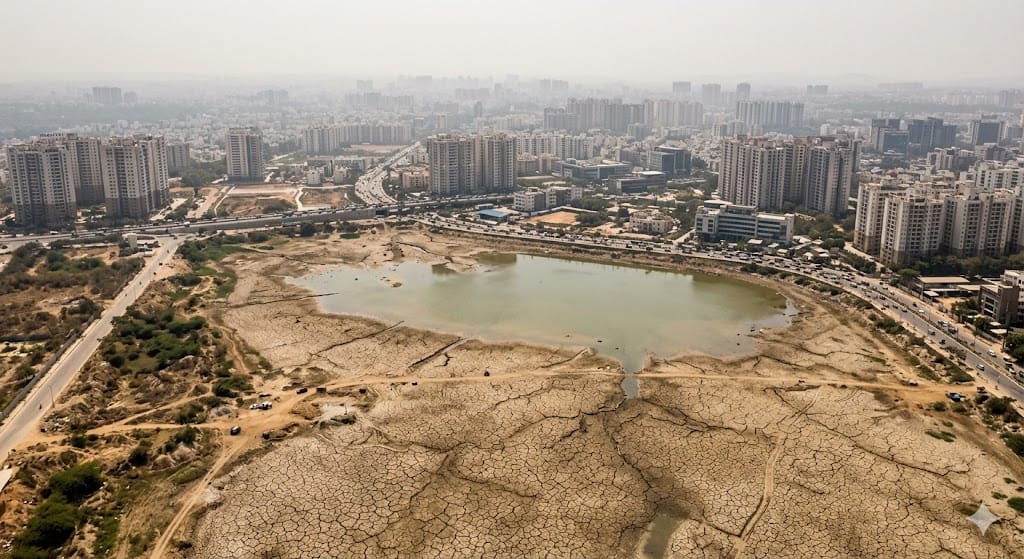
Bengaluru has lost 66 percent of its forests and 74 percent of its lakes and rivers. Those lakes and trees were the city’s natural air conditioners. Without them, there is nothing to absorb the heat or bring moisture into the air.
Experts attribute the rising heat partly to the urban heat island effect, noting that the minimum temperature has gone up and the duration of heat has extended — the heat is arriving earlier and leaving later each year.
The Real-World Impact on Bengalureans
The heat isn’t just uncomfortable — it is disrupting everyday life at every level.
IT firms have issued work-from-home advisories, schools have had to declare holidays, and the demand for water tankers has skyrocketed, leading to price surges that forced the Karnataka government to step in with regulations.
Bengaluru needs 2,600–2,800 million litres of water daily, but supply during the recent crisis was only half of what was required. Paved surfaces cover nearly 90 percent of the city, preventing rainwater from seeping down and being stored in the ground. The result is a city that floods when it rains and runs dry when it doesn’t.
A report on Bengaluru’s decaying lakes grimly described how land cover changes have wiped out 98 percent of the city’s wetlands, lakes, and greenery. Half of the city’s borewells have already run dry.
How Bengaluru Can Fight Back
The problem is serious, but it is not hopeless. Experts and urban planners have laid out a clear path — if the city has the will to follow it.
1. Become a Sponge City Measures such as rainwater harvesting, restoring open wells, and increasing permeable surfaces can help replenish aquifers and mitigate shortages. Experts emphasise the need to move towards a “sponge-city” approach that is fundamentally against over-concretisation.
2. Restore the Lakes Bengaluru once had over 1,000 lakes. Most are gone or dying. Restoring even a fraction of them would bring back natural cooling, recharge groundwater, and reduce flood risk — all at once.
3. Plant Trees Aggressively Green cover is one of the cheapest and most effective tools against urban heat. Every tree planted is a natural air conditioner running for free.
4. Cool the Streets Short-term interventions such as cooling centres in metro stations and malls, water kiosks in high-traffic areas, and temporary shade structures at traffic signals can provide immediate relief during peak summer heat.
5. Use Technology Smartly The Bengaluru Water Supply and Sewerage Board is set to launch an AI-powered water management hub under the Cauvery Stage V project, aimed at improving monitoring of both drinking water supply and sewage networks. This kind of smart infrastructure is essential for managing the city’s resources during El Niño years.
6. Mandatory Rainwater Harvesting Simple solutions like tap aerators exist, but the real focus must shift to rainwater harvesting systems and traditional wells — particularly effective ways to recharge groundwater with far-reaching impact. Enforcement, not just policy, is the need of the hour.
The Bigger Warning
The water and heat crisis in Bengaluru is not an isolated incident — it is a warning of what could become a nationwide problem. A city of over 10 million people that runs out of water and cooks in its own concrete is not a local crisis. It is a preview of what unchecked urban growth combined with climate change looks like in practice.
El Niño will come and go. But the damage Bengaluru has done to its own natural systems — its lakes, its forests, its soil — will remain unless serious action is taken now. The question is not whether the city can afford to change. It is whether it can afford not to.