


Are We Selling Our Votes or Our Future?
By Chandrakala R.N. | Editor, Digital Waves News
Bengaluru, Karnataka | www.digitalwavesnews.com
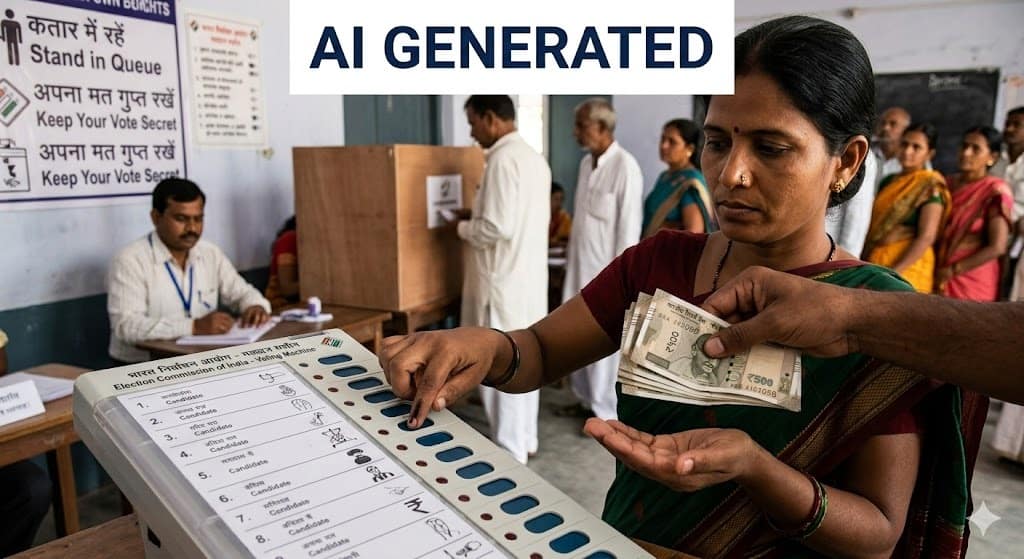
We are witnessing deeply troubling trends in recent elections. One involves the registration of fake voters to manipulate results, and another involves the outright buying of votes by paying small sums of money to ordinary citizens.
People no longer ask whether a candidate is capable of providing good governance. They know from experience that politicians make grand promises before elections and conveniently forget them afterward. Since there is no way to hold them accountable once they are in power, many voters have decided to take whatever they can get before the election. And voters, being no less clever than the politicians themselves, often accept money from multiple parties — then cast their vote for whoever paid the most.
Of course, we trust the people more than the politicians. But in this case, people have become loyal to whoever paid them more. Citizens feel uncertain about policies and taxes because regardless of which government comes to power, taxes never decrease — they only keep rising. So just as a politician thinks about how to recover their election expenses and profit within a five-year term, the voter adopts the same mindset: earn as much as possible from different political parties during election season. Freebies and welfare schemes come later — after the election is won. People are not thinking about the future of their state or country. They are focused on maximising what they can get right now.
There is another important phenomenon worth examining: why are certain parties winning by larger majorities with each passing election? It is not necessarily due to the performance of the central or state government. Some parties have become very intelligent in selecting their candidates. They identify individuals who already enjoy a strong reputation and widespread goodwill in their local area, and offer them a party ticket. These candidates could win on almost any platform — their charisma and credibility were not built in a day or two, but earned over decades of public service. People vote for those individuals out of personal faith, not out of loyalty to the party. The party simply recognises that credibility and leverages it.
Now consider the deeper question. In a democratic system, people are selling their votes for money. This raises a fundamental question: is this democracy, or is it a vote-selling system?
Our freedom fighters and the architects of our Constitution placed enormous importance on democracy, the rule of law, and the sanctity of elections. Have present generations forgotten the sacrifices made by those leaders — people who gave their lives for this country? And now, by buying and selling votes, how far have we degraded the very system they built? A few generations ago, people sacrificed their lives to win independence. Today, we are selling our votes to corrupt, evasive, and in some cases criminal politicians.
We must question ourselves: where did we lose our morals and ethics? We always blame politicians for their lack of integrity — but do we ever turn that question on ourselves? There is a saying:
“Yatho Raja, Tatho Praja” — as the king, so the subjects.
But the reverse is equally true:
“Yatho Praja, Tatho Raja” — as the people, so the ruler.
If we continue down this path, where will we end up? Has the very meaning of democracy been lost on us?
One day, the voter will say to the politician, “I gave you my vote — that is how you got your power.” And the politician will reply, “Getting to this position was not easy — I had to buy your vote to get here.” Is this a healthy sign of democracy?
Looking at the world around us, even some communist countries have citizens living in better conditions than those in many democratic setups. Their life expectancy is higher, healthcare is stronger, and they are ahead in several spheres of life. This forces us to ask: is living in a flawed, unhealthy democracy better, or is a well-functioning system of governance — regardless of its label — more desirable? At the end of the day, every citizen’s priority is simply a good life.
People must think carefully and elect their representatives on the basis of merit — not for money.
Can an ordinary, common person contest elections today? Rarely. Because politics has become a lucrative and expensive business, accessible only to those with significant wealth. Only they can afford to spend crores of rupees on an election campaign.
A common man struggling to put food on the table under this high-tax system cannot realistically think about contesting an election. While it is technically true that in a democracy everyone has the right to contest, who will vote for the poor, honest candidate? Even if that person has genuine ambitions to serve the country, real loyalty to the public, and strong moral values — without money, can they win? Never. That remains only a dream in the present Indian democratic system.
We must reflect seriously on our own responsibility. Why do we accept money? Why do we sell our votes? For whom are we selling them? Are we choosing the right candidate to represent us for the next five years — someone who will truly work for ordinary people?
We need to stop being mute spectators who simply watch as fake voter data is exposed, as election commission processes are questioned, and as the system drifts further from its ideals.
We are not just selling our votes — we are selling our democratic system itself.
Day by day, we surrender our power as citizens and become helpless spectators in our own country.
When narrow-minded politicians win elections, they reduce governance to chaos. They push amendments and counter-amendments, and gradually work to reshape the Constitution itself to impose their ideology upon us. Slowly, within a democratic setup, we are losing our fundamental rights.
Every citizen of this country must act responsibly when they stand before the voting machine. Only then will this great idea — democracy — survive and endure.
| ✍ About the Author Chandrakala R.N. is the Editor & Founder of Digital Waves News. With over 17 years of experience in journalism, she has been a strong and fearless voice for civic awareness, democratic values, and responsible citizenship in Bengaluru, Karnataka. Through Digital Waves News, she strives to bring honest, people-first journalism to every reader. 📧 Email: chandrakalashashi9@gmail.com 🌐 Website: https://digitalwavesnews.com/ 📍 Location: Bengaluru, Karnataka, India |
| ⚠ Editorial Disclaimer The views, opinions, and perspectives expressed in this editorial are solely those of the author and do not necessarily represent the official position of Digital Waves News or its editorial team. This article is intended to encourage civic awareness, democratic participation, and open public discussion. © 2024 Digital Waves News | www.digitalwavesnews.com | Bengaluru, Karnataka, India |