


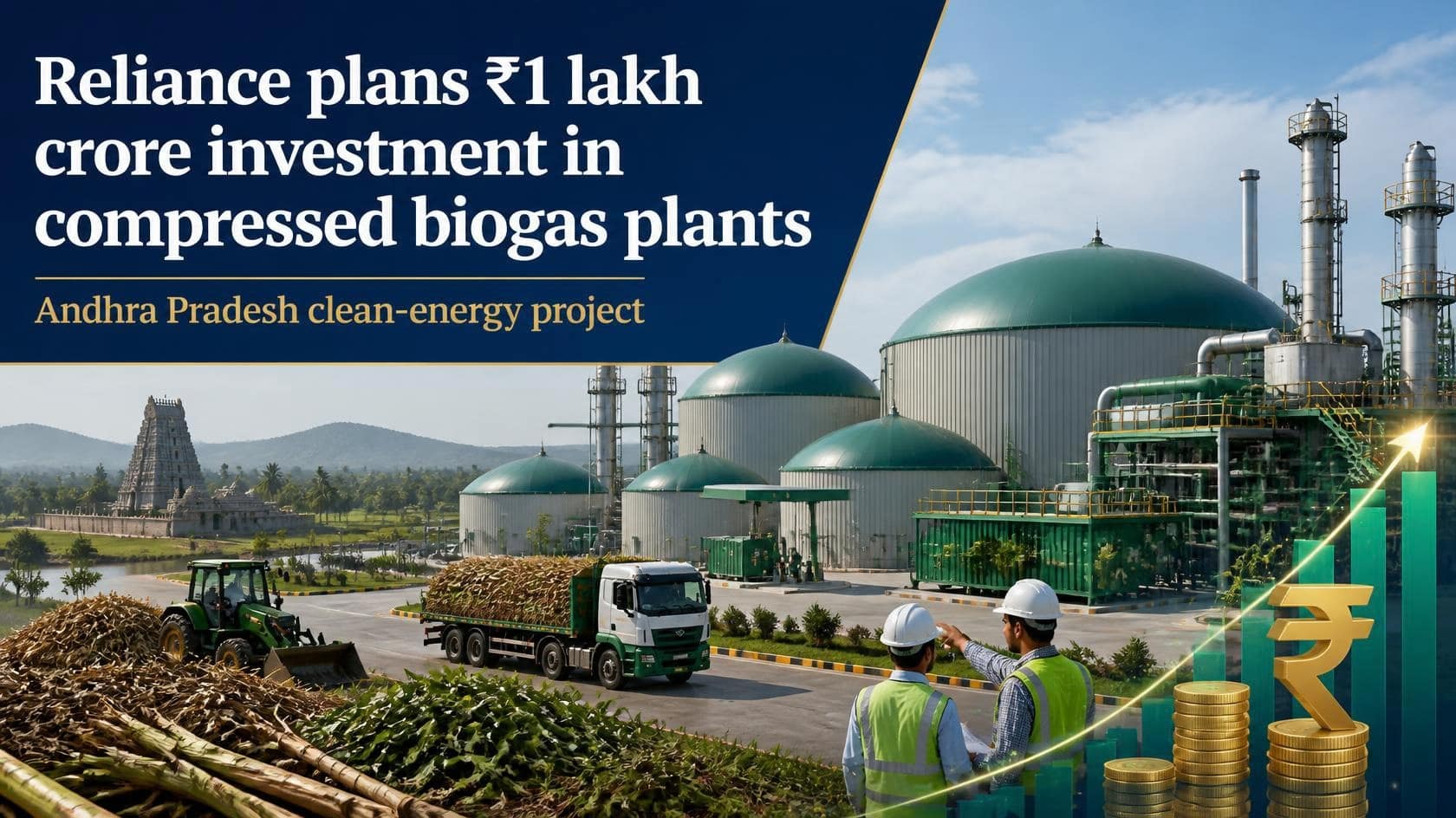
What if farm waste could power vehicles and kitchens, and create jobs in villages at the same time? That is the idea behind a big announcement in Andhra Pradesh.
What happened?
On Friday, 2 October 2026, at Madanapalle, Reliance Industries Executive Director Anant Ambani said the company plans to invest ₹1 lakh crore in Andhra Pradesh to set up compressed biogas (CBG) plants. He said this could create more than 3 lakh jobs and bring in nearly ₹60,000 crore in revenue for the state over the coming decades.
He spoke at the foundation-stone ceremony for two projects, the Rayalaseema Horticulture Hub and the Indian School of Agriculture, at B.K. Palli village in Madanapalle Mandal. Union Finance Minister Nirmala Sitharaman, Chief Minister N. Chandrababu Naidu, Deputy Chief Minister Pawan Kalyan and Minister Nara Lokesh attended.
What is compressed biogas, in simple words?
When farm waste, crop leftovers, animal dung and other organic waste rot without air, they give off a gas called biogas. Cleaned and compressed, it becomes compressed biogas, which can be used as a fuel for vehicles and for cooking and industry. The leftover material can be used as fertiliser.
For farmers, this could mean a buyer for waste that is otherwise burned or thrown away.
What else is in the package?
- ₹40,000 crore Rayalaseema Horticulture Hub. Ambani said it would help make Rayalaseema a global fruit bowl. Reports say it is planned in three phases and will focus on horticulture, food processing and adding value to produce.
- Indian School of Agriculture. A training centre meant to help farmers adopt new technology.
- Technology for farmers. Ambani said Reliance would connect millions of farmers with digital training and its Jio Krishi tools, including AI, drones, robotics, cloud computing and price information.
The state’s numbers
Ambani cited state government data showing that Andhra Pradesh has approved 388 mega projects since June 2024, with investment commitments above ₹14 lakh crore and potential employment of nearly 11 lakh people. About a third of that investment is going to Rayalaseema, he said.
What it could mean for ordinary people
These are possibilities, not promises:
- Farmers: A market for crop waste, better prices through technology, and training.
- Rural jobs: Work at plants, in collecting waste and in transport, in addition to the horticulture and food processing jobs.
- Cleaner energy: Less burning of crop waste and a home-grown fuel.
- The state: More investment and tax revenue, if the projects go ahead.
The “son of Andhra” line
Ambani’s remark got attention. Addressing farmers at the event, he asked them to treat him as a son of Andhra and tell him how he could contribute to the state’s growth. Some reports have described this as being addressed to the Chief Minister, but the account I found says he was speaking to the farmers.
What to watch
- “Plans to invest” is not “has invested”. This is an announcement. Look for approvals, land allotments, timelines and the start of construction.
- Job numbers are projections. “3 lakh jobs” is an estimate, and it may include indirect jobs. How many are permanent, and how many go to local people, will matter.
- Supply of waste. CBG plants need steady supplies of farm waste and a way to collect it. Pricing and contracts with farmers will decide whether it works.
- For scale: Earlier this year, the state sanctioned about ₹60 crore for five small municipal CBG plants. The Reliance plan is far larger than that, so delivery will be a real test.
- Benefit to farmers. Watch whether small farmers get a fair share, not just large landholders and companies.
The bottom line
Reliance has put a very large number on Andhra Pradesh’s farm and clean-energy future. The idea of turning waste into fuel is sound, but the real test is turning the announcement into plants, jobs and better incomes for farmers.
Sources: Press Trust of India reports via Daily Excelsior, The Hans India and Dainik Jagran English, Business Today, and News on Air, 2 to 3 October 2026.