


Published: June 17, 2026
Massive Textbook Controversy Erupts in Odisha
A major controversy has erupted in Odisha after the state government’s School and Mass Education Department reportedly identified 1,678 spelling, factual, grammatical, and contextual errors in newly introduced Odia-language textbooks for Classes I to VIII. The textbooks were prepared under the framework of the National Education Policy (NEP) 2020 and introduced for the 2026-27 academic session.
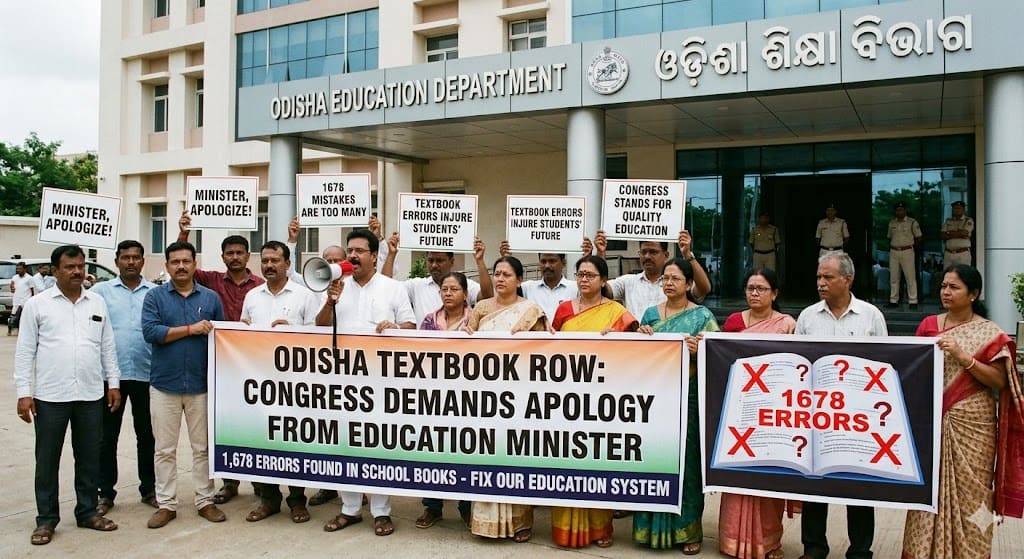
The issue has sparked widespread criticism from opposition parties, education experts, teachers, and parents, with the Odisha Congress demanding a public apology from School and Mass Education Minister Nityananda Gond.
Congress Seeks Accountability
The Odisha Congress has accused the government of negligence and questioned how such a large number of mistakes escaped multiple layers of scrutiny before the textbooks were distributed to students.
Party leaders argued that school textbooks serve as the foundation of a child’s education and that factual inaccuracies can seriously affect learning outcomes. They have demanded that the Education Minister accept responsibility and explain the lapses in the textbook preparation and review process.
What Are the Errors?
Several reported mistakes have drawn public attention and triggered criticism across the state.
Among the most notable examples:
- Scientist Isaac Newton was reportedly described as a “pilot.”
- The UNESCO World Heritage Site at Hampi was identified as the Konark Sun Temple.
- The scientific term “equinox” was confused with “equator.”
- An image of the Karnataka Legislative Assembly was allegedly used in place of the Odisha Legislative Assembly.
- Numerous spelling, grammatical, and contextual mistakes were found across multiple textbooks.
The sheer number of errors has raised concerns about the editorial standards followed during textbook development.
Why the Issue Matters
The controversy is particularly significant because the textbooks are part of Odisha’s implementation of the National Education Policy (NEP) 2020. The revised curriculum aims to modernize learning and improve educational quality for millions of students across the state.
Education experts argue that inaccurate textbooks can create confusion among students, undermine classroom teaching, and damage public confidence in the education system.
Teachers’ organizations and parent groups have also expressed concern, emphasizing that textbooks are often considered the most trusted source of information for schoolchildren.
Questions Being Raised
The controversy has generated several important questions:
- Who was responsible for preparing the textbooks?
- How many committees reviewed the content before publication?
- Why were the errors not detected during proofreading?
- Will corrected editions be printed immediately?
- What will be the financial cost of rectifying the mistakes?
- Will any officials be held accountable?
These questions are likely to dominate the political and educational debate in Odisha in the coming weeks.
Government Under Pressure
With the issue gaining national attention, the Odisha government faces increasing pressure to explain how such a large number of errors found their way into officially approved educational material.
Observers believe the government may be forced to conduct a comprehensive review of the textbook development process and introduce stricter quality-control mechanisms to prevent similar incidents in the future.
A Test for Odisha’s Education Reforms
The textbook controversy comes at a crucial time when Odisha is pursuing ambitious education reforms under NEP 2020. While curriculum modernization remains a priority, experts say the episode highlights the importance of rigorous fact-checking, professional editing, and transparent review systems.
As political parties trade accusations and education stakeholders seek answers, the focus remains on ensuring that students receive accurate, reliable, and high-quality learning materials.
The coming days will determine whether the controversy leads to meaningful reforms in Odisha’s textbook preparation and approval process.