


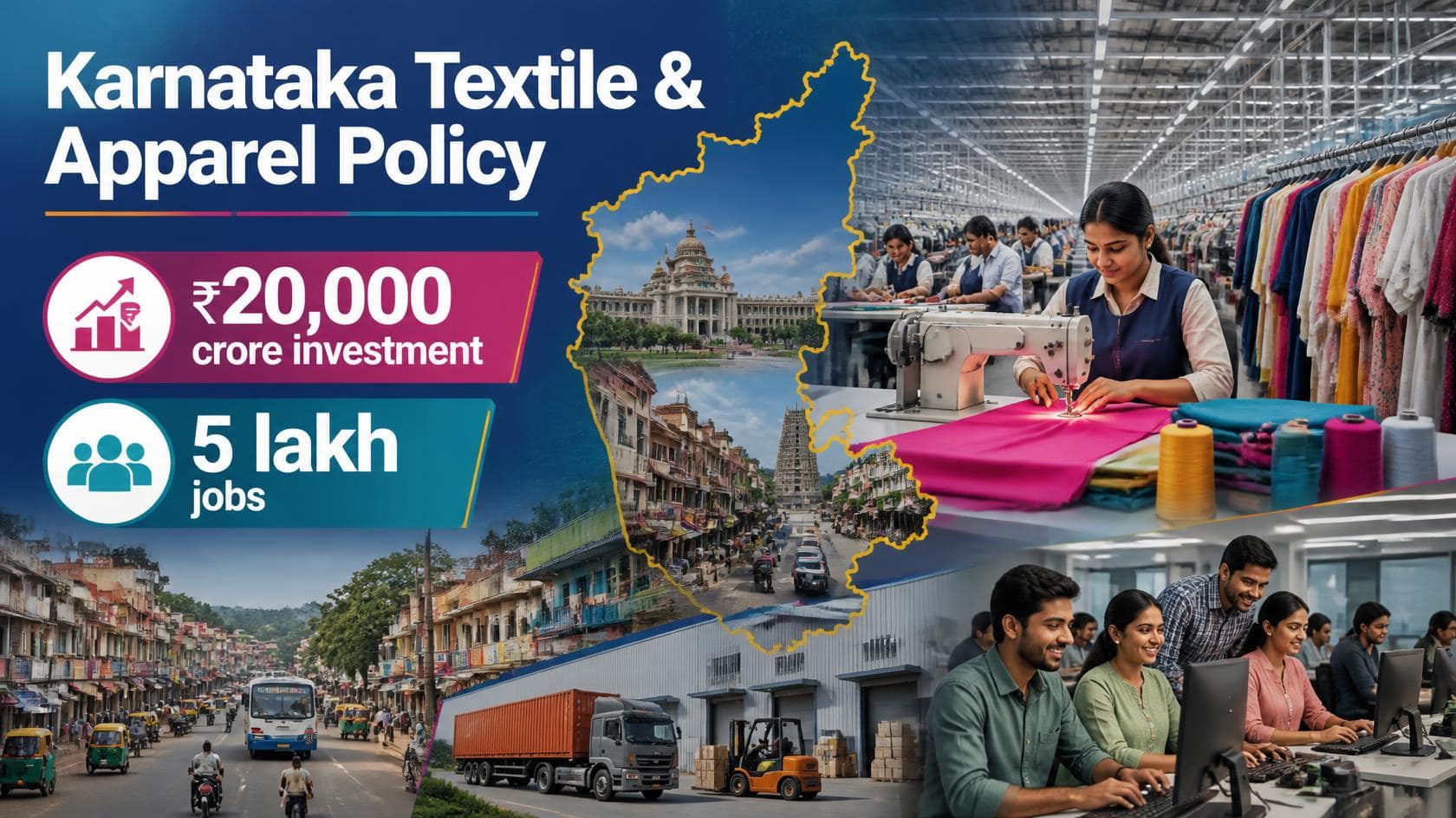
Karnataka has formally notified its Textile & Apparel Policy (4.0) for the period 2026–31, setting ambitious targets of attracting ₹20,000 crore in investments and generating 5 lakh new jobs over the next five years. The policy carries a state financial outlay of ₹4,000 crore and came into effect from September 30, 2026.
Approved under the directions of Chief Minister DK Shivakumar, the policy aims to expand textile and apparel manufacturing beyond Bengaluru, promote more balanced regional industrial growth, and position Karnataka as a globally competitive textile and apparel manufacturing hub. Officials say the framework is designed to strengthen the entire value chain — from fibre to fashion — while placing strong emphasis on sustainability, skill development and exports.
Focus on Regional Growth and Tier-2/Tier-3 Cities
One of the central objectives of the new policy is to reduce the concentration of textile and apparel units in and around Bengaluru. The government has identified 34 focus taluks across the state where new eligible textile and apparel units will receive additional incentives and concessions over and above the standard benefits available under the policy.
Special attention has been given to the Kalyana Karnataka region. Eligible units established at the Pradhan Mantri Mega Integrated Textile Region and Apparel (PM-MITRA) Park in Kalaburagi will receive special incentives and concessions. The park is expected to emerge as a major manufacturing hub and drive both investment and employment in northern Karnataka, an area that has historically lagged in industrial development.
By offering enhanced support in these locations, the government hopes to encourage entrepreneurs and large manufacturers to set up units closer to raw material sources and labour pools in smaller towns and semi-urban areas.
Where Will the 5 Lakh Jobs Come From?
The policy targets employment generation across multiple segments of the textile ecosystem. A significant share of the jobs is expected to come from new manufacturing and processing units that respond to the incentives offered in the 34 focus taluks and at the Kalaburagi PM-MITRA Park.
Key employment-generating areas include:
- Textile and apparel manufacturing — garment units, fabric production and processing facilities in Tier-2 and Tier-3 locations
- Technical textiles — a high-growth segment with applications in healthcare, infrastructure, agriculture, automotive and defence
- Silk value chain — for the first time, silk yarn production activities such as silk reeling and silk spinning have been brought under the Department of Handlooms and Textiles. This is expected to create new opportunities in Karnataka’s traditional silk clusters
- Handlooms and Geographical Indication (GI) products — the policy supports the revival of handloom clusters and better positioning of GI-tagged products
- Skill development and support services — training centres, design studios, logistics, quality testing and export-related services will also generate employment
The government has underlined the need for a structured skill development framework to bridge the talent gap and prepare workers for modern manufacturing environments. Without parallel investment in skills, absorbing 5 lakh workers into productive roles would remain a challenge.
Priority Areas of the Policy
The Textile & Apparel Policy 4.0 focuses on several strategic pillars:
- Strengthening textile production and promoting technical textiles
- Supporting handlooms and the silk sector
- Building a robust skill development ecosystem
- Boosting exports and global competitiveness
- Encouraging sustainable manufacturing practices
The policy also aims to develop modern textile clusters, improve market linkages and explore the creation of a Centre of Excellence. Officials say the overall vision is to establish Karnataka as a fibre-to-fashion destination that balances traditional strengths with emerging opportunities in technical and sustainable textiles.
Implementation and Timeline
The policy and its package of incentives and concessions will remain valid for five years from September 30, 2026, or until a new textile policy is notified, whichever is earlier. The government order notifying the policy was issued by the Department of Commerce and Industries.
With a clear focus on decentralising industrial growth, supporting silk and technical textiles, and creating large-scale employment, Karnataka’s new textile policy seeks to turn the state into a stronger player in both domestic and global markets. The real test will lie in how quickly investments materialise in the identified taluks, how effectively infrastructure and skills are developed, and whether the targeted 5 lakh jobs translate into sustainable livelihoods across the state.