


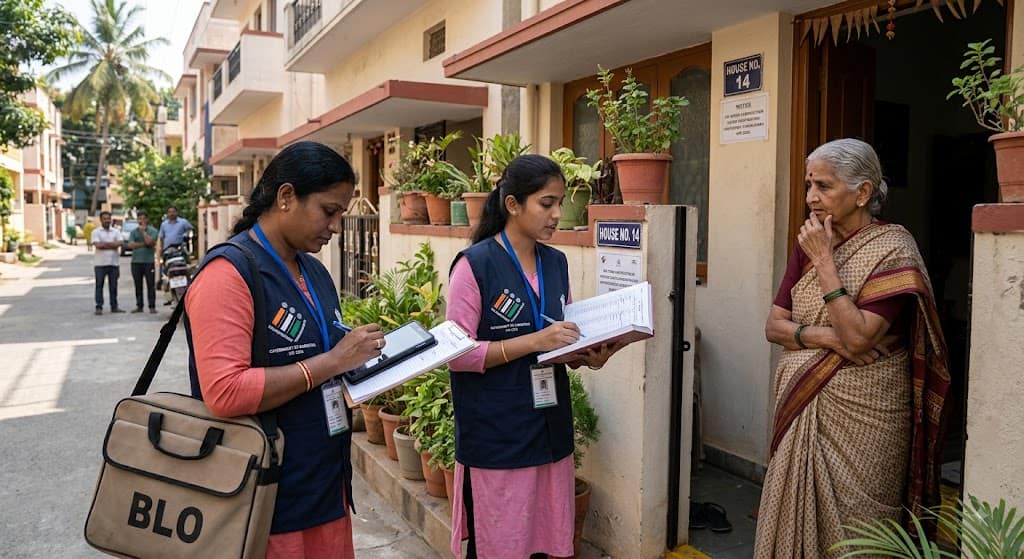
This week, one topic has dominated conversation across Karnataka — the Special Intensive Revision (SIR) of the electoral rolls, under which lakhs of names are vanishing from the draft voter list. The issue made national headlines when actor Prakash Raj publicly revealed that his own name had been removed from the Bengaluru electoral roll, sparking outrage on social media. But this isn’t just a celebrity’s problem — ordinary citizens, tenants, migrants, and senior citizens are all caught up in it, with over 65 lakh Bengaluru voters and more than 1.10 crore voters across Karnataka currently sitting in the “deletion” category. So what exactly is SIR, why are names being removed, and how can you check whether your own name is safe? Here’s everything you need to know.
What Is SIR (Special Intensive Revision)?
Normally, the Election Commission updates the voter list every year with minor corrections. SIR is very different — it’s a full house-to-house re-verification of every voter’s name, age, address, and family linkage. Even people who already hold a valid Voter ID can be dropped from the rolls if this verification fails for any reason.
In Karnataka, the process began on June 30, 2026, with Booth Level Officers (BLOs) visiting homes across the state. Karnataka has a total of 5.54 crore registered voters, and enumeration forms have been distributed to all of them as part of this exercise.
How Many Names Are at Risk? The Numbers So Far
According to Karnataka’s Chief Electoral Officer (CEO), V. Anbukumar:
- 1,10,97,426 voter names (roughly 20% of the state’s total electorate) have been flagged under the ASDDO category — Absent, Shifted, Dead, Duplicate, or Other.
- Bengaluru is the worst affected: across its 28 assembly constituencies, close to 49.34 lakh names (about 48% of the city’s total electorate) fall into this flagged category.
- Bommanahalli constituency recorded the highest proportion at over 57%, followed by Vijayanagar, Dasarahalli, BTM Layout, and C.V. Raman Nagar.
- Of the flagged names, 16.27 lakh were marked absent or untraceable, and 66.62 lakh were found to have permanently shifted residence, officials said.
Numbers of this scale have naturally triggered concern. The Election Commission maintains that this is a routine clean-up of duplicate, deceased, shifted, and ineligible entries. Opposition parties and some civil society groups disagree, alleging that genuine, eligible voters are being wrongly excluded in the process. The Congress party has already filed complaints with the Election Commission alleging that names from specific communities are being disproportionately deleted in certain constituencies.
Why the Prakash Raj Case Made Headlines
Actor Prakash Raj — who was born, raised, and educated in Bengaluru, and had even previously contested as an MP candidate from the same constituency — said his name had been struck off the electoral roll despite this long-standing local connection. He reacted with sharp sarcasm in a video message, asking what documents he would now need to produce to reclaim his own vote. Cases like his have raised an uncomfortable question for many ordinary citizens: if someone with such a well-documented, decades-long presence in a constituency can be deleted, what chance do regular voters have of avoiding the same fate? That’s exactly why this story has grown beyond a single celebrity’s grievance into a matter that concerns every voter in the state.
Who Is Most at Risk of Being Deleted?
Based on reporting so far, a few groups appear especially vulnerable:
- Tenants and migrants in cities — people who moved to Bengaluru for work and change addresses frequently are more likely to be marked “shifted.”
- People with mismatched Aadhaar and voter records — if your father’s name, for instance, is spelled differently on Aadhaar than on the voter roll, the system’s family-linking process can fail, and your entry may get flagged as unmapped.
- Anyone who didn’t submit the enumeration form — if you weren’t home when the BLO visited, or never filled out the form, you’re likely to be marked “absent/untraceable.”
- Senior citizens — those unable to respond during verification due to health or mobility issues.
How to Check If Your Name Is on the List
There are two official ways to check your status:
1. Karnataka CEO Portal (ASDDO List Check)
- Visit
ceo.karnataka.gov.in/asddo.html. - Select your district and assembly constituency.
- Look up your name or EPIC number in the district-wise list. (Note: at the time of writing, links for a few districts — including Bengaluru Urban, Belagavi, Raichur, and Shivamogga — were still being rolled out, so keep checking back if your district isn’t live yet.)
2. National ECI Voter Portal
- Visit
voters.eci.gov.in. - Select “Special Intensive Revision (SIR) – 2026,” then search by name or EPIC number.
- Log in with your mobile number and OTP to check your own status and that of family members.
3. Contact your local BLO or Voter Facilitation Centre
If the online portals are confusing or unavailable for your area, reach out directly to your Booth Level Officer, or contact the Voter Facilitation Centre through the CEO Karnataka office.
Key Dates You Need to Remember
The Election Commission issued a revised schedule on August 7, 2026:
| Stage | Date |
|---|---|
| House-to-house verification (BLO visits) ends | August 17, 2026 |
| Draft electoral roll published | August 24, 2026 |
| Window to file claims and objections | August 24 – September 23, 2026 |
| Claims/objections disposal | August 24 – October 22, 2026 |
| Final electoral roll published | October 27, 2026 |
| Qualifying date | October 1, 2026 |
The one-month window between August 24 and September 23 is your key opportunity to get your name re-added or corrected before the final list is locked in.
What to Do If Your Name Is Missing
Don’t panic — being left off the draft list is not final or permanent. Here’s what to do:
- File Form 6: Submit Form 6 along with the prescribed SIR declaration to add your name or correct an entry, either online via
voters.eci.gov.inor offline at your local BLO/ERO office. - Gather your documents: Keep ready your Aadhaar card, old Voter ID (if you have one), proof of address (electricity bill, rental agreement, ration card, etc.), and proof of family relationship (a parent’s or spouse’s EPIC number).
- Fix name mismatches first: If your name or your father’s name differs between Aadhaar and the voter roll, that’s one of the most common reasons for rejection — correct this before or while submitting your form.
- Keep your acknowledgment receipt: After submission, save the acknowledgment number or receipt so you can track the status of your application.
- Be ready for an ERO enquiry: By rule, no name can be finally deleted from the draft roll without an enquiry and a fair opportunity to respond — the Electoral Registration Officer (ERO) is required to hear your objection and issue a reasoned order.
- Appeal if unsatisfied: If you’re not happy with the ERO’s decision, you can escalate the matter to the District Election Officer (DEO) or a higher appellate authority.
Bottom Line
Karnataka’s SIR exercise is meant to clean up the electoral rolls, but the sheer scale and pace of the deletions have unsettled everyone from ordinary voters to well-known public figures. The only real way to protect your right to vote is to stop being a bystander — check your status right now on the official portals, and if your name is missing, act within the August 24 to September 23 window to file Form 6 and get it corrected. Cases like Prakash Raj’s are a wake-up call: your name might be missing too, so it’s worth checking today rather than waiting until the final list is published.
Note: The figures and dates in this article are based on official sources and news reports available as of August 11, 2026. Since the SIR process is still ongoing, the schedule may change. Always verify the latest information on the official portals — ceo.karnataka.gov.in and voters.eci.gov.in.