


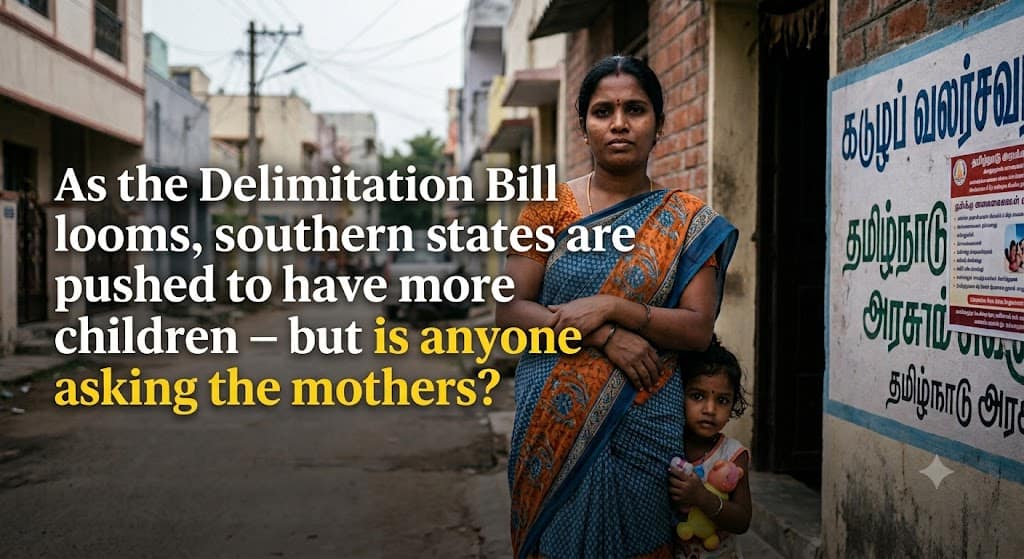
A closer look at the Delimitation Bill, the “baby bonanza” schemes in South India, and why this debate keeps leaving the mother out of it.
The Delimitation Bill Hasn’t Passed — But Its Effects Have Already Begun
Parliament has not yet approved a Delimitation Bill that would redraw the country’s 543 Lok Sabha seats based on population. But its shadow is already shaping policy in the south. We know the proposal: more seats for states with more people. And southern states — long praised for controlling population growth — have realized that success could now cost them political representation.
The response from two state governments has been striking.
Andhra Pradesh Chief Minister N. Chandrababu Naidu has announced a cash incentive scheme: ₹30,000 for the birth of a third child, ₹40,000 for a fourth, paid immediately after birth, on top of the existing ₹15,000-a-year “Talliki Vandanam” payment for every school-going child. Maternity leave has also been extended to cover every childbirth, regardless of how many children a woman already has.
Tamil Nadu’s previous Chief Minister, M.K. Stalin, had taken a rhetorical route — before his term ended in May 2026, he urged newlyweds to “have children immediately” rather than delay, reviving a Tamil saying about being blessed with “16 kinds of wealth,” reframed as an appeal to grow the state’s political weight. The state’s current Chief Minister, C. Joseph Vijay, has since followed with a concrete policy move of his own: this week, his government extended maternity leave for a third child from 12 weeks to a full 365 days, bringing it on par with the leave already granted for the first two children — alongside a separate resolution pushing to permanently freeze Lok Sabha strength at 543 seats to protect southern states’ representation.
Andhra Pradesh’s cash rewards, Tamil Nadu’s expanded leave, and both states’ resistance to delimitation are all responses to the same underlying fear: a state that succeeded at family planning may now be punished for it.
Why Compare Ourselves to China at All?
The justification offered for all of this is familiar — China is an ageing country, and India could face the same fate. But is that comparison honest?
India and China do not share a governance system, a land base, or a development trajectory. India still trails China in science and technology, artificial intelligence, infrastructure, medical research, defence capability, exports, and foreign policy reach. We are not equals in any of those fields. So why is population the one metric we suddenly want to be judged on?
As of 2026, India’s population stands at roughly 147 crore (1.48 billion) — already the highest in the world, ahead of China. We are “number one” in exactly one category. Has that made life better for the people already here? Not obviously. And yet the proposed fix is more people, not fewer problems.
What South India Actually Got Right
The southern states didn’t stumble into lower population growth. They adopted family planning policy deliberately, stuck with it for decades, and it is a major reason the south has better human-development outcomes than large parts of the north today. Reversing that — paying families to have more children — treats a policy success like a political liability.
Meanwhile, the problems that already exist for the children we have are not going away:
- Schools that lack enough seats, staff, or basic infrastructure
- Persistent child malnutrition in several districts
- Weak social security nets for the families who need them most
- A widening gap between what a minister’s child gets and what an ordinary child gets
None of this is solved by a cash bonus for a third or fourth birth. If anything, it multiplies the number of children entering the same unresolved system.
The Woman This Policy Actually Falls On
Behind every “encourage more children” headline is a woman who is rarely in the room when the policy is written. Picture her: working fifteen-hour days, married to a husband who drinks, never taught the basic rights she’s legally entitled to. She is the one this scheme will land on — not as a mother making a free choice, but as the person expected to deliver a demographic target.
She has no space in this equation for her own ambition, her own health, her own life outside motherhood. And now the state wants to hand her a cash transfer and call it empowerment.
A woman is not separate from society — she is equal to it, with the same right to an opinion and a decision over her own body. Whether to have another child cannot be decided by a chief minister, a party manifesto, or a one-time payment. It has to be decided by her.
Governments Change. Mothers Don’t Get to Start Over.
Political parties rotate in and out of power. Policies get rewritten every few years, sometimes every few months. A mother does not get that flexibility — she carries the actual, permanent weight of every child she raises, long after the scheme that encouraged her is forgotten or replaced.
So the question of another child belongs to her, not to anyone chasing a Lok Sabha seat count.
To put a price on childbirth — ₹30,000 here, ₹40,000 there — is not policy. It’s a transaction dressed up as concern.
What a Mother Should Actually Be Asked
Before any more “baby bonanza” schemes, the only questions worth asking are the ones a mother asks herself: Can I give this child good food? A real education? A stable home and the right values to grow up with?
Not — how much will the government pay me for it.