


Sep 26, 2026 ·
Karnataka has brought the whole of Bengaluru Urban district under the water board’s map. Piped water won’t arrive overnight, but for the first time the city’s fast-growing fringe is officially on the plan.
BENGALURU: The Karnataka government has extended the jurisdiction of the Bangalore Water Supply and Sewerage Board (BWSSB) to the entire Bengaluru Urban district, more than doubling the area the board is responsible for planning drinking water and sewerage services in. According to a Deccan Herald report, the change was made through a notification dated September 24, and takes the board’s service area from about 800 sq km, which largely followed the city’s municipal limits, to about 2,100 sq km.
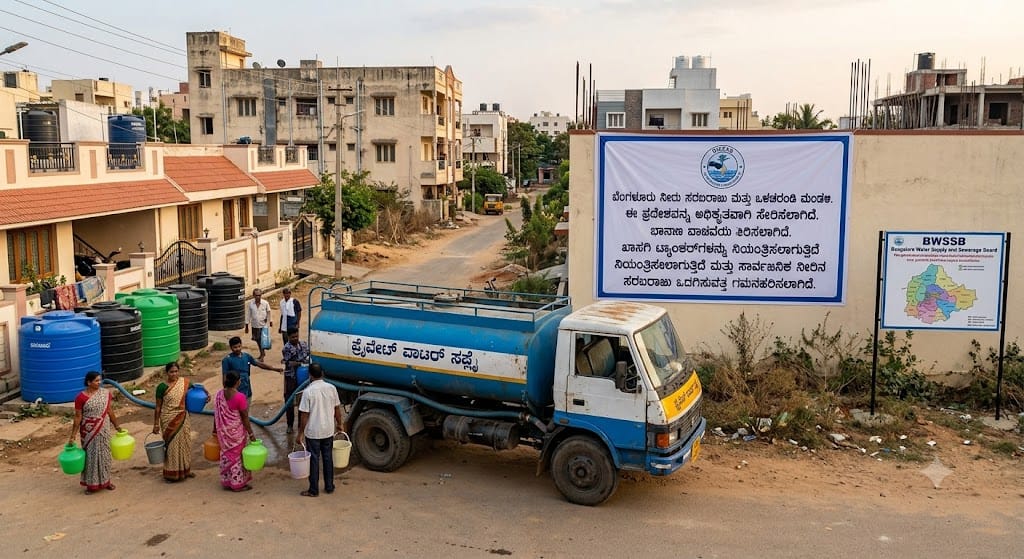
The move matters most for residents just outside the old boundary. In places like Sarjapur, Jigani, Hesaraghatta and Chandapura, people have long relied on borewells, private tankers and septic tanks, many of which leak into lakes and storm drains.
What exactly has changed
Until now, BWSSB’s mandate stopped more or less where the city corporation’s boundary did. Everything beyond it, including dense new apartment clusters, industrial belts and fast-urbanising villages, fell to gram panchayats, town municipalities or nobody in particular when it came to water and sewage.
The new limits take in urban, semi-urban and rural areas across the Bengaluru North, East, South, Yelahanka and Anekal taluks. Among the areas now inside BWSSB’s jurisdiction:
- North and west: Hesaraghatta, Soladevanahalli, Dasanapura, Makali, Doddajala
- South-west: Kumbalgodu, Bannerghatta
- South-east industrial and residential belt: Sarjapur, Bommasandra, Hebbagodi, Chandapura, Jigani, Anekal, Attibele
| Before | After | |
|---|---|---|
| BWSSB service area | ~800 sq km | ~2,100 sq km |
| Coverage | Largely municipal limits | Entire Bengaluru Urban district |
| Taluks | City core | North, East, South, Yelahanka, Anekal |
The key point: this is a jurisdictional decision, not a construction order. It gives BWSSB the legal mandate to plan, build and run water and sewerage networks across the district. The pipes come later.
Why the government is doing this now
Bengaluru has long outgrown its administrative lines. Much of the city’s new housing and many of its jobs sit along the outer ring and beyond it: the electronics and manufacturing corridors of Bommasandra, Jigani and Attibele, the apartment towers of Sarjapur and Chandapura, and the spreading layouts in the north towards Hesaraghatta.
The water math is tight. According to figures cited in the Deccan Herald’s report, the city needs about 2,750 million litres a day (MLD). The Cauvery supplies about 1,950 MLD, and groundwater makes up roughly 800 MLD. The areas now being added depend even more heavily on borewells and tankers, which became painfully visible during the 2024 summer crisis, when thousands of borewells ran dry.
Sewage is the other half of the story. Without underground drainage, untreated wastewater from peripheral layouts ends up in lakes and storm drains, polluting the same water bodies that recharge groundwater. Bringing these areas under one agency is meant to allow a single, district-wide plan for both supply and treatment, instead of piecemeal fixes.
Minister Krishna Byre Gowda framed it as planning ahead of growth: “The government has started planning for basic urban infrastructure like roads, assured drinking water and sewage systems to meet urbanisation.”
What it means for residents
In the short term, very little changes at the tap. Nobody in Anekal or Makali will get a Cauvery connection next month. What changes is who is responsible for planning it.
BWSSB Chairperson Dr Manjula N said the board would “immediately start preparing a master plan and action plan” for the expanded area, covering pipe network design, reservoirs and sewage treatment plants. That master plan is the document to watch. It will decide which areas are prioritised, where treatment plants go, and how much water can actually be allocated.
Over the longer term, residents of the newly added areas can expect:
- A path to piped water and underground drainage under a single agency, rather than depending on panchayat borewells or private tankers.
- Formal water and sewerage connections, which in BWSSB areas usually involve connection charges, pro-rata or beneficiary capital contributions and metered monthly bills. How these will apply to the new areas has not yet been spelt out.
- Better regulation of groundwater and tankers, since BWSSB has increasingly taken on tanker regulation and borewell oversight within its limits.
- Cleaner lakes, eventually, if sewage networks and treatment plants follow.
For homebuyers and developers, the decision matters too. Projects in the periphery have often been sold on promises of “Cauvery water soon.” Jurisdiction makes that promise more credible, but a master plan with dates and funding is what will make it real.
The challenges ahead
Officials themselves have cautioned that full implementation could take decades. History backs that caution. The 110 villages added to Bengaluru’s city limits in 2007 did not start receiving Cauvery water until the Cauvery Stage V project was commissioned in October 2024, a gap of about 17 years.
Several big questions remain open:
- Where will the water come from? Cauvery Stage V added 775 MLD, meant largely for the 110 villages and the existing city. Serving 1,300 additional square kilometres will need new allocations, a future Cauvery stage, or serious investment in treated wastewater reuse and lake recharge.
- Who pays? Laying trunk mains, building reservoirs and setting up sewage treatment plants across the district will need large-scale investment. The funding model (state grants, loans, or beneficiary contributions) is not yet clear.
- Coordination. The expanded area overlaps with city corporations under the Greater Bengaluru Authority, town municipalities and gram panchayats, each with its own roads and approvals. Water and sewage lines depend on all of them cooperating.
- Capacity. BWSSB is already stretched serving its existing area. More than doubling its territory without a matching increase in staff and budget risks spreading it thin.
- Groundwater in the meantime. Until pipes arrive, the new areas will keep drawing on stressed aquifers. How BWSSB manages borewells and tankers during this long transition will shape everyday life far more than the master plan will in the near term.
What happens next
The decision formally recognises that Bengaluru’s urban spread now extends well beyond its old municipal limits, and places water supply and sewage planning for the whole district under one agency.
The next milestone is the master plan BWSSB has said it will begin preparing. Residents of the newly added areas will be looking to it for three things: a confirmed water source, a funding plan and timelines for when pipelines and sewage networks will reach them.
Sources: Deccan Herald, “BWSSB jurisdiction: Karnataka expands water board limits across Bengaluru Urban” (Sept 25, 2026); Citizen Matters on Cauvery Stage V; Deccan Herald on Cauvery Stage V connections in 110 villages.