


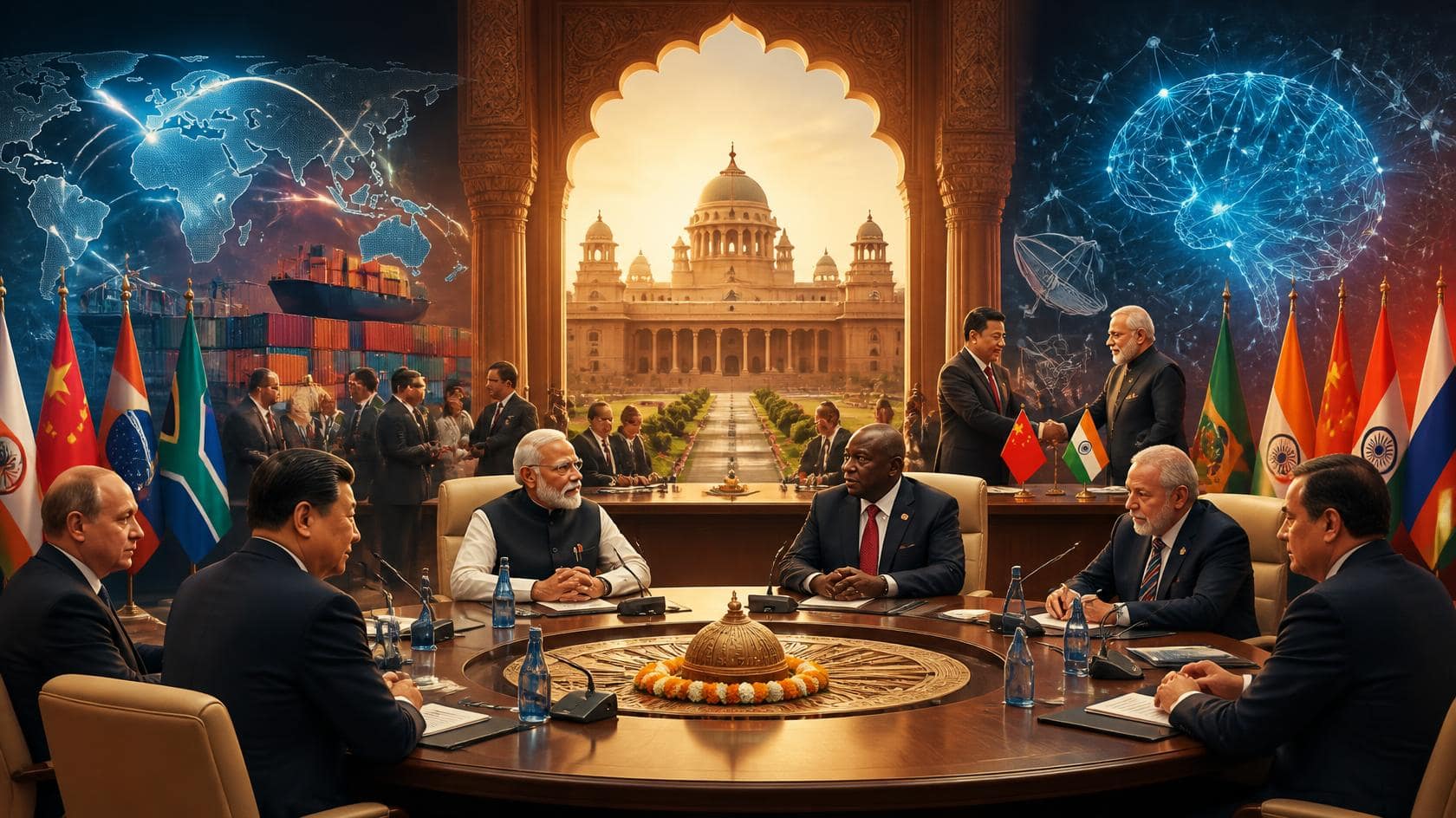
The arrivals, the photo-ops, and the security lockdown around Bharat Mandapam got most of the headlines over the past two days. Now that the 18th BRICS Summit has wrapped up, here’s the part that actually matters: what did the bloc’s leaders agree to, and what does it mean going forward?
The Big Picture: New Delhi Declaration Adopted Unanimously
BRICS leaders unanimously signed off on the New Delhi Declaration, a sweeping 140-point document covering everything from terrorism and trade to artificial intelligence and global governance reform. India hosted the summit for the fourth time, chairing BRICS through 2026 under the theme “Building for Resilience, Innovation, Cooperation and Sustainability.”
Here’s a breakdown of what was actually agreed, section by section.
Trade: No New Currency, But a Push on Tariffs and WTO Reform
The declaration didn’t create a common BRICS currency — that idea has been floated before and was set aside again this year. Instead, the bloc focused on more practical steps:
- Deeper cooperation on cross-border payment systems, aimed at making trade settlements faster, safer, and less dependent on a single global currency
- Greater use of national currencies (like the rupee) in trade and investment between member countries
- A joint statement raising concerns over unilateral tariffs and non-tariff trade measures, which the bloc said disrupt global supply chains and conflict with World Trade Organization rules
- Renewed support for WTO reform, including restoring a functioning dispute-settlement system, and backing the membership bids of Ethiopia and Iran
Terrorism, Gaza, and Global Security
The declaration took a firm stance on security issues close to India’s own concerns:
- A strong condemnation of the April 22 terror attack in Jammu and Kashmir
- A call for an immediate ceasefire in Gaza, alongside support for a two-state solution
- Opposition to economic sanctions that aren’t authorized by the UN Security Council, including so-called “secondary sanctions”
AI, Technology, and a Bigger Voice for the Global South
Beyond trade and security, the declaration touched on newer priorities:
- Cooperation on AI governance and development, an area where India specifically pushed for a joint framework
- Support for India and Brazil’s expanded roles at the United Nations, part of a broader push for global governance reform
- Backing for India-led initiatives on financial risk management and, notably, big-cat conservation
- A general commitment to strengthening the voice of emerging markets and developing countries in institutions like the UN, IMF, and World Bank
The Education Agenda
Alongside the main declaration, BRICS also moved forward on education cooperation, positioning it as one of several areas — alongside energy, technology, and finance — where member nations plan to build joint programs and exchanges going forward. This is expected to translate into more concrete initiatives as working groups meet through the rest of India’s chairship.
The Real Story on the Sidelines: Modi and Xi’s Border Talks
While the joint declaration reflects consensus among all 11 BRICS members, the more closely watched moment was a separate bilateral meeting between Prime Minister Modi and Chinese President Xi Jinping — Xi’s first visit to India in nearly seven years, and his first meeting with Modi on Indian soil since 2019.
The conversation focused on:
- A review of the 25th round of Special Representatives talks held in Beijing on August 25, where India and China agreed to set up two new military hotlines and two new commander-level meeting points along the Line of Actual Control (LAC)
- Progress toward an “early harvest” understanding on boundary delimitation and border management
- Discussions on launching a Strategic Economic Dialogue to address trade imbalances, market access, and investment hurdles
- Broader connectivity and trade cooperation, building on a cautious thaw that began after the 2024 Kazan and 2025 Tianjin meetings between the two leaders
Analysts have described the improvement in ties as “tactical and fragile” — real progress, but with a persistent trust deficit that means no major breakthrough is likely in the near term. Businesses in both countries still face regulatory hurdles, visa delays, and restrictions on industrial equipment movement despite the diplomatic warming.
Modi also held a separate bilateral meeting with Russian President Vladimir Putin ahead of the summit, covering trade, energy, and defence cooperation.
Why This Matters Beyond the Summit Itself
The New Delhi Declaration doesn’t carry the force of binding law — it’s a statement of shared intent, not a treaty. But it signals where India and its BRICS partners want global trade and governance discussions to head over the next year, particularly around reducing dependence on tariff-heavy Western-dominated trade systems and building alternative payment infrastructure.
For India specifically, the summit delivered two wins that matter beyond the joint text: continued international backing for its UN reform push, and a working framework — however fragile — for de-escalating tensions with China along a border that saw deadly clashes as recently as 2020.
This article is based on statements and reporting current as of September 13, 2026. Details of implementation for several declaration items, including the education and AI cooperation agendas, are expected to be worked out in follow-up ministerial meetings through the remainder of India’s BRICS chairship.