


Deadline: June 30, 2026
If you’re an engineer in India who’s been quietly turning research ideas into real-world solutions, this fellowship was made for you.
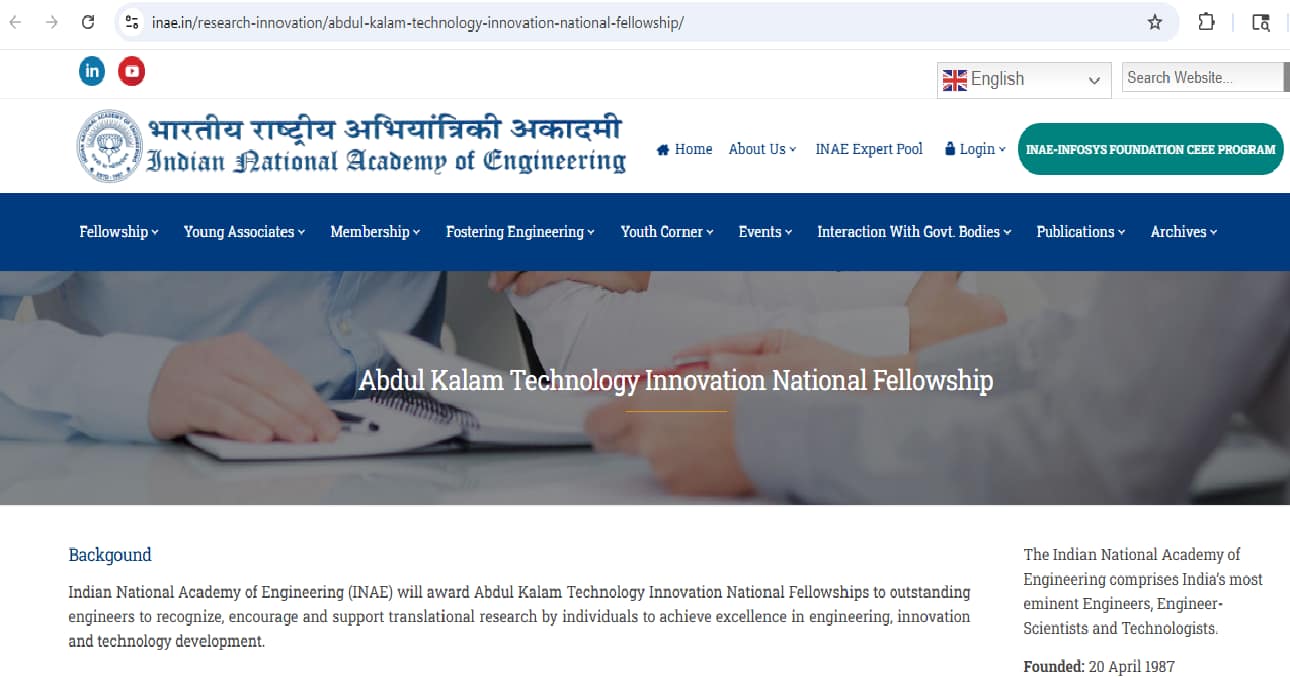
The Indian National Academy of Engineering (INAE) runs the Abdul Kalam Technology Innovation National Fellowship — named after India’s beloved scientist and former President — to back engineers who aren’t just publishing papers but actually building things that work. The focus here is on translational research: taking what’s been discovered in the lab and turning it into something you can deploy, sell, or scale.
What You Get
The financial support is meaningful. Fellows receive ₹25,000 every month on top of their regular salary, plus a research grant of ₹15 lakh per year to fund their work. Institutions hosting a fellow also get ₹1 lakh annually for overhead costs. Keep in mind the monthly stipend is taxable under Indian government rules.
What Kind of Work Does It Support?
The fellowship isn’t for blue-sky theoretical research. INAE is specifically looking for engineers working on things like working prototypes, pilot-scale solutions, and innovations that could eventually be commercialized or handed off to industry. If your work has a clear path from lab bench to the real world — whether through patents, technology transfer, or field-tested systems — this is the right programme for you.
Who Can Apply?
You need to be an Indian national or an Overseas Citizen of India (OCI). You must hold a permanent position at a publicly funded institution in India, have at least a bachelor’s degree in engineering or a related field, and have a minimum of five years of service remaining at your institution. Importantly, you cannot be holding any other fellowship at the same time — and if you’re offered multiple fellowships, you’ll have to choose one.
How Competitive Is It?
Very. Only up to 10 fellowships are awarded each year nationwide. A Search-cum-Selection Expert Committee evaluates applications, with heavy emphasis on the quality of innovation and the real-world impact potential of the proposed work.
What Happens After You’re Selected?
Fellows carry out their research, build prototypes or pilot systems, and work toward tangible outcomes — patents, publications, technology demonstrations, or industry partnerships. The programme tracks progress through these outputs, keeping the focus squarely on results you can point to.
A Few Things to Watch Out For
Don’t apply if your proposal is purely theoretical — the committee will notice. Make sure your work demonstrates clear application potential, and double-check that you meet the eligibility requirements around institutional affiliation and the no-concurrent-fellowship rule.
For full details and to apply, visit the INAE website at inae.in.
Source: INAE Official Page — The most authoritative source: https://www.inae.in/research-innovation/abdul-kalam-technology-innovation-national-fellowship/