


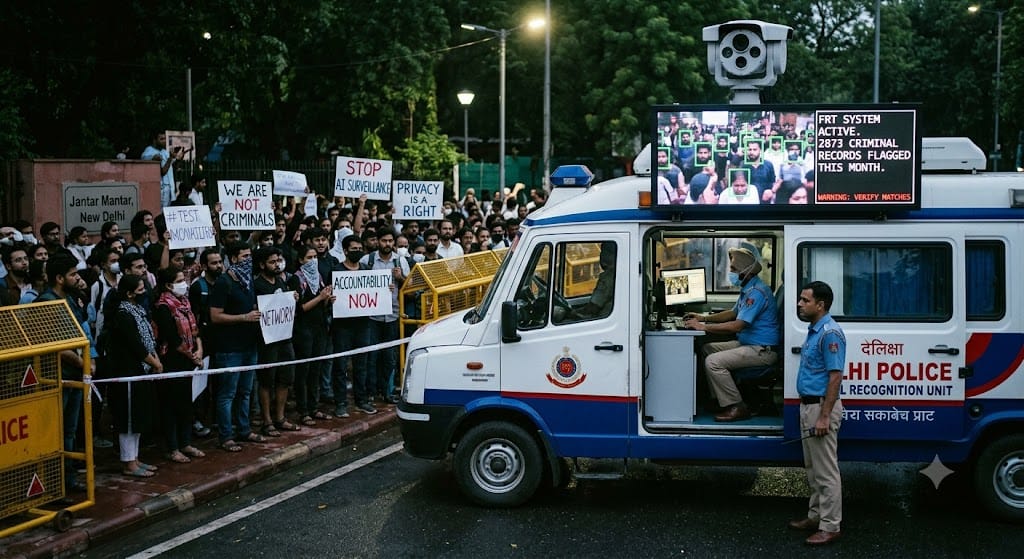
Delhi Police used facial recognition technology to flag nearly 3,000 people with criminal records at protest sites near Jantar Mantar in July 2026 — but reports that some of those identified were already in jail at the time have raised serious questions about how reliable AI-based surveillance really is.
What Happened
Between July 20 and 26, 2026, Delhi Police deployed its Facial Recognition System (FRS) to scan crowds at student protest sites in and around Jantar Mantar, New Delhi. The system flagged 2,873 people with existing criminal records — including individuals accused in murder, sexual assault, robbery, and POCSO (child protection) cases — as having been present at the protest sites, according to police sources.
The matter escalated quickly. Delhi Police later told the Supreme Court of India, in an affidavit sworn by a Deputy Commissioner of Police, that the system was used strictly to identify people with prior serious criminal antecedents — not to profile ordinary protesters. Of the 2,873 flagged, the police said 92 people had more than 10 cases against them, and 47 were classified as “history-sheeters.” The police maintained that the system does not automatically create or store profiles of every person at a protest site, and that no action is taken on a facial recognition match alone, without further human verification.
Senior advocates representing petitioners in the case, including N. Hariharan and Menaka Guruswamy, disputed the police’s account of how the system actually works — with Guruswamy specifically alleging that a private company was engaged to process the data collected through the software, raising additional questions about data handling and oversight.
According to reporting by The Indian Express, at least some individuals identified through this process were reportedly already in custody — in Tihar, Mandoli, or Rohini jails — at the time the system supposedly placed them at the protest site. This detail is central to the controversy, and readers are encouraged to consult the original Indian Express reporting for the precise figures, as this remains a developing and disputed matter before the courts.
How Does Facial Recognition Actually Work?
To understand how such an error could occur, it helps to understand what facial recognition technology actually does — and, just as importantly, what it doesn’t do.
A camera captures a face in a crowd. The software converts that face into a digital “template” — essentially a mathematical map of facial features. This template is then compared against a database of photographs, usually mugshots or ID photos of people with prior police records. If the system finds a sufficiently close match, it flags it.
Crucially, facial recognition does not “know” who someone is with certainty — it produces a probability-based match. According to RTI records previously reported by The Indian Express and obtained by the Internet Freedom Foundation, Delhi Police treats matches with over 80% accuracy as a “positive match” warranting further investigation, while anything below that threshold is treated as a “false positive” requiring additional corroborating evidence.
For comparison, when the American Civil Liberties Union (ACLU) ran a similar test on a facial recognition system in the United States, an 80% accuracy threshold was considered a mixed, unreliable result — the test produced false matches, including with sitting members of the US Congress.
So How Could Someone Already in Jail Be “Identified” at a Protest?
This is the crux of what makes the story genuinely confusing — and important.
The facial recognition system is not literally claiming it saw a specific named individual standing in a crowd. What it is doing is comparing a face captured on camera against a photograph already stored in a police database, and reporting a statistical similarity.
There are a few realistic explanations for how such a mismatch could occur, and it is worth being precise about which one applies, since the underlying cause matters for accountability:
- A resemblance-based false match: A person actually present at the protest may simply have facial features similar enough to a database photograph of someone else — the person in custody — that the algorithm flagged it as a match. Lighting, camera angle, image quality, partial obstructions like masks, and even natural changes in appearance over time can all affect accuracy.
- A database or record-keeping error: The mismatch could stem from outdated, mislabeled, or incorrectly linked records in the police database itself, rather than a flaw in the facial recognition algorithm.
- A misinterpretation of what the system output actually meant: A technically accurate database match — for instance, correctly identifying a photograph on file — could have been misread or presented as confirmation of physical presence, without adequate human verification at that stage.
It is important to note that the exact mechanism behind each disputed case has not been independently established in public reporting, and it would be inaccurate to describe every case simply as “the AI made a mistake” without knowing which of these scenarios actually applies.
Why This Story Matters Beyond Delhi
This isn’t the first time facial recognition has been used at a protest site in India, and it’s unlikely to be the last. Delhi Police has previously used similar technology to screen crowds during protests against the Citizenship Amendment Act in 2019-2020, and to identify over 1,100 individuals allegedly involved in communal violence in northeast Delhi in 2020. The technology was originally acquired in 2018 to help trace missing children, and its scope of use has expanded considerably since then.
That expansion raises a set of questions that go well beyond this one case:
Privacy: What happens to the facial data and images of people who are scanned but never flagged as matches? Is that data stored, and for how long?
Accountability: If a facial recognition system produces an incorrect match that leads to an investigation, questioning, or reputational harm, who is responsible — the police department deploying it, the company that built the software, or neither?
Transparency: The dispute over whether a private company was engaged to process the data — an allegation the police have not fully clarified — highlights a broader gap in how much the public actually knows about how these systems are built, trained, and audited.
Chilling effects on protest: Civil liberties advocates have long expressed concern that deploying facial recognition at protest sites, even with stated good intentions, could discourage people from exercising their right to peaceful assembly, out of fear of being wrongly flagged or monitored.
Can Facial Recognition Be Trusted?
The honest answer, based on how the technology actually functions, is that facial recognition should be treated as an investigative aid — not proof of identity on its own. A system generating an 80%-confidence match is providing a lead for police to investigate further, not a verified fact. Serious consequences — arrest, prosecution, or even public accusation — should only follow after independent human verification and corroborating evidence, not a database match alone.
This is broadly consistent with what Delhi Police itself told the Supreme Court: that matches undergo field verification before any action is taken. The core dispute in this case isn’t whether that principle exists on paper, but whether it was properly followed in practice for every one of the 2,873 people flagged — and whether the safeguards in place are strong enough to prevent serious errors going forward.
What Safeguards Does India Need?
As facial recognition use expands across Indian policing, a few safeguards are increasingly being called for by legal experts and civil society groups:
- Mandatory human verification before any facial recognition match results in an FIR, arrest, or public identification
- Clear, published accuracy thresholds and regular independent audits of how well the system actually performs, including its error rate
- Transparency about data handling — who processes the data, where it is stored, how long it is retained, and whether third parties are involved
- A grievance mechanism for individuals wrongly flagged, allowing them to challenge and correct errors quickly
- Judicial oversight, given that the matter is already before the Supreme Court, which may set precedent on how far such surveillance can extend
The Bottom Line
This case is still unfolding before the Supreme Court, and not every factual claim around it has been independently confirmed. But the core, well-documented facts — nearly 3,000 people flagged through an 80%-accuracy-threshold matching system, a legal dispute over how that data was processed, and credible questions from senior advocates about oversight — are enough on their own to raise a genuinely important question for ordinary citizens: as AI surveillance tools become more common in Indian policing, how much should we trust a match — and what happens when the match is wrong?
This article draws on Delhi Police’s affidavit to the Supreme Court, RTI records reported by The Indian Express and the Internet Freedom Foundation, and prior reporting on facial recognition use by Indian law enforcement. This remains a developing legal matter; readers are encouraged to follow official court proceedings for the latest developments.