


By R N Chandrakala
In Somalia and parts of Africa, mothers walk for hours to find clean water. Children sleep hungry. At the same time, the world’s richest nations spend enormous sums on weapons that can destroy a drone with a beam of light.
According to the Stockholm International Peace Research Institute (SIPRI), global military spending reached nearly 2.9 trillion US dollars in 2025. It was the 11th year in a row that spending rose, and military spending as a share of the world economy reached its highest level since 2009. The cost of ending world hunger is only a small fraction of that amount. When we place these two facts side by side, one question rises: What kind of world are we building for our children?
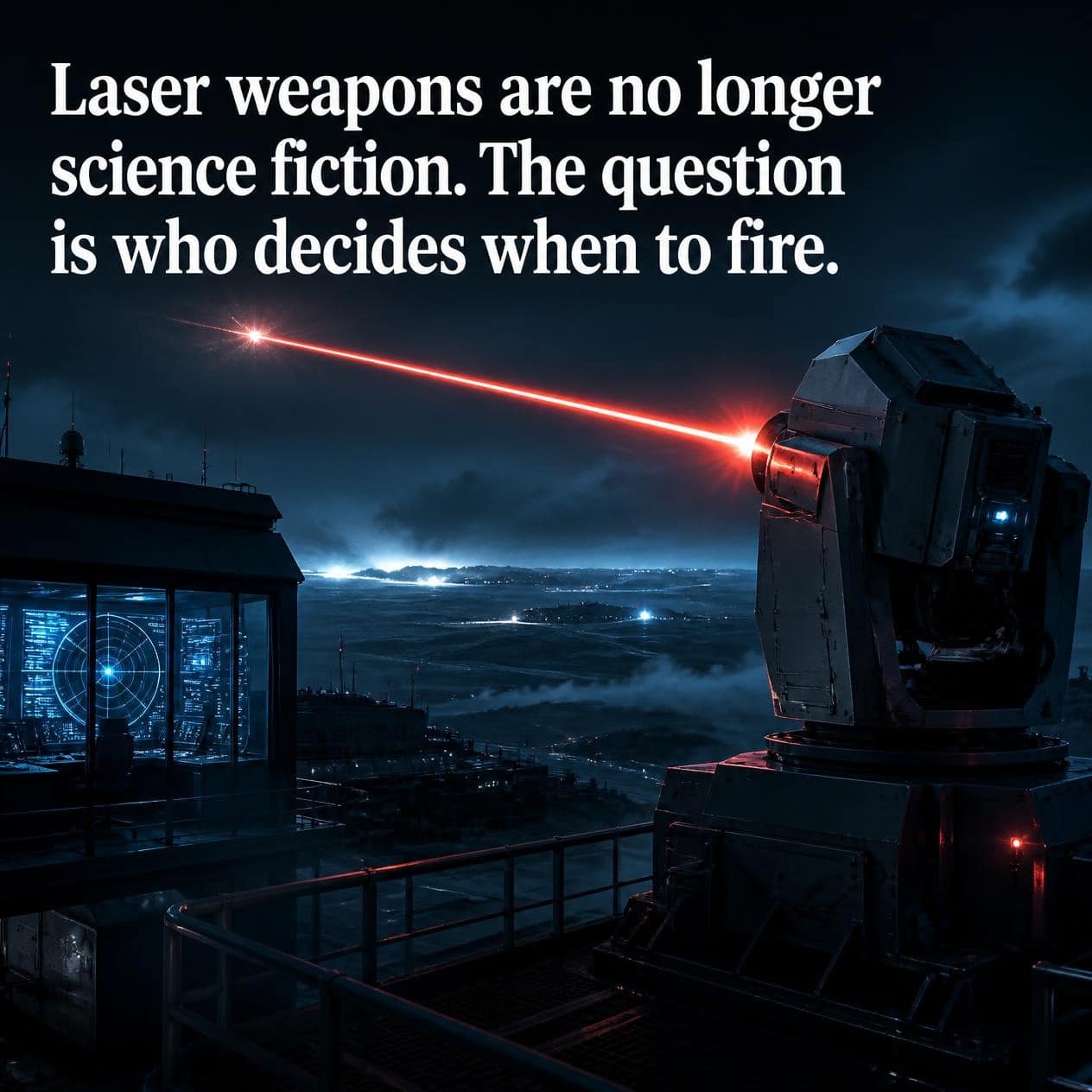
The New Age of Laser Weapons
War has moved from swords to guns, from guns to missiles, and now to lasers. What once belonged to science fiction is now reality.
Israel’s Iron Beam is described as the world’s first operational high-energy laser weapon. It was handed over to the Israeli military in late December 2025 and was reportedly first used in combat in March 2026, at a reported cost of around $2 per interception. Britain has moved up the deployment of its DragonFire laser on Royal Navy destroyers to 2027, five years ahead of the original plan. The United States, China, Russia, India and many others are racing to build their own.
It is important to be clear: today’s laser weapons are used against machines, not people. They shoot down drones, rockets and mortars before these reach cities. International law has banned lasers designed to blind people since 1995.
Supporters argue that these weapons are mostly defensive, cheap, precise and less likely to cause damage on the ground. That argument deserves a fair hearing. But the laser is not the real danger. The real danger lies in who, or what, decides when to fire.
When Machines Decide Who Lives
Artificial intelligence is changing warfare faster than laws can keep up. Countries are already developing and using weapons that can select targets and use force with little or no human intervention. Critics call them “killer robots.” Human rights groups warn that some AI-assisted weapons may behave unpredictably, raising the risk of deadly mistakes.
Fully independent robot soldiers remain science fiction. The real concern is that weapons are being given more and more freedom to decide on their own.
A soldier on the battlefield sees the face of the enemy and feels the weight of taking a life. An operator watching a screen thousands of kilometres away, or an algorithm deciding in milliseconds, does not. When killing becomes as easy as pressing a button, do we slowly forget that every target is a human being with a family?
Trillions for War, Crumbs for Hunger
Why would a nation spend so much on weapons while its own people or its neighbours go hungry? The answer is one word: fear.
Political scientists call it the “security dilemma.” One country buys weapons only to protect itself. Its neighbour feels threatened and buys more. The first country, now feeling less safe, buys even more. Neither wants war, yet both spend fortunes, driven by fear of what the other might do.
Japan’s story shows how powerful this fear is. After the horror of Hiroshima and Nagasaki, Japan renounced war in its constitution and kept its defence spending at around one percent of its economy for decades. Today, facing growing tensions in its region, Japan is moving to nearly double that. Even the one nation that suffered atomic destruction feels pushed back toward arms, because nobody knows who will come for war next.
Are We Lesser Than Animals?
It is often said that animals never kill their own kind. The truth is more complicated. Chimpanzees, our closest relatives, raid neighbouring groups and kill rivals. Lions kill the cubs of rival males. Some ant species wage organised wars.
So violence within a species is not only a human trait. But something else is uniquely human.
No animal has written a Geneva Convention. No animal has built a Red Cross, sent food to starving strangers across oceans, or written scriptures teaching that harming even an animal is a sin, as our own dharma granthas teach. Only humans can look at their own violence and say: this is wrong.
We are not lesser than animals. We carry a greater capacity for destruction than any creature on earth, and a capacity for conscience that no creature shares. The story of humanity is the struggle between the two.
What Nehru and Ashoka Teach Us
In The Discovery of India, written while he was imprisoned in Ahmednagar Fort between 1942 and 1946, Jawaharlal Nehru reflected deeply on India’s tradition of non-violence and on war as a failure of civilisation. In this view, a truly civilised nation does not seek war and does not measure human life by religion, race, caste or colour.
Nehru wrote with great admiration about Emperor Ashoka. After the bloody Kalinga war, Ashoka was so shaken by the suffering he had caused that he gave up conquest forever. He devoted his life to dhamma, compassion and the welfare of all living beings, even animals. Today his lion capital and chakra stand as the symbols of our nation.
Ashoka’s life answers the question of this age. A man who waged war chose peace. A chimpanzee cannot look back at a fight and decide never to fight again. A human can.
Is the World Trying to Stop It?
There are signs of hope. In early September 2026, 128 countries agreed on a text defining lethal autonomous weapons, a first step toward possible negotiations on an international treaty. The text affirms that human control and judgment are required for such weapons to comply with international law.
But progress is slow. The talks ended on September 4 without a legally binding agreement, and some powerful countries weakened the text by removing references to ethical considerations. Countries will decide at UN talks in November 2026 whether to move toward a treaty.
History shows that limits are possible. In 1995, the world banned blinding lasers before such weapons were ever widely used. Humanity drew a line in advance. It can do so again.
The Choice Before Our Generation
Technology is neither good nor evil. The same laser that protects a school from a missile can be built into more dangerous weapons. The same AI that guards a city can be allowed to decide, on its own, who lives and who dies.
The real question is not whether technology will destroy humanity. It is whether humans will stay in control of the technology they create.
Ashoka made his choice after Kalinga. Our generation must make ours before the next great war, not after. The rules we write today will decide whether our children inherit a world of fear or a world of peace.
No machine should ever hold the final decision over a human life. That is not just a law we need. It is the test of whether we are still civilised.
Frequently Asked Questions
What are laser weapons?
Laser weapons, also called directed energy weapons, use concentrated beams of light to destroy targets such as drones, rockets and mortars at the speed of light and at very low cost per shot.
Are laser weapons used against people?
No. Today’s laser weapons target drones, rockets and other machines. Lasers designed to blind people have been banned under international law since 1995.
What are killer robots?
“Killer robots” is a term critics use for lethal autonomous weapons, which can select and attack targets with little or no human control. Fully independent robot soldiers do not exist.
Is there a global ban on autonomous weapons?
Not yet. UN talks are ongoing, and countries will decide in November 2026 whether to begin negotiating a treaty.
The views expressed are the author’s own.
Sources: SIPRI Military Expenditure Report (April 2026); UN Convention on Certain Conventional Weapons talks on lethal autonomous weapons (September 2026); Human Rights Watch; reports on Iron Beam (Israel) and DragonFire (UK Ministry of Defence).