


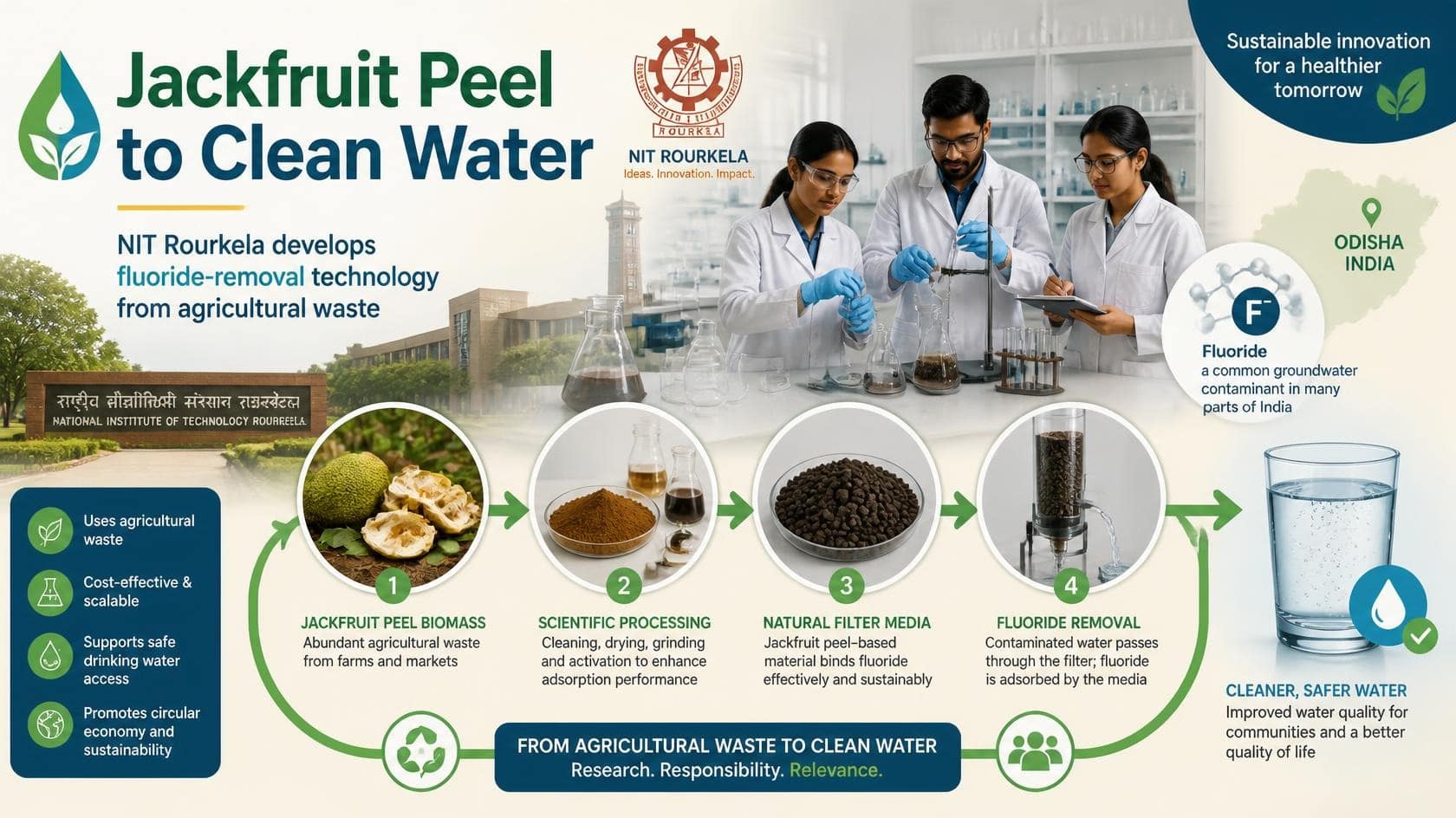
Rourkela, 14 October 2026. Researchers at the National Institute of Technology (NIT) Rourkela have developed a material from discarded jackfruit peel that removed more than 90% of fluoride from contaminated water in about 10 minutes in laboratory tests, according to a PIB Bhubaneswar release.
How the jackfruit peel fluoride removal material works
The team turned jackfruit peel into activated carbon and modified it with zirconium to improve its ability to capture fluoride. The work was carried out by Prof Susmita Mishra of the Department of Chemical Engineering and research graduate Dr Pratima Minz.
What the lab tests showed
In tests with fluoride levels of about 1–5 mg/L, the material removed more than 90% of the fluoride. Removal reached up to 97% within 10–20 minutes under the tested conditions.
Why fluoride in drinking water matters
Excess fluoride can cause dental and skeletal fluorosis, affecting the teeth and bones of children and adults. Groundwater contamination has been reported in several parts of India. The researchers say common treatments such as reverse osmosis, ion exchange and activated alumina have limitations, including wastewater generation, loss of beneficial minerals and operational demands.
Cost and patent status
The researchers estimate synthesis at about Rs 37 per gram, based on the electricity and chemicals used to prepare the material. The team has filed under patent application number 202531080242, dated 25 August 2025.
What happens next
The technology is at Technology Readiness Level 4, meaning it has been validated only in the laboratory, and it is not yet ready for widespread use. The team plans to build a physical prototype and assess long-term performance, operating costs and practical suitability. Prof Mishra said it could support low-cost, decentralised water treatment in the long term, subject to further testing and validation.
Source: PIB, Government of India