


Updated 10 October 2026
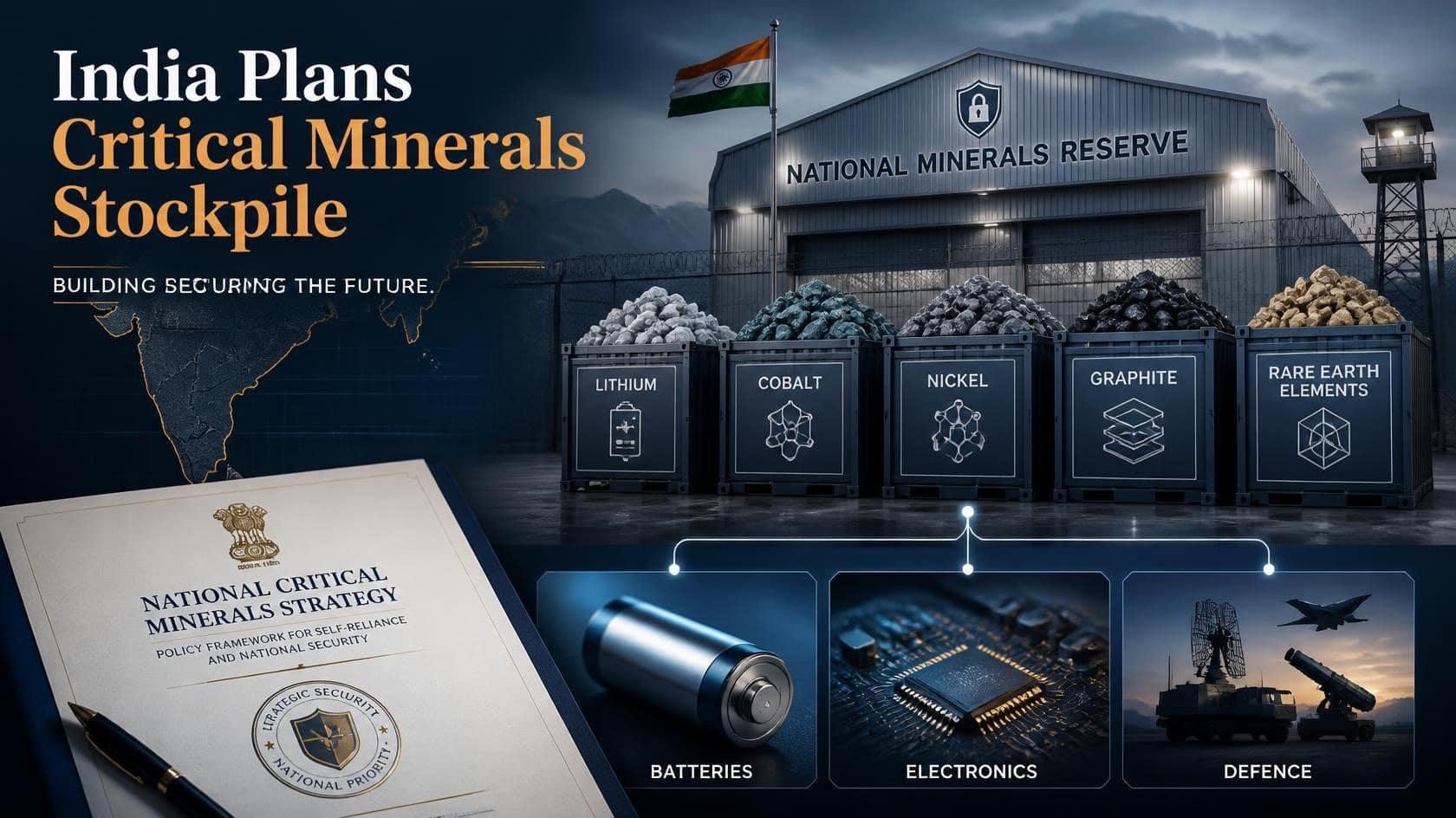
India is preparing a critical minerals stockpile, an emergency reserve of the metals that go into batteries, electronics, solar panels and defence equipment. Your phone, an electric scooter and a solar panel all depend on a handful of minerals most of us rarely hear about, and India now wants to keep a safety supply of them.
What happened?
India is preparing to finalise a policy for stockpiling critical minerals within about a month, according to Mines Secretary Keshav Chandra, as reported by The Pamphlet and Whalesbook on 10 October 2026. The stockpile would be part of the National Critical Mineral Mission (NCMM). The policy has not been announced yet, so the details can still change.
What are critical minerals, in simple words?
They are minerals that modern industry cannot do without, and whose supply can be easily disrupted. Examples include copper, lithium, nickel, cobalt and rare earth elements. They go into batteries, electric vehicles, renewable energy equipment, electronics, electricity infrastructure and defence products.
India imports most of its critical minerals, often from a few dominant suppliers. China leads in processing and refining many of them.
What is a stockpile?
A stockpile is a carefully maintained reserve of important materials. Think of the strategic oil reserves countries keep, or the spare tyre in your car. If supply is cut off or prices spike, the reserve gives industries time to keep working.
What is planned?
According to reports:
- A national programme. The proposed National Critical Mineral Stockpile Programme falls under the NCMM. The government has committed ₹500 crore for it over the mission period from 2024-25 to 2030-31.
- At least five minerals. The reserve is expected to include at least five critical minerals. Reports name lithium, cobalt, nickel, copper and rare earths as the kinds of minerals involved, but the final list has not been announced.
- For emergencies. It is meant to meet domestic needs during emergencies and to protect sectors such as defence, aerospace, clean energy and electronics from supply shocks and price swings.
- Processing parks. The government has identified Andhra Pradesh, Odisha, Gujarat and Maharashtra for critical mineral processing plants, and reports mention four dedicated parks.
An Outlook Business article from about a year ago said the plan could aim to cover roughly two months of rare-earth needs and could allow private companies to take part. Check whether this still holds once the policy is published.
The bigger mission
The NCMM was approved in January 2025. Bloomberg reported it as a ₹16,300 crore (about $1.9 billion) programme focused on 24 vital minerals, with an expected further ₹18,000 crore of investment by public sector companies, according to Tribune (ANI). It covers exploration, processing, recycling and buying mining assets abroad. The Ministry of Mines mission page lists a mineral stockpile as one of its components.
Why does this matter for India?
- Manufacturing. India wants to make more batteries, EVs, electronics and solar equipment at home. A steady supply of raw materials helps factories plan.
- Protection from shocks. If a major supplier restricts exports or prices jump, a stockpile can cushion the blow.
- National security. Defence and aerospace need reliable access to certain minerals.
- Jobs and investment. Processing plants and mining projects could create work and attract investment, if they go ahead.
What a stockpile cannot do
- It is a buffer, not a source. A stockpile does not replace mining, processing and recycling. It only buys time.
- It costs money to run. Storing minerals, keeping them in good condition and deciding when to buy and release them is complicated.
- Technology is a hurdle. Keshav Chandra said that countries with advanced processing technology are generally unwilling to share it with newer players.
- Environmental and social concerns. A Tribune editorial pointed to risks of deforestation, groundwater depletion and the displacement of local communities when mining expands.
Frequently asked questions
What are critical minerals?
Minerals such as lithium, cobalt, nickel, copper and rare earths that are essential for batteries, electronics, clean energy and defence, and whose supply is vulnerable to disruption.
What is India’s critical minerals stockpile?
A planned reserve, under the National Critical Mineral Mission, meant to protect industries from supply shocks. It is still being designed.
When will the policy be announced?
The Mines Secretary said it should be finalised within about a month, but dates can slip.
How much money is set aside?
Reports say ₹500 crore for the stockpile programme, for 2024-25 to 2030-31. The NCMM overall is a ₹16,300 crore programme.
Which minerals will be stored?
At least five, according to reports. The list has not been announced.
What to watch
- The published policy: which minerals, how much, who buys, who stores and who pays.
- Timing. The policy is said to be due within a month.
- The private sector role, and how prices will be set.
- Progress on processing parks in the four states named.
- Safeguards for forests, water and local communities.
The bottom line
India is trying to avoid being caught short of the materials that power its batteries, electronics and defence. A stockpile is a sensible safety net, but the real test is whether India can also mine, process and recycle more of these minerals at home.
Sources: The Pamphlet, Whalesbook, Tribune, Bloomberg via Yahoo, Outlook Business, PIB and IEEFA, 2025 to 10 October 2026.