


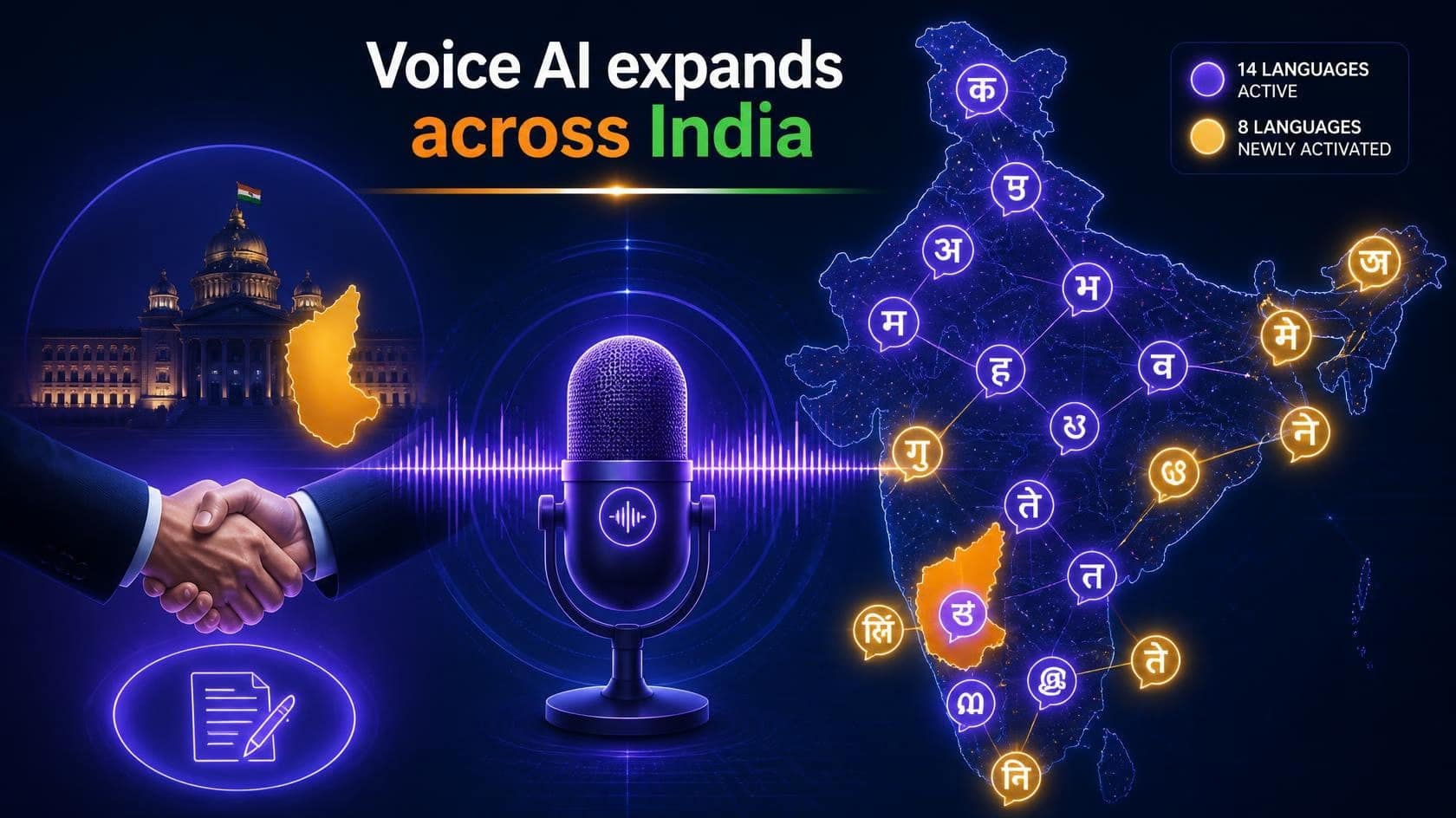
Imagine calling a customer care number and hearing a voice that speaks your language, with your accent, and answers like a person. That is the kind of technology a global AI company now wants to build for India, and Karnataka is already involved.
What happened?
On 6 October 2026, ElevenLabs co-founder and CEO Mati Staniszewski told Reuters that the company plans to invest hundreds of millions of dollars in India. The money would go to local teams, AI model development and Indian-language work. He also said the company is open to acquisitions in India, without naming any.
No exact figure, timeline or acquisition target has been disclosed. This is a plan, not money already spent.
What does ElevenLabs do?
ElevenLabs is a London-based company that makes AI voice technology. Its software turns written text into natural-sounding speech, creates voices in different languages and powers AI agents that talk to customers. Businesses use it for customer service, learning apps and voice assistants.
The company is private. Reports say its valuation reached $22 billion after an employee share sale of $300 million in late September 2026.
Why India, and why languages?
Reports say India is ElevenLabs’ largest market outside the United States. India has 22 official languages, many dialects and accents, and people often mix languages in a single sentence. That makes it a hard test for voice AI.
ElevenLabs currently supports 14 Indian languages and said at its first India Summit in Bengaluru that it plans to cover all 22 over the next year. Voice can also help people who are uncomfortable reading or typing in English use digital services.
The Karnataka partnership
At the same summit on 6 October, the Karnataka Innovation and Technology Society (KITS) signed a memorandum of understanding (MoU) with ElevenLabs. IT-BT Minister Priyank Kharge and Staniszewski formalised it. It is the company’s first partnership with an Indian state government.
According to reports, it covers:
- Voice restoration. ElevenLabs will provide free lifetime licences under its “One Million Voices” programme to eligible people who have lost the ability to speak, so they can communicate using a synthetic version of their own voice, including in Kannada. One report says the All India Institute of Speech and Hearing in Mysuru may help identify beneficiaries.
- Public services. Kannada and other languages could be used in citizen helplines, grievance redressal, skilling and access to government information.
- A voice AI safety framework. The two sides will work on rules covering deepfakes, consent for voice cloning and watermarking.
The MoU is voluntary and not legally binding. It does not commit Karnataka to buying or deploying anything, and it does not affect future procurement. The proposed services are not yet available to citizens. Karnataka had also been exploring pilots since August. These are examples of what was discussed, not confirmed projects.
Separately, one report says ElevenLabs signed a national MoU the previous week with a group working alongside the Department of Empowerment of Persons with Disabilities, to widen access to voice technology for people with speech, hearing and voice-loss disabilities.
How could voice AI change customer service?
Voice AI can handle repetitive tasks that need a human representative today: answering common questions, helping customers navigate services, booking appointments and giving information on insurance or banking. For companies serving customers in many states, it could make help available in their languages, at any hour.
It can also get things wrong. AI may misunderstand complex questions, strong accents or sensitive situations, so human supervision and a clear way to reach a person still matter, especially in healthcare, finance and government help.
Will voice AI create jobs or replace them?
Reports say voice AI could change how call centres and business-process outsourcing firms work. Some routine support tasks may move to AI, which could affect entry-level roles.
New work may appear too: AI engineering, language data, speech evaluation, software integration, quality checks, cybersecurity and multilingual customer-experience design. The company says it will expand its local team, but the number of jobs has not been disclosed and will depend on hiring plans and how fast customers adopt the technology.
For workers, building digital skills alongside language, communication and problem-solving may help.
What to be careful about
- Fake voices. The same technology that gives a voice back to a patient can copy someone’s voice for fraud. This is why the safety framework matters.
- Consent and privacy. People should know when a voice is AI-generated, whose voice was used, and how recordings are stored.
- Quality across languages. It is hard to make AI work well in languages with less recorded data. Claims about “all 22 languages” should be tested by native speakers.
- Free does not mean automatic. Voice restoration licences are for eligible people identified under the programme, not everyone.
What to watch
- The real amount, the hiring plans and any acquisitions.
- Which languages come next, and how natural they sound.
- Whether the Karnataka MoU becomes real services, such as a Kannada helpline or the voice restoration programme.
- The safety rules, and whether other states follow Karnataka.
The bottom line
A global AI company is betting that India’s many languages are an opportunity, not an obstacle. That could bring jobs, accessibility and better public services, and it brings risks that need careful rules. The proof will be how well the technology works for ordinary speakers, including in Kannada.
Sources: Reuters (as reported by Inside AI, Lapaas Voice and CNBC-TV18), Channel IAM, The News Mill (ANI), The420.in, Asianet Newsable, News Karnataka, VARindia and APAC Media, 6 to 9 October 2026.